



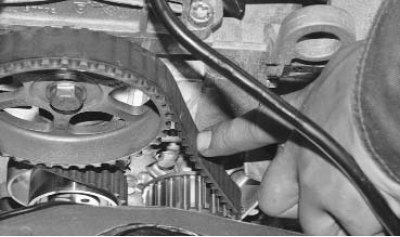
Note. The manufacturer recommends checking the belt tension and controlling it during adjustment using a special strain gauge tester. In this regard, there is no data on the magnitude of the force when deflecting a belt branch by a certain size in the technical documentation. In practice, you can initially roughly estimate the correctness of the belt tension using the "rule of thumb": press on the belt branch with your thumb and determine the deflection using a ruler. According to this universal rule, if the distance between the pulley centers is from 180 to 280 mm, the deflection should be approximately 6 mm.
There is another way to pre-check the belt tension by twisting its leading branch along the axis. If you can twist the branch by more than 90° with your hand, the belt is weak.
These methods can only diagnose excessive belt looseness, so contact a service center for an accurate check and adjustment of the tension.
Replace the timing belt if, upon inspection, you find:
- traces of oil on any surface of the belt;
- traces of wear on the toothed surface, cracks, cuts, folds and separation of the fabric from the rubber;
- cracks, folds, depressions or bulges on the outer surface of the belt;
- fraying or delamination on the end surfaces of the belt.
Warning! A belt with traces of motor oil on any of its surfaces must be replaced, as oil quickly destroys rubber. The reason for oil getting on the belt (usually this is a leak in the crankshaft and camshaft seals) eliminate immediately.
Note: Carry out the work on an inspection pit, overpass or, if possible, on a lift.
You will need: all the tools necessary to remove the accessory drive pulley and both timing belt covers, as well as a 10 mm spanner and a special key for turning the tension roller or round-nose pliers with bent jaws.
1. Set the piston of the 1st cylinder to the TDC position of the compression stroke and remove the accessory drive pulley and the lower timing belt cover (see "Setting the piston of the first cylinder to the TDC position of the compression stroke").
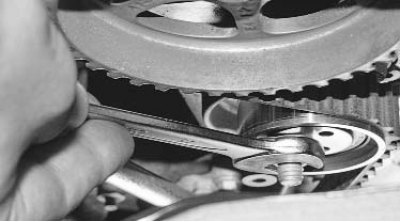
2. Remember or mark in any way the position of the tension roller relative to the axis, loosen the tightening of the roller mounting nut...
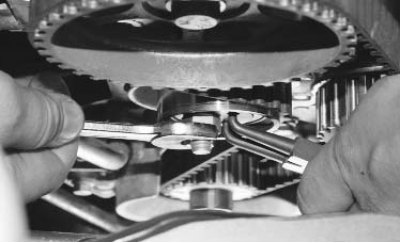
3. ...and turn the roller clockwise, thereby loosening the tension of the timing belt.
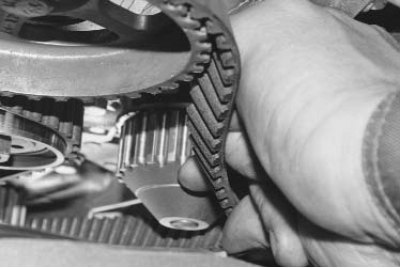
4. After removing the belt from the toothed pulleys of the water pump...
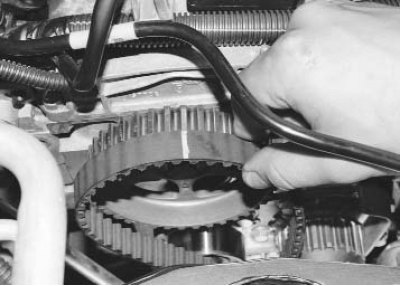
5. ...camshaft...
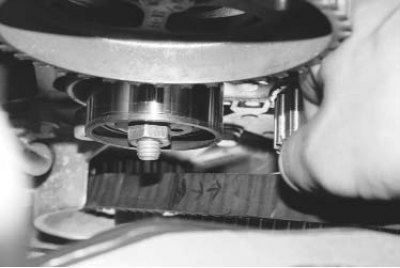
6. ...crankshaft and tension roller...
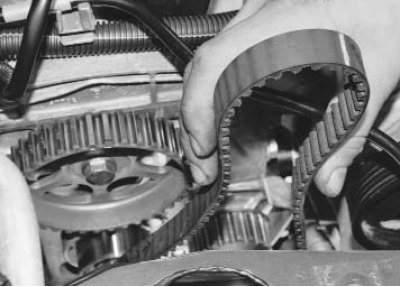
7. ... remove the belt from the vehicle.
Note: The original belt should have arrows indicating the direction of its movement when the engine is running. If there are no such arrows, and you are not removing the belt for replacement, apply them in any available way (for example, with a felt-tip pen), to return the belt to its original position.
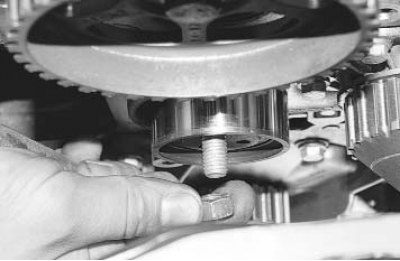
8. To replace the tension roller, completely unscrew its mounting nut...
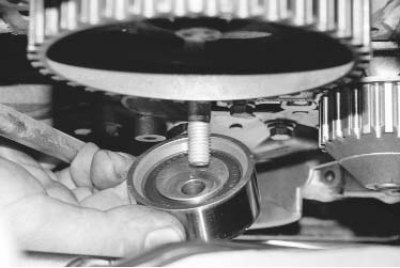
9. ...and remove the video.
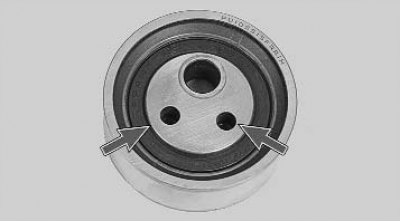
10. Install the new tension roller in the reverse order of removal. The holes for the special key should be facing outward.
Note: The tension roller replacement is shown during the timing belt replacement. However, if necessary, the roller can be replaced without removing the belt.
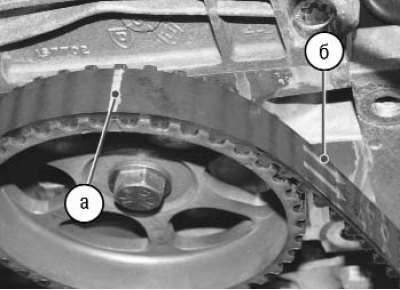
11. First install the belt on the toothed pulley of the camshaft, orienting it with arrows b (or with arrows applied by yourself) in the direction of movement when the engine is running, and also aligning the mark a with the installation mark on the pulley, and then, pulling the leading branch onto the water pump pulley...
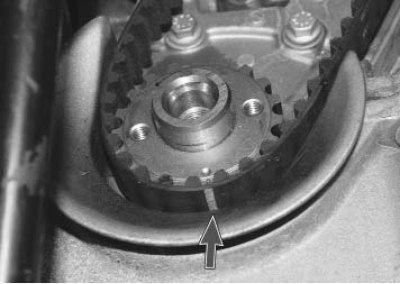
12. ...and on the crankshaft pulley, also aligning the mark on the belt with the installation mark on the pulley. Then install the belt on the tension roller.
13. Tighten the belt by turning the tension roller counterclockwise until the previously applied marks coincide, and tighten the roller mounting nut.
14. Install the accessory drive pulley on the crankshaft and turn the crankshaft by the pulley mounting bolt two turns. Check that the timing marks on the camshaft and crankshaft pulleys match (see Fig. "Setting the piston of the first cylinder to the TDC position of the compression stroke") and belt tension (see the beginning of this subsection).
15. After checking the alignment of the timing marks and the belt tension, remove the accessory drive pulley, and then install all removed components and parts in the reverse order of their removal before replacing the belt.
16. Adjust the tension of the accessory drive belt (see "Checking the tension of the auxiliary drive belt").