



Contents: Petrol engines 🠛 Engines 1.4 l (E7J) and 1.6 l (K7M) 🠛 Engines 2.0 l (F3R and F7R) 🠛 Diesel engines 🠛 All engines except 16-valve 2.0 l…🠛 16-valve 2.0L engines (F7R) with air…🠛 Diesel engines 🠛
Petrol engines
1. The auxiliary drive belt is located on the right side of the engine.
2. Depending on the engine type and vehicle equipment, you may encounter many different drive belt configurations.
3. Due to the high tension and composition, drive belts wear out over time. Therefore, belts must be adjusted and checked periodically.
4. For better access to the drive belt, lift the front of the car and remove the right wheel, then unscrew the mounting bolts and remove the engine protective cover, also remove the splash guard from the inside of the wheel arch.
5. Rotate the crankshaft pulley with a wrench on the bolt and check the drive belt for cracks, peeling rubber and torn or worn ribs. Also check for oil and wear, which gives the drive belt a shiny appearance. If there is any doubt about the condition of the drive belt, replace it.
Note: Renault recommends that any time the belt becomes loose it should be replaced.
Auxiliary Drive Belt Routing Diagram - 1.4L & 1.6L Non-AC Models
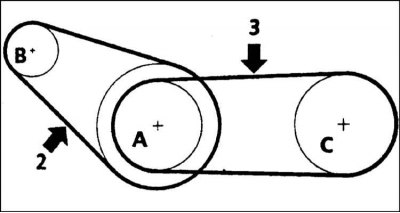
2 - Tension check point for alternator drive belt; 3 - Tension check point for power steering drive belt; A - Crankshaft pulley; B - Generator; C - Power steering pump
Auxiliary Drive Belt Routing Diagram - 1.4L & 1.6L Models with Air Conditioning
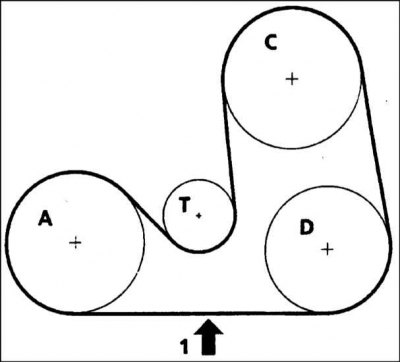
1 - Tension check point; A - Crankshaft pulley; C - Power steering pump; D - Air conditioning compressor; T - Tensioning mechanism
Auxiliary Drive Belt Routing Diagram - 2.0L Petrol & Diesel Models Without Air Conditioning
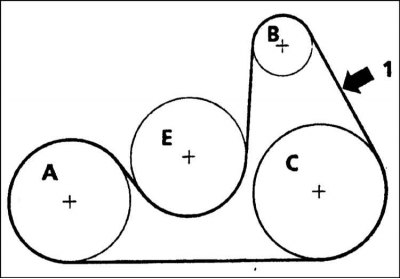
1 - Tension check point; A - Crankshaft pulley; B - Generator; C - Power steering pump; E - Cooling system pump
Auxiliary Drive Belt Routing Diagram - 16-Valve 2.0L Petrol & Diesel Models with Air Conditioning (the tension check point is shown by the arrow)
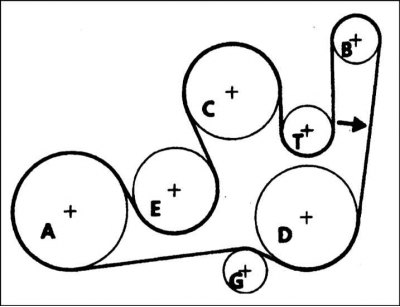
A - Crankshaft pulley; B - Generator; C - Power steering pump; D - Air conditioning compressor; E - Cooling system pump; G - Roller; T - Tensioning mechanism
Auxiliary Drive Belt Routing Diagram - 8-Valve 2.0L Models with Air Conditioning
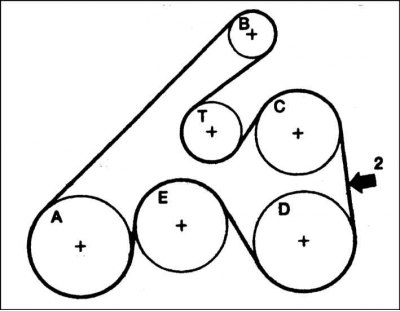
2 - Tension check point; A - Crankshaft pulley; B - Generator; C - Power steering pump; D - Air conditioning compressor; E - Cooling system pump; T - Tensioning mechanism
1. Service stations use a special device to check the tension of the drive belt, but to check the tension at home, press on the belt with your fingers in the middle of the longest section between the pulleys (refer to the illustrations above).
Engines 1.4 l (E7J) and 1.6 l (K7M)
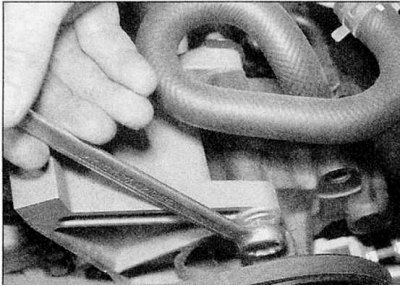
1a. If adjustment is required on the power steering pump drive belt (models without air conditioning), loosen the pump mount and pivot bolts.
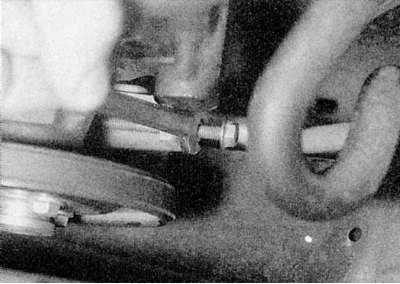
1b. Then loosen the adjusting lock nut and turn the adjusting bolt until you achieve the correct tension (refer to the illustrations).
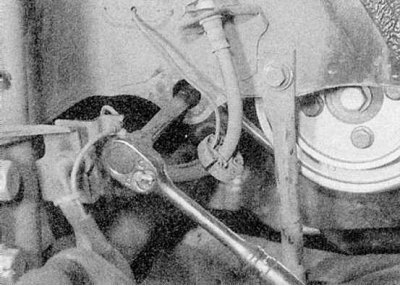
2a. If adjustment is required on the alternator drive belt (models without air conditioning), jack up the front of the car and place it on axle stands.
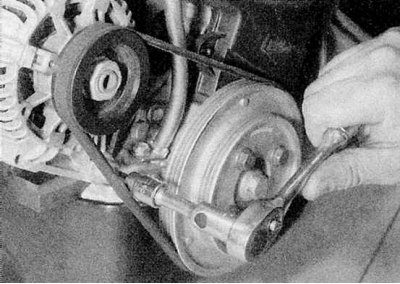
2b. Remove the right front wheel and wheel arch liner, then loosen the alternator lower mounting bolt.
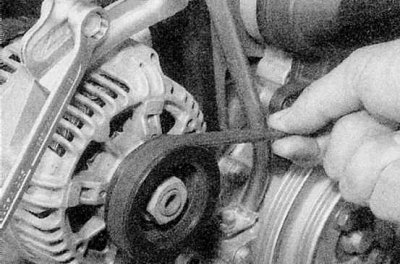
2c. In the engine compartment, loosen the adjusting bolt, then move the generator as required and retighten the bolt (refer to the illustrations). Install the liner and wheel, then lower the vehicle to the ground.
3. If the power steering drive belt and air conditioning compressor need adjustment (models with air conditioning), release the electronic engine management system unit and move it to the side without disconnecting the electrical wiring.
4. While holding the tensioner pulley stationary with a 22mm wrench, loosen the pulley bolt using a 7mm socket wrench. Move the tensioner to reduce the belt tension.
5. To tension the belt, move the tensioner pulley as required, then hold the pulley in this position with a wrench. Tighten the pulley bolt.
6. Run the engine for about 5 minutes, then recheck the tension.
Engines 2.0 l (F3R and F7R)
1. If adjustment is necessary on models without air conditioning, jack up the front of the vehicle and support it on axle stands. Remove the right front wheel and wheel arch liner, then loosen the alternator lower mounting bolt. In the engine compartment, loosen the adjustment bolt, then move the alternator as required and retighten the bolt. Install the liner and wheel, then lower the vehicle to the ground.
2. Run the engine for about 5 minutes, then recheck the tension.
3. If adjustment is required on an F3R engine with air conditioning, refer to the procedures described above. On F7R engines with air conditioning, the drive belt is adjusted by an automatic tensioner.
Diesel engines
1. Depending on the vehicle equipment, you may encounter two types of drive belt configurations (refer to the illustrations "Auxiliary Drive Belt Routing Diagram - 2.0L Petrol and Diesel Models without Air Conditioning" and "Auxiliary Drive Belt Routing Diagram - 16-Valve 2.0L Petrol and Diesel Models with Air Conditioning" above).
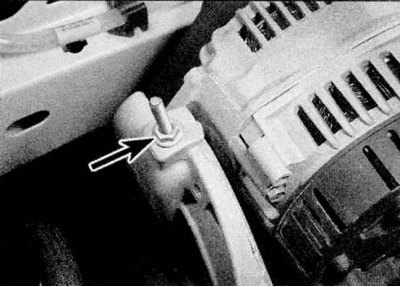
2. If adjustment is necessary, on models without air conditioning, loosen the generator pivot bolts, then loosen the lock nut and turn the adjusting bolt (refer to the accompanying illustration). Run the engine for approximately 5 minutes, then recheck the tension.
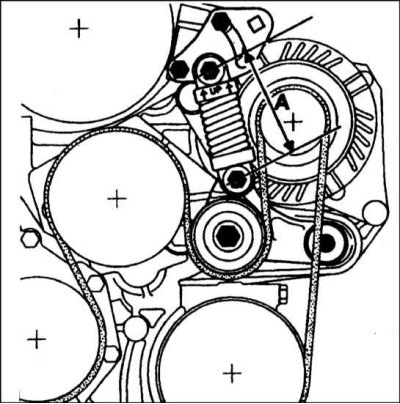
3. On models with air conditioning, an automatic tensioner is fitted. If you suspect that the drive belt tension is incorrect, contact a Renault workshop. To check the distance (A) between the centres of the tensioner mounting bolts, special tool Mot. 1387 is required (refer to the accompanying illustration). Since the actual distance between the bolts is not specified by Renault, the distance can only be checked using a special tool.
4. If a tool is available, proceed as follows: Loosen the knurled locking wheel, install the tool on the tensioner as shown in the illustration, then tighten the knurled wheel to lock the tool. Remove the tool and check that the distance between the bolt centers is within the specified tolerance range. If the distance is below or above the tolerance range, first check that the tensioner mounting plate has been positioned correctly, that the belt is the correct type (not too short or too long) and that it is laid3.
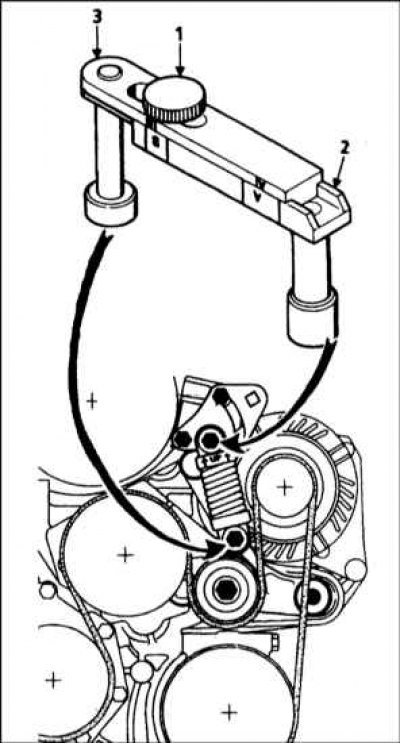
4a. Fitting the special tool Mot 1387 to check the operation of the automatic tensioner - models with air conditioning:
1 - Locking wheel.
2, 3 - Levers.
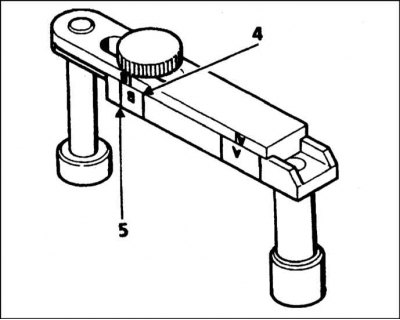
4b. Checking the distance between the centers of the automatic tensioner bolts - models with air conditioning:
4 - Minimum range of acceptable deviations.
5 - Maximum range of permissible deviations.
All engines except 16-valve 2.0 l (F7R) with air conditioning
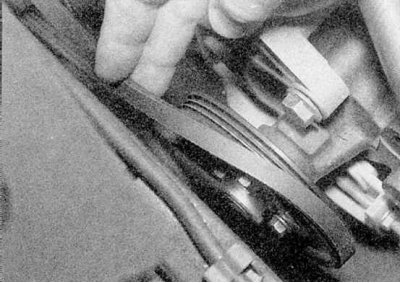
1. To remove the belt, completely release the tension as described above, then remove the belt from the pulleys. Note that where two belts are installed, the power steering pump drive belt must be removed first (refer to the accompanying illustration).
2. Install the new belt.
3. Adjust the tension as described above.
16-valve 2.0L engines (F7R) with air conditioning
Note: To perform the following procedure you will need the special Renault tool Mot. 1318.
1. Jack up the front of the car and place it on axle stands. Remove the right front wheel and wheel arch liner.
2. Disconnect the ground cable from the battery (refer to Chapter Engine electrical equipment for Scenic models).
Attention! If the radio in your car is coded, make sure you have the correct key code
3. Release the engine control unit and move it to the side without disconnecting the electrical connector.
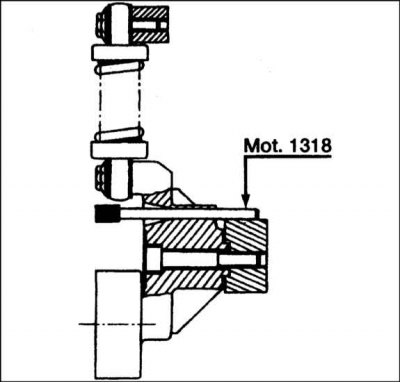
4a. Insert the Renault Mot. 1318 special tool into the hole in the tensioner backplate. Insert a 10 mm square key into the adjacent hole in the tensioner backplate. Using the square key, move the tensioner to the left, releasing the belt, until the special tool aligns with the tensioner mounting. The tensioner should now lock in the loosened position.
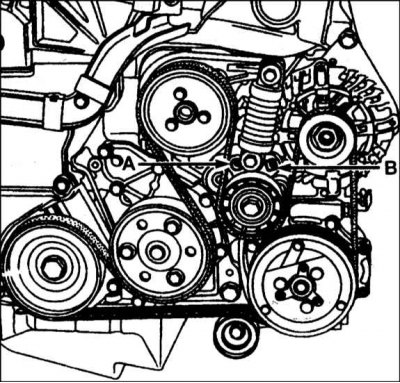
4b. Auxiliary Drive Belt Replacement - 16-Valve 2.0L Models with Air Conditioning:
A - Hole for installing the special Renault tool
B - 10mm square hole
5. Remove the belt from the pulleys.
6. When installing a new belt, make sure that it is correctly positioned in the pulley grooves (refer to the accompanying illustration).
7. Using a square wrench, lightly squeeze the tensioner and pull out the special tool. Slowly release the square wrench and allow the tensioner to tighten the drive belt.
8. Install the removed components, then lower the vehicle to the ground and install the negative cable to the battery.
Diesel engines
Note: Renault recommends that any time the belt becomes loose it should be replaced.
Models without air conditioning
1. Loosen the belt tension completely as described above. Remove the belt from the pulleys, then install a new one. Make sure it is routed correctly.
2. Adjust the belt tension as described above.
Models with air conditioning
Note: Before removing the belt, it is necessary to check the distance between the tensioner mounting bolts using the Renault Mot 1387 tool.
1. Unscrew the bracket holding the fuel hose connecting the fuel filter to the pump.
2. Install the 9mm square wrench into the hole in the tensioner mounting plate.
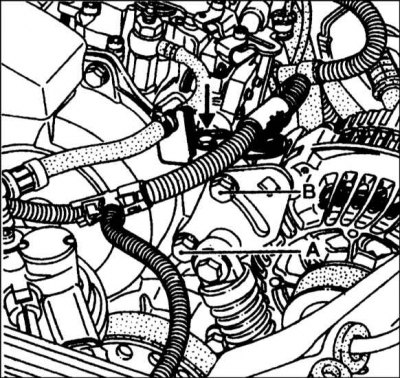
3. While holding the plate in this position, loosen the lower (A), then the upper (B) tensioner plate mounting bolts (refer to the accompanying illustration). The arrow points to the fuel supply hose bracket bolt.
4. Move the tensioner plate counterclockwise (if you look from the front of the car), to loosen the belt tension.
5. Remove the belt from the pulleys, then install a new one. Make sure it is routed correctly.
6. Reset the automatic tensioner mechanism to its original position by moving the mounting plate clockwise, then tighten the two mounting bolts.
7. Install the fuel hose bracket.