



Note: Renault does not give any specific recommendation regarding the interval for replacing spark plugs. Renault mechanics connect special diagnostic equipment to the car. It checks the system and reads all the fault codes registered.
Replacing spark plugs
All engines
1. The correct operation and performance of the engine depends on the correct functioning of the spark plugs. It is essential that the spark plugs installed are suitable for the engine (the appropriate type is defined at the beginning of this Chapter). If this type is used and the engine is in good condition, the spark plugs should not require attention between scheduled replacements. Cleaning the spark plug is rarely necessary and should not be attempted unless special equipment is available, as the plug can be easily damaged.
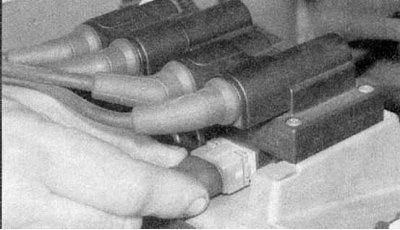
2a. On 1.6 l engines (K7M), disconnect and remove the plastic cover.
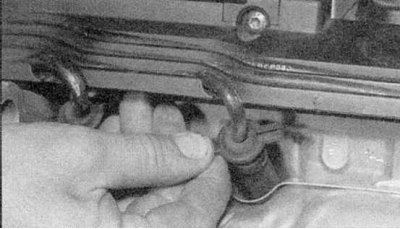
2b. Disconnect the spark plug wires from their retainer, and remove the screws securing the retainer to the ignition coil assembly.
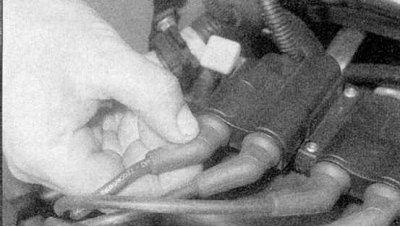
2c. Move the lock to the side (refer to the illustrations). On 16-valve 2.0L engines (F7R), remove the ignition coils as described in Chapter Engine electrical equipment.
3. Disconnect the high voltage wires from the spark plugs (except for models with F7R engine).
4. It is advisable to clean dirt from the spark plugs using a clean brush, electric vacuum cleaner or compressed air to prevent dirt from entering the cylinders.
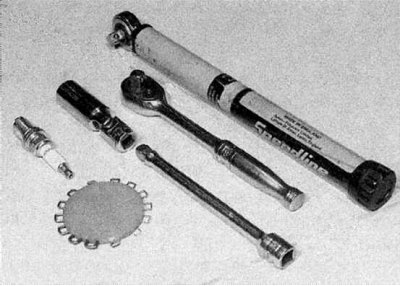
5a. Remove the spark plugs using a spark plug wrench or a suitable open-end wrench (refer to the illustrations).
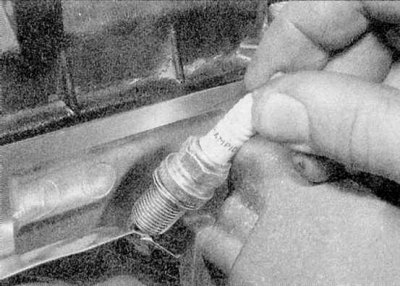
5b. Check their condition as follows.
6. The condition of the spark plugs can be used to determine the condition of the engine. If the nose of the spark plug insulator is clean and white, without carbon deposits, this indicates a weak mixture or a too hot plug.
7. If the tip and nose of the insulator are covered with hard black carbon, this indicates that the mixture is too rich. If the spark plug is black and oily, the engine is probably badly worn.
8. If the nose of the insulator is covered with a light brown coating, the mixture is correct and the engine is probably in good condition.
9. The spark plug gap is very important. If it is too large or too small, the spark size and performance will be seriously impaired. The gap should be within the value given in the Specifications at the beginning of this Chapter.
Adjustment
Note: Some engines are equipped with spark plugs with two or three electrodes. The gaps on these are not adjustable. If there is any doubt about their condition, replace all four spark plugs as a set.
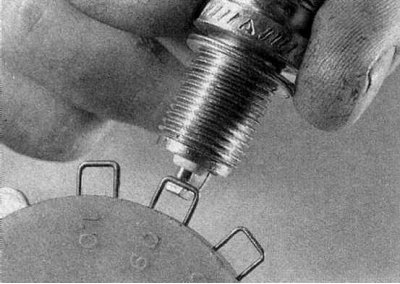
1. To set the gap, measure it with a feeler gauge, then bend the open or closed outer electrode until the correct gap is obtained. The gap is correct if a feeler gauge of the correct size holds firmly and slides freely (refer to the illustrations).
2. A special tool for adjusting the spark plug gap is available for sale in spare parts stores.
All engines
Installation
1. Before installing the spark plugs, check that the outside surface of the plug and the threads are clean. Apply a small amount of anti-seize compound to the threads of each spark plug.
2. Screw in the spark plugs by hand where possible, then tighten them to the torque specified in the Specification.
3. Connect the high voltage wires in the correct order.
Checking the ignition system
Warning! The voltage produced by the contactless ignition system is significantly higher than that produced by conventional ignition systems. Use extreme caution when working on the system with the ignition on.
Models with 1.4L engine (e7j)
1. Whenever you replace the spark plugs, check the high tension wires.
2. If necessary, mark the high voltage wires from 1 to 4 (1 cylinder closest to the engine toothed drive belt). When removing wires, pull on the tip, not the wire itself.
3. Check the inner tip for signs of corrosion, which will look like a hard white powder. Make sure the tip fits tightly onto the spark plug.
4. Using a clean rag, wipe the entire length of the wires to remove any dirt and grease that has accumulated. Check for burns, cracks, or other damage.
5. Disconnect the wire from the distributor cap. Check it for signs of corrosion. If an ohmmeter is available, check the resistance of the wire by connecting the meter between the wire that goes to the spark plugs and the contact inside the distributor cap. Finally, reinstall the wire securely.
6. Check the remaining wires in the same way.
7. Remove the air cleaner duct system from the left hand side of the engine as described in Chapter Power supply and exhaust systems, then unscrew the mounting screws and remove the distributor cap. Wipe the cap with a clean rag and inspect it for cracks, burnt indentations, burnt or loose contacts; check that the carbon brush is not worn, moves freely under the spring force and makes good contact with the distributor rotor. Also inspect the cover seal for signs of wear or damage, replace it if necessary. Remove the distributor rotor from the end of the camshaft and inspect it. When replacing the spark plugs, it is recommended to also replace the cover and distributor rotor. When connecting high-tension wires to the new cover, do not mix up the wires.
All other models
Check the condition of the high voltage wires as described above.