
Attention! Your vehicle has a microprocessor ignition system (IPSZ) high energy. A voltage of approximately 40,000 V is supplied to the high-voltage wires, and although it is not life-threatening at a low current strength, a possible electric shock when checking the ignition system can lead to serious consequences. Therefore, if you take on a high-voltage wire with the ignition on, use a thick rubber glove or, in extreme cases, pliers with insulated handles.
Note. Before checking the ignition system, place the shift lever in neutral and leave the parking brake applied.
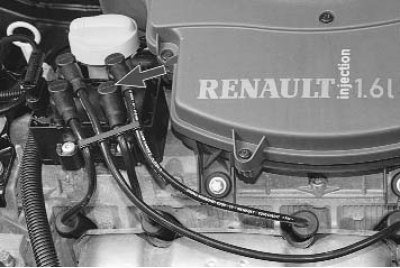
1. With the ignition off, check the integrity and fit of the high-voltage wires in the sockets of the ignition module.
2. Check the ignition module (see «Checking the ignition module»).
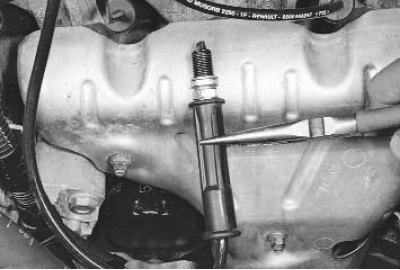
3. If the ignition module low voltage circuit is OK, check for spark at the spark plugs. Remove the high voltage wire from any spark plug. Insert a spare spark plug into the end of the wire and press it with the metal part against «mass» car (e.g. to exhaust manifold heat shield). Have an assistant turn the engine crankshaft with the starter.
Attention! Reliable contact of the candle body with «weight» is mandatory, since if an additional spark gap appears that is larger than the gap between the spark plug electrodes, the high-voltage circuit of the ignition module or the engine control unit may be damaged.
Carry out the indicated check for no more than five seconds so as not to damage the exhaust gas converter if gasoline that has not been burned in the engine cylinders gets into it.
4. If there is no spark, replace the high voltage wires with new ones. You can first try to install not new, but proven, «from a working machine».
5. If there is no spark after replacing the wires, replace the ignition module (see «Removal and installation of the ignition module»). If there is spark but the engine does not start, replace the spark plugs with new ones. You can also try to install not new ones, but proven ones, with «working machine».
6. If after that the engine does not start, check the engine management system (see «Fuel Injection System Malfunctions»).