



 |
 |
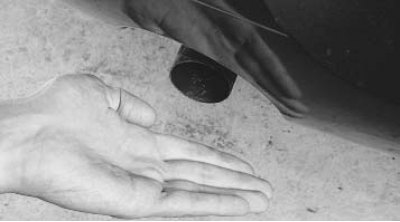
1. Start the engine and let it idle. Go to the exhaust pipe and listen to the sound of the exhaust. You can put your hand to the end of the exhaust pipe - this way you can feel the interruptions better. The sound should be smooth, "soft", of one tone. Pops from the exhaust pipe at regular intervals indicate that one cylinder is not working due to a faulty spark plug, no spark on it, a failed injector, as well as a strong air leak in one cylinder or a significant decrease in compression in it. Pops at irregular intervals occur due to contamination of the injector nozzles, severe wear or contamination of the spark plugs. If pops are heard at irregular intervals, you can try to replace the entire set of spark plugs yourself, regardless of mileage and appearance, but it is better to do this after contacting a car service for diagnostics and repair of the engine management system.
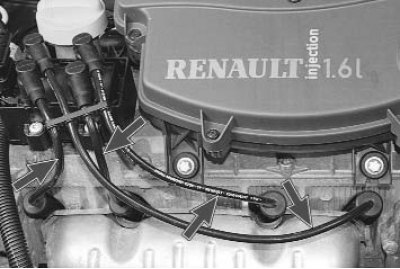
2. If the popping sounds are irregular, stop the engine and open the hood. Check the condition of the ignition system wires. The high-voltage wires should not have any damage to the insulation, and their tips should not be oxidized. If there is damage to the wires, replace the faulty wire.
Note. The simplest and at the same time most effective way to check high-voltage wires is to check in the dark. Place the car in a dark place, start the engine and open the hood. Inspect the high-voltage wires. If the wire insulation is damaged, you will see a characteristic blue-violet spark ("northern lights"). In this case, the high-voltage wires must be replaced.
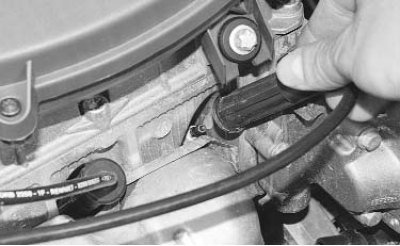
3. Remove the high-voltage wire tips.
Caution! When removing high-voltage wire tips, never pull the wire. Grasp the tip directly with your hand and pull it, turning it from side to side.
The text is available on this website: renaultbook.ru
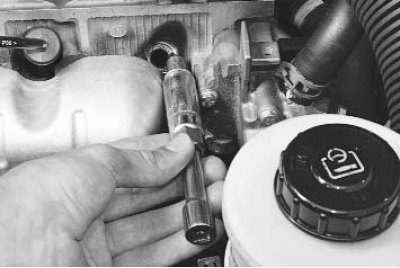
4. Remove the spark plugs using a spark plug wrench (see "Replacement and maintenance of spark plugs").
5. Carefully inspect the spark plugs and compare their appearance with the photographs provided in the next subsection "Diagnostics of engine condition by the appearance of spark plugs". The gap between the spark plug electrodes should be 0.9–1.0 mm. If the spark plug is black and wet, it can be thrown away.
6. If all the spark plugs look OK, reinstall them and reconnect the spark plug wires. Cylinder firing order 1-3-4-2, cylinder numbering (1, 2, 3, 4th) is driven from the engine flywheel.
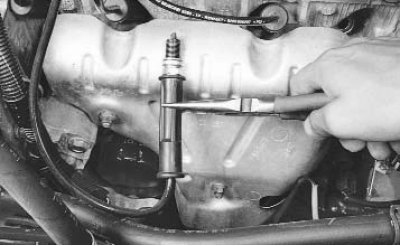
7. Take a spare spark plug. Secure it to the engine in any way. Connect the high-voltage wire of the 1st cylinder to the spare spark plug. Start the engine. If the engine misfires do not increase, replace the spark plug in the 1st cylinder with a known good one. If the misfires increase, repeat this procedure sequentially with all cylinders to find the faulty spark plug.
Attention! Reliable contact of the spark plug body with the "ground" is required, since if an additional spark gap appears, larger than the gap between the spark plug electrodes, the high-voltage circuit of the ignition module or the engine control unit may be damaged. Try to spend as little time as possible on the check described above: the catalytic converter, if unburned gasoline enters it for a long time, may fail due to overheating, since the gasoline will burn in it.
If the engine misfires are not eliminated as a result of the measures taken, check the compression in each cylinder (see "Checking the compression in the cylinders"). Normal compression is more than 1.1 MPa (11 kgf/cm²), a difference of more than 0.1 MPa (1 kgf/cm²) in one cylinder indicates the need for engine repair.