
English Русский
Български
Беларускі
Український
Српски
Hrvatski
Română
Polski
Slovenský
Magyar
Bookmark Contacts Articles Sitemap
Company vehicles Peugeot Company vehicles Opel Company vehicles Skoda Company vehicles Land Rover Company vehicles Mitsubishi Company vehicles Volkswagen Company vehicles Honda
RenaultBook.ru


Duster   Fluence   Kangoo   Laguna   Logan   Megane   Sandero   Scenic   Symbol   Clio   Other
Logan 1 (2004-2012, petrol) Logan 2 (2012-2020)

Checking the compression in the cylinders (Renault Logan 1)

  • Main
  • Logan
  • Logan 1 (2004-2012, petrol)
  • Power unit
  • Engine repair
  • Checking the compression in the cylinders
0
Compression (compression stroke end pressure) in cylinders is the most important indicator for diagnosing the condition of the engine without disassembling it. Based on its average value and the difference in values in individual cylinders, it is possible to determine with sufficient accuracy the degree of general wear of the connecting rod and piston group of the engine and to identify faults in this group and valve mechanism parts.

Compression is checked with a special device - a compression meter, which can now be freely purchased in large auto parts stores.
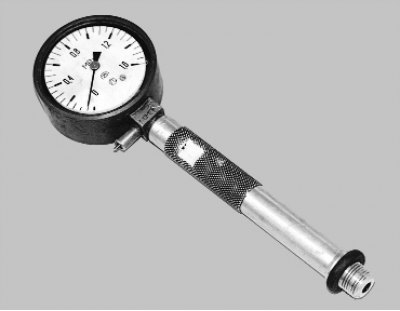
Compression is checked with a special device - a compression meter, which can now be freely…


Note: This is what the compression tester used to illustrate this book looks like. There are versions of compression testers that have a rubber tip instead of a spark plug instead of a threaded nipple for screwing in. When checking compression, such compression testers are simply pressed hard against the spark plug hole.


Attention! Important conditions for correct readings when checking compression are the serviceability of the starter and its electrical circuits, as well as the full charge of the battery.


You will need...
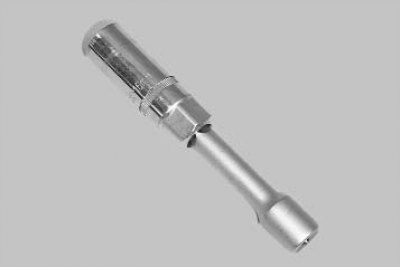
You will need...


...a 16 mm socket wrench for removing spark plugs.


1. Start the engine and warm it up to operating temperature.
1. Start the engine and warm it up to operating temperature.


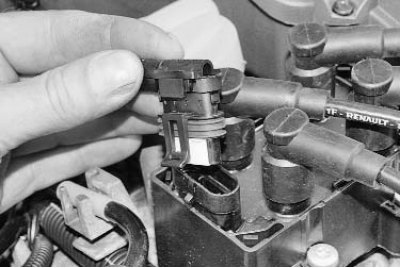
2. Stop the engine, disconnect the low voltage wire harness connector from the ignition module.

Caution! Cranking the engine with the starter while the high-voltage wire ends are disconnected and the ignition module is not disconnected may cause a breakdown of its high-voltage circuit.

Caution! Cranking the engine with the starter while the high-voltage wire ends are disconnected and…


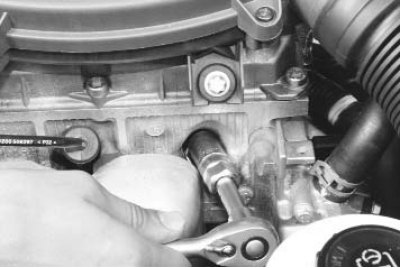
3. Remove all spark plugs (see "Replacement and maintenance of spark plugs").
3. Remove all spark plugs (see «Replacement and maintenance of spark plugs»).


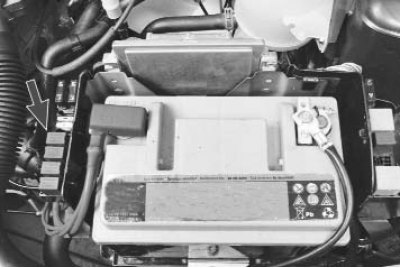
4. Disconnect the fuel pump by removing its relay in the mounting block installed in the engine compartment.


4. Disconnect the fuel pump by removing its relay in the mounting block installed in the engine…


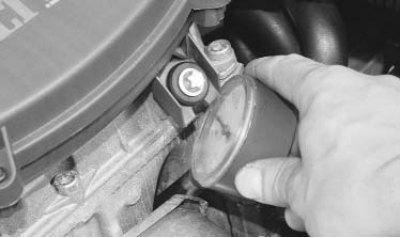
5. Screw the compression gauge into the spark plug hole of the cylinder being tested.

6. Press the accelerator pedal all the way down to fully open the throttle valve.

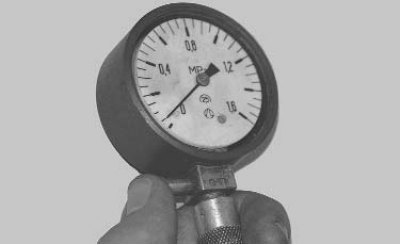
7. Turn on the starter and turn the engine crankshaft until the pressure in the cylinder stops increasing. This corresponds to approximately four compression strokes.

Note: To obtain correct compression tester readings, the crankshaft must rotate at 180–200 min⁻¹ or higher, but not more than 350 min⁻¹.

Note: To obtain correct compression tester readings, the crankshaft must rotate at 180–200 min⁻¹ or…


8. After recording the compression gauge readings, set its arrow to zero by pressing the air release valve.

Note: Compression gauges of other designs may reset their readings in other ways (in accordance with the instructions for the device).


9. Repeat steps 5–8 for the remaining cylinders. The pressure should be no lower than 1.0 MPa and should not differ by more than 0.1 MPa in different cylinders. Low compression in individual cylinders may result from loose valve seats, damaged cylinder head gaskets, broken or burnt piston rings. Low compression in all cylinders indicates worn piston rings.

10. To determine the causes of insufficient compression, pour about 20 cm³ of clean motor oil into the cylinder with low compression and measure the compression again. If the compression meter readings have increased, the piston rings are most likely faulty. If the compression value remains unchanged, this indicates that the valve plates do not fit tightly to their seats or that the cylinder head gasket is damaged.

Note. The cause of insufficient compression can also be determined by applying compressed air to the cylinder, in which the piston is pre-installed in the TDC of the compression stroke. To do this, remove the tip from the compressor meter and attach the compressor hose to it. Insert the tip into the candle hole and apply air to the cylinder at a pressure of 0.2-0.3 MPa. To prevent the engine's crankshaft from turning, put the car in high gear and apply the parking brake. The output (leakage) of air through the throttle assembly indicates a leak in the intake valve, and through the muffler-a leak in the exhaust valve. If the cylinder head gasket is damaged, air will escape through the expansion tank mouth in the form of bubbles or into the adjacent cylinder, which is detected by a characteristic hissing sound.
This article is available on: russian, bulgarian, belarusian, ukrainian, serbian, croatian, romanian, polish, slovak, hungarian
Article has been reviewed by editor: Podkrepilov Maxim
Share with friends:
Previous
Logan 1: Engine repair
Next

Useful tips for engine diagnostics
Possible engine malfunctions
Description of engine design
Removal and installation mudguards and engine crankcase protection
Replacing the right powertrain suspension support
Replacing the left support of the powertrain suspension
Replacing the rear support of the powertrain suspension
Setting the piston of the first cylinder to the TDC position of the…
Other articles on other Renault models

➽ Checking the compression in the cylinders Renault Megane 1 (1995-2002)
➽ Checking the compression in the cylinders Renault Sandero 1 (2007-2012, petrol)
➽ Checking the diameters, ovality and taper of cylinders of H4J… Renault Fluence 1 (2009-2020, petrol)
➽ Compression in cylinders — check Renault Scenic 1 (1996-2003)
➽ Measuring compression in cylinders Renault 19 (1988-1996)
Link to this article in different formats
Reviews and comments of visitors
No comments yet


Add two numbers 50 + 34


Logan 2 (2012-2020) 
  • General information
  • Faults en route
  • Daily checks
  • Governing bodies
  • Maintenance
  • Power unit
  • Petrol engines 1.2 l
  • Petrol engines 1.6 l
  • Diesel engines 1.5 l
  • Cooling system
  • Lubrication system
  • Power and control system
  • Intake and exhaust system
  • Engine electrical equipment
  • Transmission
  • Clutch
  • Car gearbox
  • Drive shafts
  • Chassis, running gear
  • Suspension and wheels
  • Brake system
  • Steering
  • Body and interior
  • Exterior (external elements)
  • Interior (internal elements)
  • Safety system
  • Heating and air conditioning
  • Electrical equipment
  • Equipment and devices
  • Wiring diagrams (sedan)
  • Wiring diagrams (wagon)
Logan 1 (2004-2012, petrol) 
  • General information
  • Vehicle device
  • User manual
  • Faults en route
  • Daily maintenance
  • First maintenance
  • Second maintenance
  • Driver tips
  • Power unit
  • Engine repair
  • Lubrication system
  • Cooling system
  • Power and exhaust system
  • Transmission
  • Clutch
  • Car gearbox
  • Drive shafts
  • Chassis, running gear
  • Front suspension
  • Rear suspension
  • Steering
  • Brake system
  • Wheels and tires
  • Body and interior
  • Exterior (external elements)
  • Interior (internal elements)
  • Doors, locks and windows
  • Body Care
  • Electrical equipment
  • Equipment and devices
  • Headlights and lighting
  • Power devices
  • Electrical circuits
RenaultBook.ru © 2018–2026 | Mobile version | News and articles | Sitemap: EN BG BY UA RS HR RO PL SK HU | Administration | Site search | Bookmark
Duster 1 (2009-2017) | Fluence 1 (2009-2020, petrol) | Kangoo 1 (1997-2007) | Laguna 2 (2001-2007) | Logan 1 (2004-2012, petrol) | Logan 2 (2012-2020) | Megane 1 (1995-2002) | Megan 2 (2002-2009, petrol) | Sandero 1 (2007-2012, petrol) | Scenic 1 (1996-2003) | Symbol 1 (1999-2008, petrol) | Symbol 2 (2008-2013, petrol) | Renault 19 (1988-1996) | Espace I and II (1984-1996) | Espace III (1996-2002) | Clio 1 (1990-1998) |
We want your visit to be comfortable 😌 and use cookies 🍪 to do so.