
English Русский
Български
Беларускі
Український
Српски
Hrvatski
Română
Polski
Slovenský
Magyar
Bookmark Contacts Articles Sitemap
Company vehicles Peugeot Company vehicles Opel Company vehicles Skoda Company vehicles Land Rover Company vehicles Mitsubishi Company vehicles Volkswagen Company vehicles Honda
RenaultBook.ru


Duster   Fluence   Kangoo   Laguna   Logan   Megane   Sandero   Scenic   Symbol   Clio   Other
Scenic 1 (1996-2003)

Compression in cylinders — check (Renault Scenic 1)

  • Main
  • Scenic
  • Scenic 1 (1996-2003)
  • Power unit
  • Engine repair
  • Compression in cylinders — check
0
Compression testing allows you to draw conclusions about the condition of the engine. Only when checking can it be determined whether the valves or pistons are worn out (piston rings) or they are in normal condition. In addition, the test results show whether the engine needs to be replaced or whether it only needs to be completely overhauled. For testing, a compression tester is required, which is offered by specialized stores for gasoline engines at an affordable price.

Attention! For diesel engines, a compression tester with a large measurement range of almost 40 bar is required.


The pressure difference in individual cylinders can be a maximum of 1.5 bar. If the pressure in one or more cylinders differs from the pressure in other cylinders by more than 1.5 bar, this indicates a defect in the valves, wear of the piston knees or working surfaces of the cylinders.

1. Warm up the engine to measure the compression. To do this, drive some distance until the coolant reaches operating temperature. Once the coolant temperature reaches the desired value, drive another 5 km or so to ensure sufficient oil temperature, which should be +80°C.

2. Shift into neutral and apply the parking brake.

3. Gasoline-powered vehicles: Disconnect fuel pump relay B to prevent fuel from being supplied when the engine is started (see illustration).
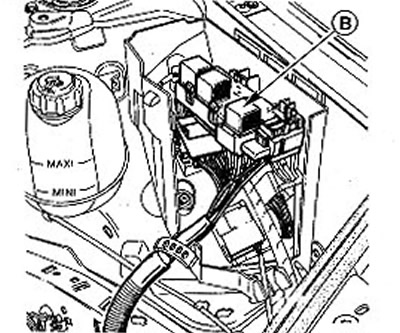
12.3 Disconnect the fuel pump relay B to prevent fuel from being supplied when the engine is started

12.3 Disconnect the fuel pump relay B to prevent fuel from being supplied when the engine is started


4. Cars with petrol engines. Disconnect the high-voltage wire tips from the spark plugs using special pliers, such as HAZET 1849-1. Then blow out the spark plug seating areas with compressed air and air and unscrew the spark plugs with the appropriate spark plug wrench.

5. Vehicles with diesel engines: Disconnect the fuel shut-off valve plug to prevent fuel from being supplied and injected by the injectors into the combustion chambers of the cylinders.

6. Vehicles with diesel engines: Remove all glow plugs.

7. Turn the engine over a couple of times with the starter to throw out carbon deposits and soot.

Caution! Do not lean over the engine compartment when turning the engine. Risk of injury from small solid particles ejected from the engine.


8. Press or screw the compression tester into the spark plug/glow plug socket according to the instructions in the operating instructions.

9. Ask the assistant to press the accelerator pedal all the way down and hold it in this position until the check is completed.

10. Let the engine turn over approximately 8 revolutions until the pressure reading on the gauge stops increasing.

11. Check all cylinders one by one and compare the results with the nominal compression value.

Installation


Cars with gasoline engines


12. Connect the fuel pump and ignition system relay.

13. Screw in the spark plugs and fit the high-tension wire caps onto them, see the relevant chapter.

Diesel Engine Cars


14. Connect the fuel shut-off valve plug.

15. Screw in all glow plugs.
This article is available on: russian, bulgarian, belarusian, ukrainian, serbian, croatian, romanian, polish, slovak, hungarian
Article has been reviewed by editor: Fedoseev Denis
Share with friends:
Previous
Scenic 1: Engine repair
Next

Vacuum Pump (1.9L Diesel Engine) — Removal, Installation and Checking
Valve clearance — checking and adjustment
Valves — removal and installation
Plate tappets
Camshaft — Removal and Installation
V-belt (petrol engines 1.4/1.6 l, E7J/K7M, without air conditioning)
V-belt — removal, installation, inspection and tensioning
Engine lubrication system — general information
Motor oil — circulation
Oil pressure — check
Other articles on other Renault models

➽ Compression Stroke End Pressure — Check Renault Duster 1 (2009-2017)
➽ Compression check Renault Fluence 1 (2009-2020, petrol)
➽ Checking the compression in the cylinders Renault Logan 1 (2004-2012, petrol)
➽ Checking the compression in the cylinders Renault Megane 1 (1995-2002)
➽ Checking the compression in the cylinders Renault Sandero 1 (2007-2012, petrol)
Link to this article in different formats
Reviews and comments of visitors
No comments yet


Add two numbers 24 + 12


Scenic 1 (1996-2003) 
  • General information
  • User manual
  • Maintenance
  • Troubleshooting
  • Power unit
  • Engine repair
  • Cooling and ventilation
  • Injection system (petrol)
  • Fuel system (diesel)
  • Fuel system
  • Exhaust system
  • Ignition system
  • Transmission
  • Clutch
  • Car gearbox
  • Chassis, running gear
  • Brake system
  • Car suspension
  • Steering
  • Body and interior
  • Exterior (external elements)
  • Interior (internal elements)
  • Doors, locks and windows
  • Electrical equipment
  • Equipment and devices
  • Headlights and lighting
  • Power devices
  • Electrical circuits
RenaultBook.ru © 2018–2026 | Mobile version | News and articles | Sitemap: EN BG BY UA RS HR RO PL SK HU | Administration | Site search | Bookmark
Duster 1 (2009-2017) | Fluence 1 (2009-2020, petrol) | Kangoo 1 (1997-2007) | Laguna 2 (2001-2007) | Logan 1 (2004-2012, petrol) | Logan 2 (2012-2020) | Megane 1 (1995-2002) | Megan 2 (2002-2009, petrol) | Sandero 1 (2007-2012, petrol) | Scenic 1 (1996-2003) | Symbol 1 (1999-2008, petrol) | Symbol 2 (2008-2013, petrol) | Renault 19 (1988-1996) | Espace I and II (1984-1996) | Espace III (1996-2002) | Clio 1 (1990-1998) |
We want your visit to be comfortable 😌 and use cookies 🍪 to do so.