



Contents: Removal 🠛 Installation 🠛 Checking the belt tension 🠛 Only cars with 113 hp engine. 🠛 Only cars with 150 hp engine. 🠛 Only cars with 1.4-/1.6-liter petrol…🠛 Only cars with 1.4-/1.6-liter petrol…🠛
Cars with 1.4-/1.6-liter petrol engines (E7J/K7M) with air conditioning, 1.9-liter diesel engine and 2.0-liter petrol engine.
Brook (poly-V-shaped) the belt is wider than the V-belt and has ribs on the working surface. It is used to drive all auxiliary units. Due to the fact that the V-belt tension is performed and maintained constant by means of an automatic tension roller, then the belt does not require tightening, as well as its maintenance.
The V-belt must be replaced if it has the following defects:
- swelling and cracks;
- the appearance of noise during operation (for example, as a result of oil ingress);
- for such damages as transverse cracks on the ribs, rib breaks, deposits and small stones between the ribs, fringing and lateral wear of the rib rubber.
Attention! The removed V-belt cannot be reinstalled. It must be replaced with a new one.
Removal
1. Mark the position of the right front wheel on the hub with paint. This will allow you to install the balanced wheel in its original position during assembly.
2. Loosen the wheel mounting bolts while the car is on the ground.
3. Place the front of the car on jack stands and remove the front wheel.
4. Remove the right mudguard liner, see the corresponding chapter.
5. Vehicles with diesel engine: Unscrew and remove the fuel hose holder (see illustration).
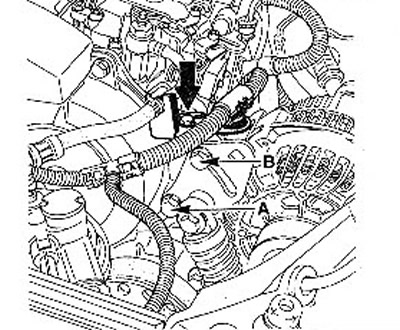
14.5 Unscrew and remove the fuel hose holder. Diesel vehicles
6. Insert a 9mm square wrench into the square hole of the tensioner plate.
7. Loosen bolts A and B, holding the board from turning, until the bolt flanges protrude(see illustration 14.5).
8. Turn the key in the direction of the arrow in the illustration to loosen the belt tension (see illustration).
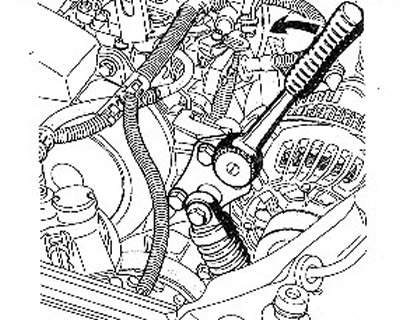
14.8 Turn the key in the direction of the arrow in the illustration and thus loosen the belt tension
9. Diesel vehicles: Remove the lower part of the V-ribbed/toothed belt cover.
10. Remove the V-belt.
Installation
11. Place the V-belt on the belt pulleys.
12. Tighten bolt B of the V-belt automatic tensioner plate until it stops using a 9 mm square wrench (see illustration).
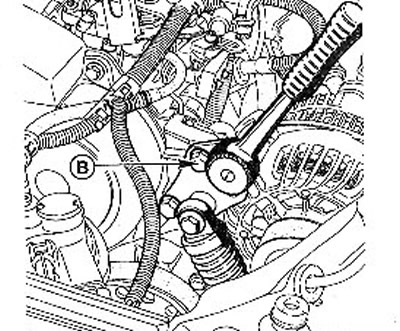
14.12 Tighten the new belt groove with bolt B on the automatic tensioner plate until it stops using a 9 mm square wrench
13. Check the belt tension and adjust it with a square wrench. Once the required belt tension is achieved, tighten both belt tensioner plate bolts.
Checking the belt tension
14. Check the tension of the V-belt at the points marked with arrows in the illustration (see illustration).
- A = belt pulley on crankshaft;
- B = alternator drive belt pulley;
- C = Power steering pump belt pulley;
- D = air conditioning compressor pulley;
- E = water pump pulley;
- G = guide roller;
- T = tension roller.
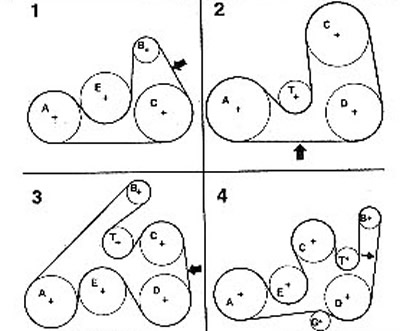
14.14 Check the tension of the V-belt at the points marked with arrows in the illustration
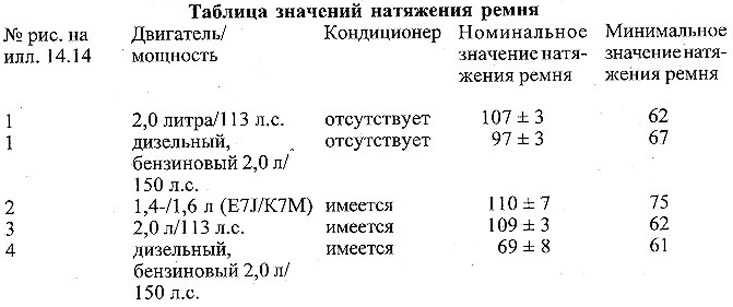
In workshops, the RENAULT Mot. 1273 device is used to check the tension of the V-belt, which is also used to check the tension of the toothed belt.
Attention! When checking a V-ribbed belt that has already been run in, its tension must be increased if it is less than the nominal value.
If the specified measuring device is not available, the tension of the V-belt is checked at the points shown in Illustration 14.14 by pressing on the belt and measuring the deflection. The nominal deflection value should be approximately 3 mm.
Caution: When installing a new V-belt, check its tension after approximately 10 minutes of engine operation.
Attention! When checking the tension of a long-installed V-belt, it is necessary to tighten it only if the deflection exceeds 6 mm.
Nominal values of V-belt tension for vehicles with air conditioning:
- belt deflection when the engine is cold - approximately 2 mm;
- belt deflection with the engine warmed up to operating temperature is approximately 3 mm. Belt tightening is necessary if the deflection exceeds 3.5 mm.
15. Install the mudguard liner on the right wheel splash guard, see the corresponding chapter.
16. Install the front wheel in accordance with the marks made during removal. Before doing this, lubricate the seat of the wheel disk on the hub with a thin layer of bearing grease. Do not lubricate the threads of the wheel bolts. Secure the wheel with bolts and lower the car.
17. Tighten the wheel bolts in a crisscross pattern to 90 Nm.
Only cars with 113 hp engine.
18. Disconnect the engine control unit bracket and place the unit on the engine.
Loosening the V-belt tension
19. Loosen the tension roller clamp bolt 4 using a 7 mm socket wrench by 1/4 turn. At the same time, hold the outer nut from turning with a 22 mm wrench (see illustration).
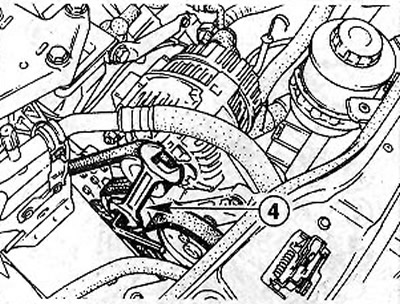
14.19 Loosen the tension roller clamping bolt 4 using a 7 mm socket wrench by 1/4 turn
Please note: Due to limited access, the socket wrench will need to be shortened by approximately 12 mm.
20. Loosen the V-belt tension by turning the tension roller with a wrench.
Caution! Loosening the belt tensioner with a wrench will break off the adjusting teeth and damage the air conditioning compressor mount or power steering pump.
This article is taken from the website www.Renaultbook.ru
21. Install and secure the engine control unit bracket.
Only cars with 150 hp engine.
22. Disconnect the engine control unit bracket and place the unit on the engine (see illustration).
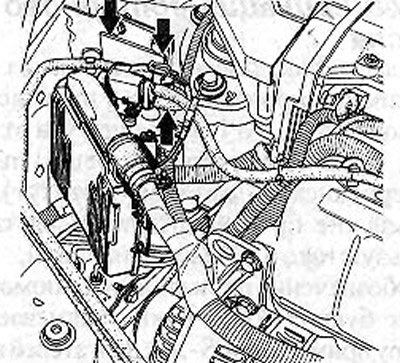
14.22 Disconnect the engine control unit bracket and place the unit on the engine
23. Disconnect the hose from the canister purge valve.
24. Insert a pin or punch of suitable diameter (for example, bolt Mot.l318 for fixing the crankshaft) into hole A (see illustration).
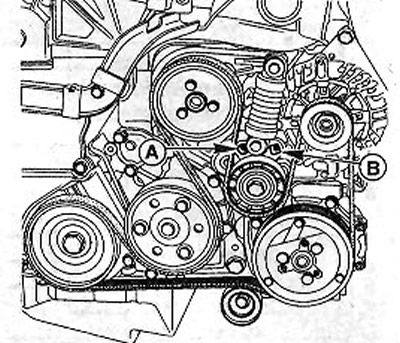
14.24 Insert a pin or punch of suitable diameter (for example, bolt Mot.1318 for fixing the crankshaft) into hole A
25. Insert a 10mm square key into hole B (see illustration 14.24).
26. Loosening the V-belt tension. Turn the key to the right and tighten the belt tensioner. Then turn the tensioner plate to the left and push the pin as far to the side as possible so that it rests against the bracket of the attachment units.
27. Tensioning the V-belt. Turn the key slightly to the left and remove the pin. Then slowly turn it to the right until the tension force of the belt tensioner spring is equalized.
28. Connect the hose to the canister purge valve.
29. Install and secure the bracket with the engine control unit.
Only cars with 1.4-/1.6-liter petrol engines (E7J/K7M) with air conditioning
30. Move the automatic tension roller to the left with a 13 mm socket wrench until the tensioner can be secured with a 6 mm socket wrench (see illustration).
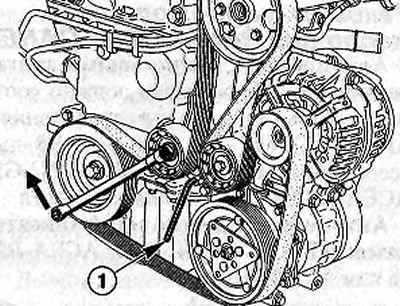
14.30 Move the automatic tension roller to the left using a 13 mm socket wrench until the tensioner can be secured with a 6 mm socket wrench
The V-belt tension does not need to be adjusted. It is automatically set by the automatic roller.
Only cars with 1.4-/1.6-liter petrol engines (E7J/K7M) without air conditioning
31. Unscrew both V-belt tensioner mounting bolts. The bolts are located below bolt 1 (see illustration).
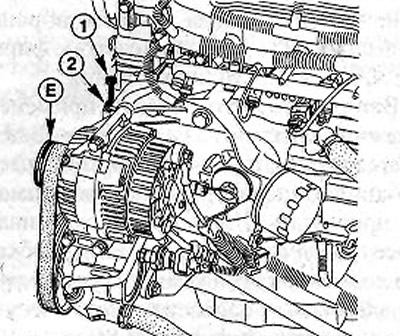
14.31 Unscrew both V-belt tensioner mounting bolts. The bolts are located below bolt 1
The V-belt tension measurement point is located at the bottom between the crankshaft pulley and the power steering pump pulley.
To check the tension of the V-belt, use the RENAULT Mot. 1273 device, which is also used to check the tension of the toothed belt. The nominal value of the tension of a new belt is 108±6 units. Tightening of the worn-in belt is necessary if its tension is less than 60 units.
The belt tension is adjusted using bolt 1. Before doing this, loosen the lock nut and then tighten it again (see illustration 14.31).
Caution! The V-belt has five longitudinal ribs. The alternator and power steering pump pulleys have 6 grooves for the belt ribs. When installing the belt, make sure that groove E at the end of the alternator and power steering pump pulleys remains free (see illustration 14.31).