
English Русский
Български
Беларускі
Український
Српски
Hrvatski
Română
Polski
Slovenský
Magyar
Bookmark Contacts Articles Sitemap
Company vehicles Peugeot Company vehicles Opel Company vehicles Skoda Company vehicles Land Rover Company vehicles Mitsubishi Company vehicles Volkswagen Company vehicles Honda
RenaultBook.ru


Duster   Fluence   Kangoo   Laguna   Logan   Megane   Sandero   Scenic   Symbol   Clio   Other
Renault 19 (1988-1996) Espace I and II (1984-1996) Espace III (1996-2002)

Removal, checking and installation the thermostat (Renault 19)

  • Main
  • Renault
  • Renault 19 (1988-1996)
  • Power unit
  • Cooling system
  • Removal, checking and installation the thermostat
0
Contents: Removal and installation 🠛 Checking the Thermostat 🠛

Removal and installation


It is difficult to remove the thermostat on the road, since it is necessary to drain the coolant completely. In addition, when the engine is hot, this process takes a very long time, since it is necessary to wait until the coolant cools down. When replacing the thermostat, you also need to install a new sealing ring, in which the thermostat is located in the radiator hose (engine type "C") or in the housing (engine type "F"), and a new thermostat housing gasket.

1. Unscrew the expansion tank cap to bring the pressure in the cooling system to atmospheric pressure.

Attention! Attention! Unscrew with a thick cloth so as not to burn yourself!


2. Disconnect the lower radiator hose, drain 2-3 liters of coolant into a clean container.

3. Disconnect the upper radiator hose from the coolant pump (type "C" engine) or from the thermostat housing (type "F" engine) and from the cylinder head.

4. Type "C" engine: Cut off the factory clamps with a knife.

5. Move the stuck thermostat by squeezing the radiator hose. Remember how it was installed (the direction of fluid movement is important!).

6. Before installation, clean the place where the thermostat is attached in the hose from scale. Then install the thermostat and fix its position with a threaded clamp.

7. Engine type "F": Unscrew the 3 thermostat housing bolts and carefully remove the housing.

8. If the body does not give in, help yourself by hitting with your hand.


9. Release the thermostat safety clamp and remove the thermostat and sealing ring from the housing.

10. Before installation, clean the sealing surfaces from any remaining sealant. Then apply a layer of sealant to them (for example, Loctite 518) thickness no more than 1 mm.

Checking the Thermostat


Using a thermometer, you can check for yourself whether the thermostat actually turns on at the required temperature.

1. Disconnect the thermostat.

2. Place the thermostat in a container of water and heat the water.

3. Make sure that the valve lifts from its place at the required temperature.
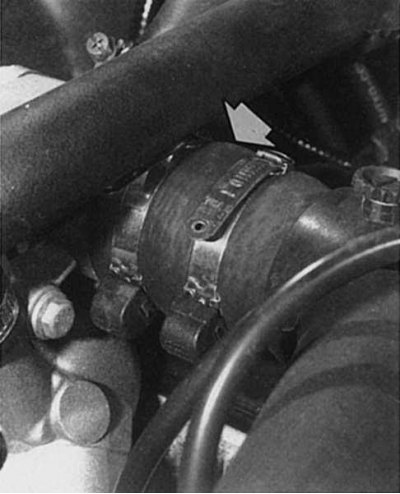
In the C-type engine, the thermostat is located in the upper radiator hose and is clamped there…


In the C-type engine, the thermostat is located in the upper radiator hose and is clamped there between two hose clamps (shown by arrow).
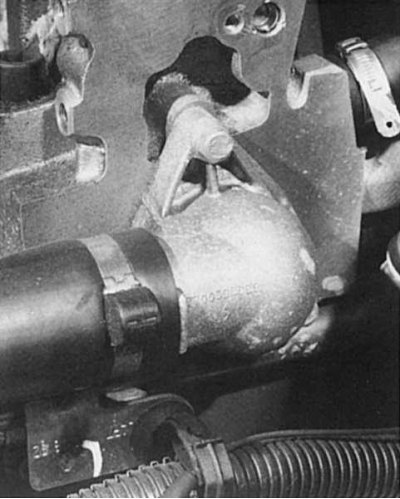
On «F» type engines, the thermostat is bolted to the front of the engine in the housing. Coolant…


On "F" type engines, the thermostat is bolted to the front of the engine in the housing. Coolant pumped by the pump passes through the engine and flows back to the radiator through the top hose after the thermostat.


engine
1.4 liter
(C3J)
1.7 liter
(F3N)
1.8 liter
(F3P)
16-valve
(FTP)
Diesel
(F8Q)
Thermostat opening temperature
open fully at *
86°C
98°C
89°C
98°C
89°C
101°C
89°C
101°C
82 єC
94 єC

* the used thermostat may have a fluctuation of ±3°C
This article is available on: russian, bulgarian, belarusian, ukrainian, serbian, croatian, romanian, polish, slovak, hungarian
Article has been reviewed by editor: Trofimova Anastasia
Share with friends:
Previous
19: Cooling system
Next

Troubleshooting a Thermostat
Thermostat — description of the operating principle
Expansion tank cap
Removal and installation the radiator
Replacing the coolant
Coolant pump — removal and installation
Checking the V-belt tension
Engine cooling system fan
Additional electric coolant pump
Possible malfunctions and their elimination
Other articles on other Renault models

➽ Removal, checking the serviceability and installing the… Renault Megane 1 (1995-2002)
➽ Thermostat — Removal, Installation and Checking Renault Scenic 1 (1996-2003)
➽ Removal, checking and installation the thermostat Renault Symbol 1 (1999-2008, petrol)
➽ Thermostat — removal, checking for serviceability and… Renault Clio 1 (1990-1998)
➽ Checking oil pressure Renault Duster 1 (2009-2017)
Link to this article in different formats
Reviews and comments of visitors
No comments yet


Add two numbers 24 + 48


Renault 19 (1988-1996) 
  • General information
  • Maintenance
  • Power unit
  • Engine repair
  • Exhaust system
  • Cooling system
  • Supply system
  • Single-point injection
  • Multi-point injection
  • Diesel injection system
  • Transmission
  • Clutch
  • Car gearbox
  • Chassis, running gear
  • Car suspension
  • Steering
  • Brake system
  • Wheels and tires
  • Body and interior
  • Exterior (external elements)
  • Interior (internal elements)
  • Heating and ventilation
  • Electrical equipment
  • Equipment and devices
  • Headlights and lighting
  • Ignition system
  • Power devices
  • Electrical circuits
Espace I and II (1984-1996) 
  • General information
  • Introduction to the guide
  • Troubleshooting
  • Power unit
  • Engine repair
  • Cooling system
  • Carburetor fuel system
  • Injection fuel system
  • Diesel fuel system
  • Ignition system
  • Transmission
  • Clutch
  • Car gearbox
  • Drive shafts
  • Chassis, running gear
  • Brake system
  • Steering
  • Front suspension
  • Rear suspension
  • Body and interior
  • Exterior (external elements)
  • Interior (internal elements)
  • Doors, locks and windows
  • Electrical equipment
  • Equipment and devices
  • Electrical circuits
Espace III (1996-2002) 
  • General information
  • Introduction to the manual
  • User manual
  • Power unit
  • Petrol engines F3R
  • Petrol engines Z7X
  • Diesel engines G8T
  • Diesel engines G9T
  • Transmission
  • Clutch
  • Mechanical gearbox
  • Automatic gearbox
  • Drive shafts
  • Chassis, running gear
  • Steering
  • Front suspension
  • Rear suspension
  • Brake system
  • Body and interior
  • Exterior (external elements)
  • Interior (internal elements)
  • Doors, locks and windows
  • Heating and ventilation
  • Electrical equipment
  • Equipment and instruments
  • Power devices
  • Electrical circuits
RenaultBook.ru © 2018–2026 | Mobile version | News and articles | Sitemap: EN BG BY UA RS HR RO PL SK HU | Administration | Site search | Bookmark
Duster 1 (2009-2017) | Fluence 1 (2009-2020, petrol) | Kangoo 1 (1997-2007) | Laguna 2 (2001-2007) | Logan 1 (2004-2012, petrol) | Logan 2 (2012-2020) | Megane 1 (1995-2002) | Megan 2 (2002-2009, petrol) | Sandero 1 (2007-2012, petrol) | Scenic 1 (1996-2003) | Symbol 1 (1999-2008, petrol) | Symbol 2 (2008-2013, petrol) | Renault 19 (1988-1996) | Espace I and II (1984-1996) | Espace III (1996-2002) | Clio 1 (1990-1998) |
We want your visit to be comfortable 😌 and use cookies 🍪 to do so.