Share with friends:

Car front and rear suspension Renault 19
Reliable grip on the ground of all 4 wheels depends on the harmonious interaction of all suspension elements at any degree of load. Therefore, the early detection of faults is of great importance for traffic safety.

Front suspension — design description
Front suspension elements 1 - rotary fist; 2 - thrust of the steering trapezoid; 3 - sealing cuff of the steering mechanism; 4 - steering gear; 5 - upper steering shaft; 6 - shock absorber strut; 7 - lower steering...
Front suspension elements 1 - rotary fist; 2 - thrust of the steering trapezoid; 3 - sealing cuff of the steering mechanism; 4 - steering gear; 5 - upper steering shaft; 6 - shock absorber strut; 7 - lower steering...

Rear Axle — Design Description
The top picture shows the rear suspension with a single torsion bar integrated into the axle tube with a transverse stabilizer, the bottom picture shows the Renault 19 rear axle with four torsion bars. 1 - anti-roll...
The top picture shows the rear suspension with a single torsion bar integrated into the axle tube with a transverse stabilizer, the bottom picture shows the Renault 19 rear axle with four torsion bars. 1 - anti-roll...

Suspension — general information
As already mentioned, the Renault 19 front suspension is equipped with a MacPherson shock absorber strut. The concept of a shock absorber strut is understood as a spring and a shock absorber combined into a single...
As already mentioned, the Renault 19 front suspension is equipped with a MacPherson shock absorber strut. The concept of a shock absorber strut is understood as a spring and a shock absorber combined into a single...
Shock absorbers — general information
The wheels only roll correctly and confidently on the road when they have constant contact with the ground. This is exactly what shock absorbers are designed for, or rather «vibration dampers». Impacts from uneven...
The wheels only roll correctly and confidently on the road when they have constant contact with the ground. This is exactly what shock absorbers are designed for, or rather «vibration dampers». Impacts from uneven...
Checking the sealing collars of the steering gear rack
The toothed rack protruding from its housing is protected on the left and right by sealing collars. Through damaged cuffs, dirt and moisture can even get into a well-protected steering gear. When mixed with steering...
The toothed rack protruding from its housing is protected on the left and right by sealing collars. Through damaged cuffs, dirt and moisture can even get into a well-protected steering gear. When mixed with steering...

Checking dust caps and tie rod end clearance
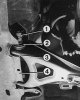
Tie Rod End (4) fixed with a self-locking nut (1) in steering pivot (2). Sealing collar (3) should be regularly checked for cracks. A hinge is located on both sides between the tie rod and the steering knuckle tie rod...
Tie Rod End (4) fixed with a self-locking nut (1) in steering pivot (2). Sealing collar (3) should be regularly checked for cracks. A hinge is located on both sides between the tie rod and the steering knuckle tie rod...
Checking the dust caps
The hinges between the control arm and the steering knuckle are maintenance free. The ball joint is housed in a grease-filled plastic bushing. Dustproof rubber cuffs are used to protect against moisture and dirt. Dirt...
The hinges between the control arm and the steering knuckle are maintenance free. The ball joint is housed in a grease-filled plastic bushing. Dustproof rubber cuffs are used to protect against moisture and dirt. Dirt...
Checking wheel bearing play
An independent suspension wishbone is attached to the chassis on both sides (3), which is fixed in silent blocks (2). Silent blocks are screwed with a self-locking nut (1) to auxiliary frame (4). It is also necessary to...
An independent suspension wishbone is attached to the chassis on both sides (3), which is fixed in silent blocks (2). Silent blocks are screwed with a self-locking nut (1) to auxiliary frame (4). It is also necessary to...
Checking shock absorbers
Degradation of shock absorbers is often difficult to detect due to constantly changing driving conditions. The rule of thumb is that after two sets of tires have worn out, stock shock absorbers are only half as...
Degradation of shock absorbers is often difficult to detect due to constantly changing driving conditions. The rule of thumb is that after two sets of tires have worn out, stock shock absorbers are only half as...
Troubleshooting shock absorbers
Shock absorber Here are some signs that dampers are deteriorating: Vibration of the steering wheel, as the wheels do not have constant contact with the surface. Rocking of the body after moving through the bumps....
Shock absorber Here are some signs that dampers are deteriorating: Vibration of the steering wheel, as the wheels do not have constant contact with the surface. Rocking of the body after moving through the bumps....

Dismantling the front suspension
Sectional front view of the front suspension 1 - upper mount of the shock absorber strut; 2 - helical spring; 3 - shock absorber assembly; 4 - steering swivel support; 5 - thrust of the steering trapezoid with a sealing...
Sectional front view of the front suspension 1 - upper mount of the shock absorber strut; 2 - helical spring; 3 - shock absorber assembly; 4 - steering swivel support; 5 - thrust of the steering trapezoid with a sealing...

Rear axle disassembly
Renault 19 rear suspension elements with four torsion bars 1 - V-profile transverse beam; 2 - trailing arm suspension (welded to cross beam); 3 - fastening of the longitudinal suspension arm; 4 - transverse stabilizer;...
Renault 19 rear suspension elements with four torsion bars 1 - V-profile transverse beam; 2 - trailing arm suspension (welded to cross beam); 3 - fastening of the longitudinal suspension arm; 4 - transverse stabilizer;...
This section is available on: russian, bulgarian, belarusian, ukrainian, serbian, croatian, romanian, polish, slovak, hungarian
Other sections on other Renault models
➽ Chassis, running gear: Car suspension Renault Kangoo 1 (1997-2007)
➽ Chassis, running gear: Car suspension Renault Laguna 2 (2001-2007)
➽ Chassis, running gear: Suspension and wheels Renault Logan 2 (2012-2020)
➽ Chassis, running gear: Car suspension Renault Megane 1 (1995-2002)
➽ Chassis, running gear: Car suspension Renault Scenic 1 (1996-2003)
➽ Chassis, running gear: Car suspension Renault Symbol 1 (1999-2008, petrol)
Link to this section in different formats
TEXTHTMLBB Code
- General information
- Maintenance
- Power unit
- Engine repair
- Exhaust system
- Cooling system
- Supply system
- Single-point injection
- Multi-point injection
- Diesel injection system
- Transmission
- Clutch
- Car gearbox
- Chassis, running gear
- Car suspension
- Steering
- Brake system
- Wheels and tires
- Body and interior
- Exterior (external elements)
- Interior (internal elements)
- Heating and ventilation
- Electrical equipment
- Equipment and devices
- Headlights and lighting
- Ignition system
- Power devices
- Electrical circuits
- General information
- Introduction to the guide
- Troubleshooting
- Power unit
- Engine repair
- Cooling system
- Carburetor fuel system
- Injection fuel system
- Diesel fuel system
- Ignition system
- Transmission
- Clutch
- Car gearbox
- Drive shafts
- Chassis, running gear
- Brake system
- Steering
- Front suspension
- Rear suspension
- Body and interior
- Exterior (external elements)
- Interior (internal elements)
- Doors, locks and windows
- Electrical equipment
- Equipment and devices
- Electrical circuits
- General information
- Introduction to the manual
- User manual
- Power unit
- Petrol engines F3R
- Petrol engines Z7X
- Diesel engines G8T
- Diesel engines G9T
- Transmission
- Clutch
- Mechanical gearbox
- Automatic gearbox
- Drive shafts
- Chassis, running gear
- Steering
- Front suspension
- Rear suspension
- Brake system
- Body and interior
- Exterior (external elements)
- Interior (internal elements)
- Doors, locks and windows
- Heating and ventilation
- Electrical equipment
- Equipment and instruments
- Power devices
- Electrical circuits
RenaultBook.ru © 2018–2024 | Mobile version | News and articles | Sitemap: EN BG BY UA RS HR RO PL SK HU | Administration | Site search | Bookmark
Duster 1 (2009-2017) | Fluence 1 (2009-2020, petrol) | Kangoo 1 (1997-2007) | Laguna 2 (2001-2007) | Logan 1 (2004-2012, petrol) | Logan 2 (2012-2020) | Megane 1 (1995-2002) | Megan 2 (2002-2009, petrol) | Scenic 1 (1996-2003) | Symbol 1 (1999-2008, petrol) | Symbol 2 (2008-2013, petrol) | Renault 19 (1988-1996) | Espace I and II (1984-1996) | Espace III (1996-2002) |