



Share with friends:
Car front suspension Renault Espace 3

Front suspension — general information
The suspension is the connecting link between the body and the wheels. Through it, the forces acting on the wheels are transmitted to the body. The elements included in the suspension soften dynamic loads, reduce body...
The suspension is the connecting link between the body and the wheels. Through it, the forces acting on the wheels are transmitted to the body. The elements included in the suspension soften dynamic loads, reduce body...

Front suspension — technical data
Springs Cylindrical spiral spring. Deflection when applying a force of 100 kg, mm: cars with petrol engines 20.5 diesel cars 19 Anti-roll bar The anti-roll bar, which is a suitably bent rod, is made of spring steel and...
Springs Cylindrical spiral spring. Deflection when applying a force of 100 kg, mm: cars with petrol engines 20.5 diesel cars 19 Anti-roll bar The anti-roll bar, which is a suitably bent rod, is made of spring steel and...
Shock absorber strut
Note: When installing on the same axle of the vehicle, it is necessary to use springs and shock absorbers with the same technical characteristics. If it is necessary to replace one spring or shock absorber, the second...
Note: When installing on the same axle of the vehicle, it is necessary to use springs and shock absorbers with the same technical characteristics. If it is necessary to replace one spring or shock absorber, the second...

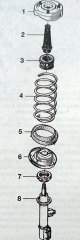
Spring and shock absorber
Fig. 10.1. Steering knuckle fastening elements: 1 - bolts for fastening the lower part of the shock absorber strut; 2 - tie rod end ball joint fastening; 3 - lower arm ball joint mount; 4 - steering knuckle; 5 - lower...
Fig. 10.1. Steering knuckle fastening elements: 1 - bolts for fastening the lower part of the shock absorber strut; 2 - tie rod end ball joint fastening; 3 - lower arm ball joint mount; 4 - steering knuckle; 5 - lower...
Lower control arm of the front suspension
Removal Remove the wheel. Using the Tav 476 puller, disconnect the steering tie rod end from the steering knuckle (Fig. 10.7). Remove the front right floating brake caliper bracket and secure it to the suspension spring...
Removal Remove the wheel. Using the Tav 476 puller, disconnect the steering tie rod end from the steering knuckle (Fig. 10.7). Remove the front right floating brake caliper bracket and secure it to the suspension spring...

Replacing the silent block of the lower arm
Remove the front lower suspension arm. Attention. When replacing the silent block, it is necessary to maintain the lower arm of the front suspension in a position in which the ball joint journal is directed strictly...
Remove the front lower suspension arm. Attention. When replacing the silent block, it is necessary to maintain the lower arm of the front suspension in a position in which the ball joint journal is directed strictly...
Replacing the lower arm ball joint
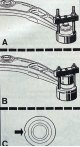
Attention The ball joint can only be replaced once, after which the lower control arm of the front suspension must be replaced. Ball joints supplied as spare parts have an identification notch (cutout on the supporting...
Attention The ball joint can only be replaced once, after which the lower control arm of the front suspension must be replaced. Ball joints supplied as spare parts have an identification notch (cutout on the supporting...

Front wheel hub and bearing
Note: Since considerable force is required to press in the outer race of the hub bearing, if this race has been removed, the entire bearing must be replaced, as the bearing race will be damaged. Removal Disconnect the...
Note: Since considerable force is required to press in the outer race of the hub bearing, if this race has been removed, the entire bearing must be replaced, as the bearing race will be damaged. Removal Disconnect the...

Anti-roll bar
Removal Place the vehicle on a 4-post lift. Remove three bolts (1, Fig. 10.24) fastenings of the sub-engine frame reinforcement, loosen the bolt (2) and turn the reinforcement. Fig. 10.24. Location of bolts (1 and 2)...
Removal Place the vehicle on a 4-post lift. Remove three bolts (1, Fig. 10.24) fastenings of the sub-engine frame reinforcement, loosen the bolt (2) and turn the reinforcement. Fig. 10.24. Location of bolts (1 and 2)...

Sub-engine frame
Removal Disconnect the cable from the negative battery terminal. On vehicles with Z and G engines, remove the exhaust downpipe and disconnect the torque rod On vehicles with F engines, disconnect the torque rod, move...
Removal Disconnect the cable from the negative battery terminal. On vehicles with Z and G engines, remove the exhaust downpipe and disconnect the torque rod On vehicles with F engines, disconnect the torque rod, move...
Bottom of the body checkpoints
The height of the underbody checkpoints is measured on an unladen vehicle standing on a level horizontal surface with a full fuel tank and normal air pressure in the tires.
The height of the underbody checkpoints is measured on an unladen vehicle standing on a level horizontal surface with a full fuel tank and normal air pressure in the tires.
Influence of front wheel alignment angles
Front wheel alignment angles affect vehicle stability on the road and tire wear. Collapse Comparison of the camber angles of the right and left wheels is important. The presence of a difference between the two sides of...
Front wheel alignment angles affect vehicle stability on the road and tire wear. Collapse Comparison of the camber angles of the right and left wheels is important. The presence of a difference between the two sides of...

Principle of checking the front wheel alignment angles
Preliminary checks Before checking the wheel alignment angles, you must do the following: check the condition and size of the tires, tire pressure and degree of wear; check the condition of the hinge joints, silent...
Preliminary checks Before checking the wheel alignment angles, you must do the following: check the condition and size of the tires, tire pressure and degree of wear; check the condition of the hinge joints, silent...
Checking and adjusting the front wheel alignment angles
Wheel alignment is an important parameter when operating a vehicle and has a significant impact on vehicle stability, tire wear and fuel consumption. Due to the design of the front suspension, one of the angles changes...
Wheel alignment is an important parameter when operating a vehicle and has a significant impact on vehicle stability, tire wear and fuel consumption. Due to the design of the front suspension, one of the angles changes...

Front suspension diagnostics
Malfunction Possible reasons Incorrect angle of the longitudinal tilt of the wheel rotation axis The suspension arm is deformed The side member or subframe is deformed the "turn-on angle" is correct, but the camber and...
Malfunction Possible reasons Incorrect angle of the longitudinal tilt of the wheel rotation axis The suspension arm is deformed The side member or subframe is deformed the "turn-on angle" is correct, but the camber and...
This section is available on: russian, bulgarian, belarusian, ukrainian, serbian, croatian, romanian, polish, slovak, hungarian
Other sections on other Renault models
➽ Chassis, running gear: Front suspension Renault Symbol 2 (2008-2013, petrol)
➽ Chassis, running gear: Front suspension Renault Fluence 1 (2009-2020, petrol)
➽ Chassis, running gear: Front suspension Renault Sandero 1 (2007-2012, petrol)
➽ Chassis, running gear: Front suspension Renault Logan 1 (2004-2012, petrol)
Link to this section in different formats
TEXTHTMLBB Code
- General information
- Maintenance
- Power unit
- Engine repair
- Exhaust system
- Cooling system
- Supply system
- Single-point injection
- Multi-point injection
- Diesel injection system
- Transmission
- Clutch
- Car gearbox
- Chassis, running gear
- Car suspension
- Steering
- Brake system
- Wheels and tires
- Body and interior
- Exterior (external elements)
- Interior (internal elements)
- Heating and ventilation
- Electrical equipment
- Equipment and devices
- Headlights and lighting
- Ignition system
- Power devices
- Electrical circuits
- General information
- Introduction to the guide
- Troubleshooting
- Power unit
- Engine repair
- Cooling system
- Carburetor fuel system
- Injection fuel system
- Diesel fuel system
- Ignition system
- Transmission
- Clutch
- Car gearbox
- Drive shafts
- Chassis, running gear
- Brake system
- Steering
- Front suspension
- Rear suspension
- Body and interior
- Exterior (external elements)
- Interior (internal elements)
- Doors, locks and windows
- Electrical equipment
- Equipment and devices
- Electrical circuits
- General information
- Introduction to the manual
- User manual
- Power unit
- Petrol engines F3R
- Petrol engines Z7X
- Diesel engines G8T
- Diesel engines G9T
- Transmission
- Clutch
- Mechanical gearbox
- Automatic gearbox
- Drive shafts
- Chassis, running gear
- Steering
- Front suspension
- Rear suspension
- Brake system
- Body and interior
- Exterior (external elements)
- Interior (internal elements)
- Doors, locks and windows
- Heating and ventilation
- Electrical equipment
- Equipment and instruments
- Power devices
- Electrical circuits