
English Русский
Български
Беларускі
Український
Српски
Hrvatski
Română
Polski
Slovenský
Magyar
Bookmark Contacts Articles Sitemap
Company vehicles Peugeot Company vehicles Opel Company vehicles Skoda Company vehicles Land Rover Company vehicles Mitsubishi Company vehicles Volkswagen Company vehicles Honda
RenaultBook.ru


Duster   Fluence   Kangoo   Laguna   Logan   Megane   Sandero   Scenic   Symbol   Clio   Other
Renault 19 (1988-1996) Espace I and II (1984-1996) Espace III (1996-2002)

Lower control arm of the front suspension (Renault Espace III)

  • Main
  • Renault
  • Espace III (1996-2002)
  • Chassis, running gear
  • Front suspension
  • Lower control arm of the front suspension
0

Removal


  • Remove the wheel.
  • Using the Tav 476 puller, disconnect the steering tie rod end from the steering knuckle (Fig. 10.7).
  • Remove the front right floating brake caliper bracket and secure it to the suspension spring to protect the brake hose from damage.
  • Install the protective cover onto the corrugated protective boot of the outer joint of the drive shaft.
  • Loosen the lower ball joint pin nut as much as possible and use a ball joint impact remover to press the joint out of the steering knuckle.
  • Loosen the bolts securing the shock absorber strut to the steering knuckle.
  • Disconnect the steering knuckle from the shock absorber strut, being careful not to damage the suspension arm ball joint boot.
  • Move the steering knuckle assembly with the drive shaft to the side and hang it from the body using soft wire.
  • Loosen the two mounting bolts (A, Fig. 10.9) and (B) the suspension arm on the subframe and remove it. To loosen the bolt (A), use a 12-point 22 mm socket.
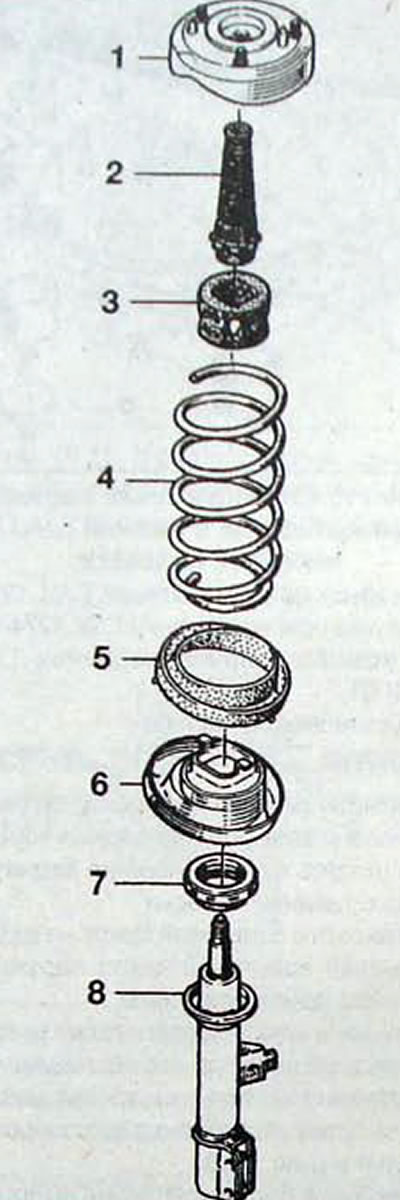
Fig. 10.6. Elements of the front suspension shock absorber strut: 1 - upper spring plate; 2 -…

Fig. 10.6. Elements of the front suspension shock absorber strut: 1 - upper spring plate; 2 - corrugated protective cover; 3 - spring; 4 - damper; 5 - elastic support; 6 - lower spring support; 7 - bearing; 8 - shock absorber
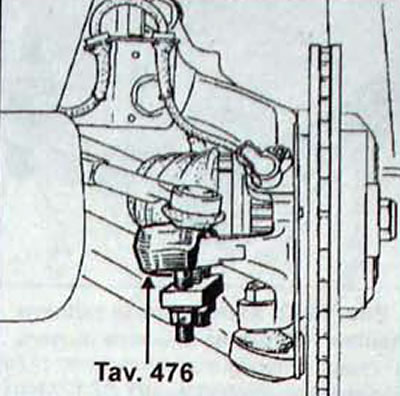


Fig. 10.7. Using the Tav. 476 puller to disconnect the tie rod end from the steering knuckle
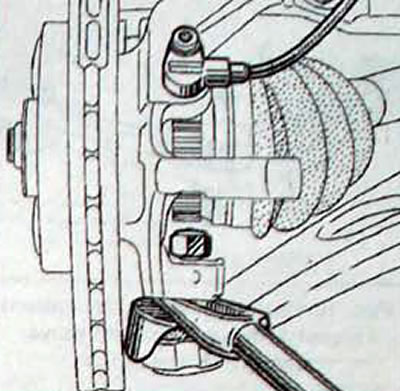
Fig. 10.7. Using the Tav. 476 puller to disconnect the tie rod end from the steering knuckle


Fig. 10.8. Using an impact puller to press out the lower ball joint
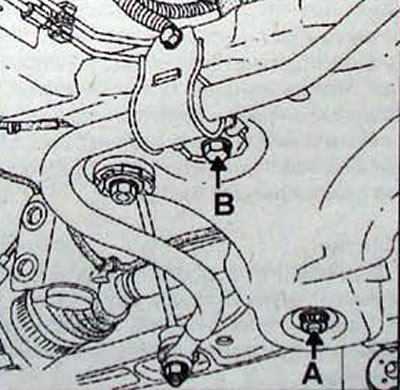
Fig. 10.8. Using an impact puller to press out the lower ball joint


Fig. 10.9. Location of bolts and nuts (A and B) for fastening the lower arm of the front suspension

Fig. 10.9. Location of bolts and nuts (A and B) for fastening the lower arm of the front suspension
This article is available on: russian, bulgarian, belarusian, ukrainian, serbian, croatian, romanian, polish, slovak, hungarian
Article has been reviewed by editor: Trofimova Anastasia
Share with friends:
Previous
Espace III: Front suspension
Next

Spring and shock absorber
Shock absorber strut
Front suspension — technical data
Front suspension — general information
Replacing the silent block of the lower arm
Replacing the lower arm ball joint
Front wheel hub and bearing
Anti-roll bar
Sub-engine frame
Other articles on other Renault models

➽ Lower control arm of the front suspension Renault Duster 1 (2009-2017)
➽ Lower control arm of the front suspension Renault Fluence 1 (2009-2020, petrol)
➽ Lower control arm of the front suspension — removal, overhaul… Renault Clio 1 (1990-1998)
➽ Removal and installation the ball joint of the lower arm of the… Renault Megane 1 (1995-2002)
➽ Height of control points of the lower part of the body Renault Laguna 2 (2001-2007)
Link to this article in different formats
Reviews and comments of visitors
No comments yet


Add two numbers 11 + 11


Renault 19 (1988-1996) 
  • General information
  • Maintenance
  • Power unit
  • Engine repair
  • Exhaust system
  • Cooling system
  • Supply system
  • Single-point injection
  • Multi-point injection
  • Diesel injection system
  • Transmission
  • Clutch
  • Car gearbox
  • Chassis, running gear
  • Car suspension
  • Steering
  • Brake system
  • Wheels and tires
  • Body and interior
  • Exterior (external elements)
  • Interior (internal elements)
  • Heating and ventilation
  • Electrical equipment
  • Equipment and devices
  • Headlights and lighting
  • Ignition system
  • Power devices
  • Electrical circuits
Espace I and II (1984-1996) 
  • General information
  • Introduction to the guide
  • Troubleshooting
  • Power unit
  • Engine repair
  • Cooling system
  • Carburetor fuel system
  • Injection fuel system
  • Diesel fuel system
  • Ignition system
  • Transmission
  • Clutch
  • Car gearbox
  • Drive shafts
  • Chassis, running gear
  • Brake system
  • Steering
  • Front suspension
  • Rear suspension
  • Body and interior
  • Exterior (external elements)
  • Interior (internal elements)
  • Doors, locks and windows
  • Electrical equipment
  • Equipment and devices
  • Electrical circuits
Espace III (1996-2002) 
  • General information
  • Introduction to the manual
  • User manual
  • Power unit
  • Petrol engines F3R
  • Petrol engines Z7X
  • Diesel engines G8T
  • Diesel engines G9T
  • Transmission
  • Clutch
  • Mechanical gearbox
  • Automatic gearbox
  • Drive shafts
  • Chassis, running gear
  • Steering
  • Front suspension
  • Rear suspension
  • Brake system
  • Body and interior
  • Exterior (external elements)
  • Interior (internal elements)
  • Doors, locks and windows
  • Heating and ventilation
  • Electrical equipment
  • Equipment and instruments
  • Power devices
  • Electrical circuits
RenaultBook.ru © 2018–2026 | Mobile version | News and articles | Sitemap: EN BG BY UA RS HR RO PL SK HU | Administration | Site search | Bookmark
Duster 1 (2009-2017) | Fluence 1 (2009-2020, petrol) | Kangoo 1 (1997-2007) | Laguna 2 (2001-2007) | Logan 1 (2004-2012, petrol) | Logan 2 (2012-2020) | Megane 1 (1995-2002) | Megan 2 (2002-2009, petrol) | Sandero 1 (2007-2012, petrol) | Scenic 1 (1996-2003) | Symbol 1 (1999-2008, petrol) | Symbol 2 (2008-2013, petrol) | Renault 19 (1988-1996) | Espace I and II (1984-1996) | Espace III (1996-2002) | Clio 1 (1990-1998) |
We want your visit to be comfortable 😌 and use cookies 🍪 to do so.