Share with friends:

Interior (internal body elements) Renault 19
In the car, due to increased traffic flows and increasing traffic jams, you have to spend more and more time. Therefore, engineers are constantly improving the comfort of the car interior and strive to bring it closer to home comfort. Individual parts and interior trim, however, have reliable and simple attachments and can therefore be easily removed by yourself.
Removal and installation of seats
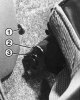
Left: To remove the rear seat backrest, fold down the lever (2), to swivel back (3) got rid of the hinged fingers (1) body. Right: To install the rear seat cushion, hold it upright and insert the guide into the...
Left: To remove the rear seat backrest, fold down the lever (2), to swivel back (3) got rid of the hinged fingers (1) body. Right: To install the rear seat cushion, hold it upright and insert the guide into the...

Removal and installation of facing
To install individual cladding elements, it is necessary to prepare new clamps in advance, as they often break. 1 - lining of the A-pillar; 2 - lining of the B-pillar; 3 - roof lining; 4 - lining of the C-pillar; 5 -...
To install individual cladding elements, it is necessary to prepare new clamps in advance, as they often break. 1 - lining of the A-pillar; 2 - lining of the B-pillar; 3 - roof lining; 4 - lining of the C-pillar; 5 -...

Removing the dashboard and center console
Removing the dashboard Removing the dashboard is a rather complicated job that must be done with great care to avoid damage to the interior. Operation is described in chapter Heating and ventilation . Removing the...
Removing the dashboard Removing the dashboard is a rather complicated job that must be done with great care to avoid damage to the interior. Operation is described in chapter Heating and ventilation . Removing the...

Ceiling and floor covering
The figure shows the most important elements of the car interior. Here you can see that, for example, in order to remove the upholstery of the ceiling, it is necessary to dismantle a number of elements. The same applies...
The figure shows the most important elements of the car interior. Here you can see that, for example, in order to remove the upholstery of the ceiling, it is necessary to dismantle a number of elements. The same applies...

Safety belt
The seat belt system consists of the following elements 1 - conventional seat belt buckle; 2 - seat belt buckle with emergency tensioner; 3 - electrical wire to the emergency tensioner; 4 - seat belt with tensioner and...
The seat belt system consists of the following elements 1 - conventional seat belt buckle; 2 - seat belt buckle with emergency tensioner; 3 - electrical wire to the emergency tensioner; 4 - seat belt with tensioner and...

Emergency belt tensioner
In a frontal impact, the seat belt buckle is instantly pulled back by about 70 mm. To do this, the sensor actuates a small gas generator and the gas released from it presses the piston on the seat belt into the cylinder...
In a frontal impact, the seat belt buckle is instantly pulled back by about 70 mm. To do this, the sensor actuates a small gas generator and the gas released from it presses the piston on the seat belt into the cylinder...
This section is available on: russian, bulgarian, belarusian, ukrainian, serbian, croatian, romanian, polish, slovak, hungarian
Other sections on other Renault models
➽ Body and interior: Interior (internal elements) Renault Duster 1 (2009-2017)
➽ Body and interior: Interior (internal elements) Renault Fluence 1 (2009-2020, petrol)
➽ Body and interior: Interior (internal elements) Renault Logan 1 (2004-2012, petrol)
➽ Body and interior: Interior (internal elements) Renault Megane 1 (1995-2002)
➽ Body and interior: Interior (internal elements) Renault Scenic 1 (1996-2003)
➽ Body and interior: Interior (internal elements) Renault Symbol 1 (1999-2008, petrol)
Link to this section in different formats
TEXTHTMLBB Code
- General information
- Maintenance
- Power unit
- Engine repair
- Exhaust system
- Cooling system
- Supply system
- Single-point injection
- Multi-point injection
- Diesel injection system
- Transmission
- Clutch
- Car gearbox
- Chassis, running gear
- Car suspension
- Steering
- Brake system
- Wheels and tires
- Body and interior
- Exterior (external elements)
- Interior (internal elements)
- Heating and ventilation
- Electrical equipment
- Equipment and devices
- Headlights and lighting
- Ignition system
- Power devices
- Electrical circuits
- General information
- Introduction to the guide
- Troubleshooting
- Power unit
- Engine repair
- Cooling system
- Carburetor fuel system
- Injection fuel system
- Diesel fuel system
- Ignition system
- Transmission
- Clutch
- Car gearbox
- Drive shafts
- Chassis, running gear
- Brake system
- Steering
- Front suspension
- Rear suspension
- Body and interior
- Exterior (external elements)
- Interior (internal elements)
- Doors, locks and windows
- Electrical equipment
- Equipment and devices
- Electrical circuits
- General information
- Introduction to the manual
- User manual
- Power unit
- Petrol engines F3R
- Petrol engines Z7X
- Diesel engines G8T
- Diesel engines G9T
- Transmission
- Clutch
- Mechanical gearbox
- Automatic gearbox
- Drive shafts
- Chassis, running gear
- Steering
- Front suspension
- Rear suspension
- Brake system
- Body and interior
- Exterior (external elements)
- Interior (internal elements)
- Doors, locks and windows
- Heating and ventilation
- Electrical equipment
- Equipment and instruments
- Power devices
- Electrical circuits
RenaultBook.ru © 2018–2024 | Mobile version | News and articles | Sitemap: EN BG BY UA RS HR RO PL SK HU | Administration | Site search | Bookmark
Duster 1 (2009-2017) | Fluence 1 (2009-2020, petrol) | Kangoo 1 (1997-2007) | Laguna 2 (2001-2007) | Logan 1 (2004-2012, petrol) | Logan 2 (2012-2020) | Megane 1 (1995-2002) | Megan 2 (2002-2009, petrol) | Scenic 1 (1996-2003) | Symbol 1 (1999-2008, petrol) | Symbol 2 (2008-2013, petrol) | Renault 19 (1988-1996) | Espace I and II (1984-1996) | Espace III (1996-2002) |