Share with friends:
Car engine cooling system Renault 19
For efficient engine operation and long service life, maintaining a high operating temperature in certain engine components is of utmost importance. Thus, the concept of "water" in the cooling system has long been replaced by the term "coolant" due to the high requirements placed on the physical properties of this fluid. The coolant is driven by a pump, circulates through the cooling system hoses and engine channels, providing heat removal.

How is engine cooling
The coolant pump, driven by a V-belt, continuously pumps coolant into the cooling system. When the engine is cold, the thermostat blocks access to the radiator, and the circulation of the coolant is limited by the...
The coolant pump, driven by a V-belt, continuously pumps coolant into the cooling system. When the engine is cold, the thermostat blocks access to the radiator, and the circulation of the coolant is limited by the...

Pressurized cooling system
In order for the coolant to be able to remove more heat, it is in a pressurized cooling system. This raises the boiling point of the liquid from 100°C to about 120°C. Increasing the boiling point increases the...
In order for the coolant to be able to remove more heat, it is in a pressurized cooling system. This raises the boiling point of the liquid from 100°C to about 120°C. Increasing the boiling point increases the...

Checking the coolant level
Check the coolant level only when the engine is cold and top up if necessary. On a cold engine, the cooling system is without pressure. The hotter the engine, the more careful you must be when opening the expansion tank...
Check the coolant level only when the engine is cold and top up if necessary. On a cold engine, the cooling system is without pressure. The hotter the engine, the more careful you must be when opening the expansion tank...
Antifreeze additive
Your car's cooling system contains not just pure water, but a mixture of anti-freeze and anti-corrosion agents mixed with water. Therefore, the term is usually used «coolant». The mixture that is poured into the Renault...
Your car's cooling system contains not just pure water, but a mixture of anti-freeze and anti-corrosion agents mixed with water. Therefore, the term is usually used «coolant». The mixture that is poured into the Renault...
Coolant Density Check
You will need a hydrometer to check the density of the coolant. Antifreeze additive concentration correction It often happens that due to the addition of water to the cooling system, the concentration of antifreeze...
You will need a hydrometer to check the density of the coolant. Antifreeze additive concentration correction It often happens that due to the addition of water to the cooling system, the concentration of antifreeze...
Checking the cooling system for leaks
Are the hoses on the radiator, engine and heating system sealed? Are the hoses cracked? Bending the hoses with your fingers, check if they are stiff and brittle - if so, replace them. Are the hoses firmly attached to...
Are the hoses on the radiator, engine and heating system sealed? Are the hoses cracked? Bending the hoses with your fingers, check if they are stiff and brittle - if so, replace them. Are the hoses firmly attached to...

Radiator — construction and cleaning
The radiator fixed on the transverse beam consists of two tanks, between which there are many thin-walled tubes connected to each other by means of a large number of cooling plates. As a result, the cooling surface has...
The radiator fixed on the transverse beam consists of two tanks, between which there are many thin-walled tubes connected to each other by means of a large number of cooling plates. As a result, the cooling surface has...

Coolant replacement
Only if from the cooling system (pictured 1.4 liter engine) air is completely removed through air separators (shown by arrows), the cooling system will work without overheating. Depending on the Renault 19 modification,...
Only if from the cooling system (pictured 1.4 liter engine) air is completely removed through air separators (shown by arrows), the cooling system will work without overheating. Depending on the Renault 19 modification,...
Removal and installation of a radiator
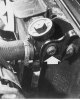
To remove the radiator (left engine type «WITH», right engine type «F») it is necessary to unscrew both mounting bolts on the left and right and remove it from the rubber supports (shown by arrows). First you need to...
To remove the radiator (left engine type «WITH», right engine type «F») it is necessary to unscrew both mounting bolts on the left and right and remove it from the rubber supports (shown by arrows). First you need to...
Expansion tank cap
Since the cooling system works under pressure, the expansion tank cap plays an important role: A gasket with a screwed cap does not allow the pressure in the system to decrease. If the pressure in the cooling system...
Since the cooling system works under pressure, the expansion tank cap plays an important role: A gasket with a screwed cap does not allow the pressure in the system to decrease. If the pressure in the cooling system...
Thermostat — description of the principle of operation
Small and large circle of coolant circulation In order for the engine to warm up to operating temperature faster, the cooling system is divided into a small and a large circle of coolant circulation. After starting a...
Small and large circle of coolant circulation In order for the engine to warm up to operating temperature faster, the cooling system is divided into a small and a large circle of coolant circulation. After starting a...
Troubleshooting the thermostat
Symptom Reason / Features A. The temperature, according to the readings of the device, slowly increases, the operating temperature is reached very slowly, the heating is weak. Thermostat valve poppet stuck open (for...
Symptom Reason / Features A. The temperature, according to the readings of the device, slowly increases, the operating temperature is reached very slowly, the heating is weak. Thermostat valve poppet stuck open (for...

Removal, check and installation of the thermostat
Removal and installation On the road, it is difficult to remove the thermostat, since it is necessary to completely drain the coolant. In addition, with a hot engine, this process takes a very long time, since it is...
Removal and installation On the road, it is difficult to remove the thermostat, since it is necessary to completely drain the coolant. In addition, with a hot engine, this process takes a very long time, since it is...
Coolant pump — removal and installation
The coolant is driven by a centrifugal pump - which keeps the cooling system circulating. Engine coolant pump type «WITH» and on the engine type «F» driven by a V-belt. The coolant pump is maintenance free. However, it...
The coolant is driven by a centrifugal pump - which keeps the cooling system circulating. Engine coolant pump type «WITH» and on the engine type «F» driven by a V-belt. The coolant pump is maintenance free. However, it...
Checking the tension of the V-belt
Since the coolant pump on the engine type «WITH» and on all engines «F» is driven by a V-belt, maintenance of the cooling system also includes checking the tension of the V-belt. Description of this work can be found in...
Since the coolant pump on the engine type «WITH» and on all engines «F» is driven by a V-belt, maintenance of the cooling system also includes checking the tension of the V-belt. Description of this work can be found in...

Engine cooling system fan
All Renault l9 modifications have an electric engine cooling fan, which turns on only when necessary. This saves engine power. A thermal switch is installed in the right radiator tank, which turns on the engine cooling...
All Renault l9 modifications have an electric engine cooling fan, which turns on only when necessary. This saves engine power. A thermal switch is installed in the right radiator tank, which turns on the engine cooling...
Additional electric coolant pump
Are established on the 16-valve engine and the diesel engine. When the engine stops running, the circulation of the coolant also stops, which can lead to local overheating of the cylinder head. This is avoided by an...
Are established on the 16-valve engine and the diesel engine. When the engine stops running, the circulation of the coolant also stops, which can lead to local overheating of the cylinder head. This is avoided by an...
Possible malfunctions and their elimination
Cooling system Malfunction Her reason Debugg A. Temperature gauge pointer (depending on modification) is in the shaded area or the coolant temperature warning lamp is on. 1. V-belt is too tight or broken. 2. Not enough...
Cooling system Malfunction Her reason Debugg A. Temperature gauge pointer (depending on modification) is in the shaded area or the coolant temperature warning lamp is on. 1. V-belt is too tight or broken. 2. Not enough...
This section is available on: russian, bulgarian, belarusian, ukrainian, serbian, croatian, romanian, polish, slovak, hungarian
Other sections on other Renault models
➽ Power unit: Cooling system Renault Duster 1 (2009-2017)
➽ Power unit: Cooling and lubrication system Renault Fluence 1 (2009-2020, petrol)
➽ Power unit: Cooling system Renault Laguna 2 (2001-2007)
➽ Power unit: Cooling system Renault Logan 2 (2012-2020)
➽ Power unit: Cooling system Renault Megan 2 (2002-2009, petrol)
➽ Power unit: Cooling and ventilation Renault Scenic 1 (1996-2003)
➽ Power unit: Cooling system Renault Symbol 2 (2008-2013, petrol)
Link to this section in different formats
TEXTHTMLBB Code
- General information
- Maintenance
- Power unit
- Engine repair
- Exhaust system
- Cooling system
- Supply system
- Single-point injection
- Multi-point injection
- Diesel injection system
- Transmission
- Clutch
- Car gearbox
- Chassis, running gear
- Car suspension
- Steering
- Brake system
- Wheels and tires
- Body and interior
- Exterior (external elements)
- Interior (internal elements)
- Heating and ventilation
- Electrical equipment
- Equipment and devices
- Headlights and lighting
- Ignition system
- Power devices
- Electrical circuits
- General information
- Introduction to the guide
- Troubleshooting
- Power unit
- Engine repair
- Cooling system
- Carburetor fuel system
- Injection fuel system
- Diesel fuel system
- Ignition system
- Transmission
- Clutch
- Car gearbox
- Drive shafts
- Chassis, running gear
- Brake system
- Steering
- Front suspension
- Rear suspension
- Body and interior
- Exterior (external elements)
- Interior (internal elements)
- Doors, locks and windows
- Electrical equipment
- Equipment and devices
- Electrical circuits
- General information
- Introduction to the manual
- User manual
- Power unit
- Petrol engines F3R
- Petrol engines Z7X
- Diesel engines G8T
- Diesel engines G9T
- Transmission
- Clutch
- Mechanical gearbox
- Automatic gearbox
- Drive shafts
- Chassis, running gear
- Steering
- Front suspension
- Rear suspension
- Brake system
- Body and interior
- Exterior (external elements)
- Interior (internal elements)
- Doors, locks and windows
- Heating and ventilation
- Electrical equipment
- Equipment and instruments
- Power devices
- Electrical circuits
RenaultBook.ru © 2018–2024 | Mobile version | News and articles | Sitemap: EN BG BY UA RS HR RO PL SK HU | Administration | Site search | Bookmark
Duster 1 (2009-2017) | Fluence 1 (2009-2020, petrol) | Kangoo 1 (1997-2007) | Laguna 2 (2001-2007) | Logan 1 (2004-2012, petrol) | Logan 2 (2012-2020) | Megane 1 (1995-2002) | Megan 2 (2002-2009, petrol) | Scenic 1 (1996-2003) | Symbol 1 (1999-2008, petrol) | Symbol 2 (2008-2013, petrol) | Renault 19 (1988-1996) | Espace I and II (1984-1996) | Espace III (1996-2002) |