
English Русский
Български
Беларускі
Український
Српски
Hrvatski
Română
Polski
Slovenský
Magyar
Bookmark Contacts Articles Sitemap
Company vehicles Peugeot Company vehicles Opel Company vehicles Skoda Company vehicles Land Rover Company vehicles Mitsubishi Company vehicles Volkswagen Company vehicles Honda
RenaultBook.ru


Duster   Fluence   Kangoo   Laguna   Logan   Megane   Sandero   Scenic   Symbol   Clio   Other
Renault 19 (1988-1996) Espace I and II (1984-1996) Espace III (1996-2002)

Radiator — design and cleaning (Renault 19)

  • Main
  • Renault
  • Renault 19 (1988-1996)
  • Power unit
  • Cooling system
  • Radiator — design and cleaning
0
The radiator, mounted on a cross beam, consists of two tanks, between which are located a multitude of thin-walled tubes, connected to each other by a large number of cooling plates. As a result, the cooling surface has a significant size.

The picture shows the radiator of a 1.4-liter engine. You can see the cooling fins of the radiator, the space between which must be cleaned after the summer (from insects) and autumn (from foliage).
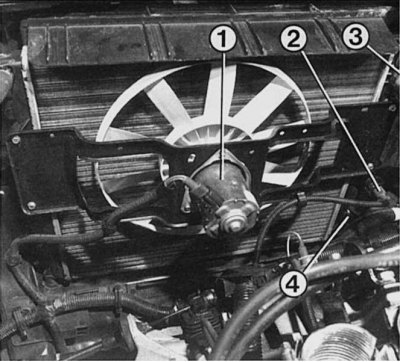
1 - engine cooling system fan; 2 - thermal switch of the engine cooling system fan; 3 - Upper…

1 - engine cooling system fan; 2 - thermal switch of the engine cooling system fan; 3 - Upper radiator hose; 4 - lower radiator hose.


Radiator cleaning


The radiator is very susceptible to small foreign bodies, such as insect remains, getting between the cooling fins. A large number of foreign bodies getting into the radiator will have a negative effect on its operation. Therefore, if necessary, clean the radiator with compressed air or a stream of water in the direction from the engine outwards.
  • Treat dried insect remains with a protein dissolving agent.
  • After dissolving the residue, rinse the radiator in the direction from the engine outwards. Do not clean the radiator with a hard brush or sharp objects, as this may damage the radiator fins.
  • It is not necessary to use special cleaning agents for internal cleaning of the radiator if the coolant contains antifreeze and anti-corrosion additives.
  • Once every 5 years, remove the hoses from the radiator and engine and flush the radiator with pressurized water.


View the original on the specified resource [RENAULTBOOK.ru]
This article is available on: russian, bulgarian, belarusian, ukrainian, serbian, croatian, romanian, polish, slovak, hungarian
Article has been reviewed by editor: Trofimova Anastasia
Share with friends:
Previous
19: Cooling system
Next

Checking the cooling system for leaks
Checking the density of the coolant
Antifreeze additive
Checking the coolant level
Pressurized cooling system
Replacing the coolant
Removal and installation the radiator
Expansion tank cap
Thermostat — description of the operating principle
Troubleshooting a Thermostat
Other articles on other Renault models

➽ Radiator — removal, inspection, cleaning and installation Renault Clio 1 (1990-1998)
➽ Radiator of the cooling system (engine K4M) Renault Duster 1 (2009-2017)
➽ Cleaning the cylinder head of the K4M engine Renault Fluence 1 (2009-2020, petrol)
➽ Heater radiator Renault Kangoo 1 (1997-2007)
➽ Cleaning the cylinder head Renault Laguna 2 (2001-2007)
Link to this article in different formats
Reviews and comments of visitors
No comments yet


Add two numbers 48 + 22


Renault 19 (1988-1996) 
  • General information
  • Maintenance
  • Power unit
  • Engine repair
  • Exhaust system
  • Cooling system
  • Supply system
  • Single-point injection
  • Multi-point injection
  • Diesel injection system
  • Transmission
  • Clutch
  • Car gearbox
  • Chassis, running gear
  • Car suspension
  • Steering
  • Brake system
  • Wheels and tires
  • Body and interior
  • Exterior (external elements)
  • Interior (internal elements)
  • Heating and ventilation
  • Electrical equipment
  • Equipment and devices
  • Headlights and lighting
  • Ignition system
  • Power devices
  • Electrical circuits
Espace I and II (1984-1996) 
  • General information
  • Introduction to the guide
  • Troubleshooting
  • Power unit
  • Engine repair
  • Cooling system
  • Carburetor fuel system
  • Injection fuel system
  • Diesel fuel system
  • Ignition system
  • Transmission
  • Clutch
  • Car gearbox
  • Drive shafts
  • Chassis, running gear
  • Brake system
  • Steering
  • Front suspension
  • Rear suspension
  • Body and interior
  • Exterior (external elements)
  • Interior (internal elements)
  • Doors, locks and windows
  • Electrical equipment
  • Equipment and devices
  • Electrical circuits
Espace III (1996-2002) 
  • General information
  • Introduction to the manual
  • User manual
  • Power unit
  • Petrol engines F3R
  • Petrol engines Z7X
  • Diesel engines G8T
  • Diesel engines G9T
  • Transmission
  • Clutch
  • Mechanical gearbox
  • Automatic gearbox
  • Drive shafts
  • Chassis, running gear
  • Steering
  • Front suspension
  • Rear suspension
  • Brake system
  • Body and interior
  • Exterior (external elements)
  • Interior (internal elements)
  • Doors, locks and windows
  • Heating and ventilation
  • Electrical equipment
  • Equipment and instruments
  • Power devices
  • Electrical circuits
RenaultBook.ru © 2018–2026 | Mobile version | News and articles | Sitemap: EN BG BY UA RS HR RO PL SK HU | Administration | Site search | Bookmark
Duster 1 (2009-2017) | Fluence 1 (2009-2020, petrol) | Kangoo 1 (1997-2007) | Laguna 2 (2001-2007) | Logan 1 (2004-2012, petrol) | Logan 2 (2012-2020) | Megane 1 (1995-2002) | Megan 2 (2002-2009, petrol) | Sandero 1 (2007-2012, petrol) | Scenic 1 (1996-2003) | Symbol 1 (1999-2008, petrol) | Symbol 2 (2008-2013, petrol) | Renault 19 (1988-1996) | Espace I and II (1984-1996) | Espace III (1996-2002) | Clio 1 (1990-1998) |
We want your visit to be comfortable 😌 and use cookies 🍪 to do so.