
English Русский
Български
Беларускі
Український
Српски
Hrvatski
Română
Polski
Slovenský
Magyar
Bookmark Contacts Articles Sitemap
Company vehicles Peugeot Company vehicles Opel Company vehicles Skoda Company vehicles Land Rover Company vehicles Mitsubishi Company vehicles Volkswagen Company vehicles Honda
RenaultBook.ru


Duster   Fluence   Kangoo   Laguna   Logan   Megane   Sandero   Scenic   Symbol   Clio   Other
Renault 19 (1988-1996) Espace I and II (1984-1996) Espace III (1996-2002)

Engine cooling system fan (Renault 19)

  • Main
  • Renault
  • Renault 19 (1988-1996)
  • Power unit
  • Cooling system
  • Engine cooling system fan
0
Contents: Engine cooling system fan…🠛 Troubleshooting 🠛 Removal the engine cooling fan 🠛
All Renault l9 modifications are equipped with an electric engine cooling fan, which is switched on only when necessary. This saves engine power.

A thermal switch is installed in the right radiator tank, which turns on the engine cooling system fan if the coolant flowing through this tank has a temperature higher than the required one. It also turns off the fan if the coolant temperature drops below a certain value. At the switch-on temperature, the contact in the thermal relay closes the electric circuit of the engine cooling system fan, and it starts working.

Be careful when working in the engine compartment: when the ignition is off and the engine is hot, the fan may turn on by itself. Therefore, when the engine is hot, do not put your hands in the area where the engine cooling system fan is operating!

Note: Recommendation: in order to check whether the engine cooling fan will actually start working on a hot engine, you need to do the following: with the engine already warmed up and idling, watch the coolant temperature readings. The fan should turn on before the instrument needle (depending on modification) enters the shaded area. The overheating indicator lamp should not light up, otherwise there is a high probability that the thermal relay is faulty.


Engine cooling system fan malfunctions


A faulty engine cooling fan can cause the coolant temperature to become too high; this happens when the engine is idling for a long time or when driving in the mountains.


A faulty fan doesn't mean your ride is over:
  • After the engine has cooled down, you can drive to the nearest auto repair shop at medium engine speed and a constant, fairly high speed. At the same time, monitor the coolant temperature and the overheating indicator lamp.
  • Idling and slow driving in this case are dangerous for the engine, since not enough air passes through the radiator fins for cooling.

Troubleshooting


1. Disconnect the dual plug of the thermal relay.

2. Connect both contacts in one of the halves of the double plug with wire.

3. If the fan starts working, then the thermal relay is faulty.

4. To continue the trip, securely fasten the previously inserted piece of wire that closes the contacts.

5. To prevent loose wire from dangling and to avoid short circuit, wrap the double plug connector with adhesive tape.

Removal the engine cooling fan
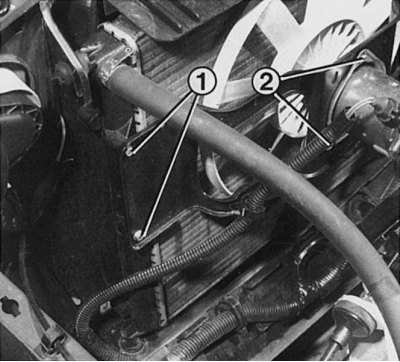


The C-type engine, and some F-type engines, have a free-running fan, with its motor riveted to the…


The C-type engine, and some F-type engines, have a free-running fan, with its motor riveted to the fan holder (2). The fan holder is screwed to the left and right radiator tanks (1).

A more powerful diesel or 16-valve engine fan has a higher quality flat motor that rotates the fan impeller in the air duct.


1. Disconnect the terminal of the battery from the battery and disconnect the plug connection of the wire of the thermal relay and the engine cooling fan.

2. Disconnect the wire from the fan mount holder.

3. To remove, unscrew the two fan motor mounting bolts.

4. Remove the fan motor and holder from the radiator.

5. If the fan motor is riveted to the bracket, drill out the rivets.

6. Fix the fan pulley and unscrew the central nut.

Attention! Attention: left-hand thread!


7. Remove the fan pulley.

8. When installing, use bolts instead of rivets to connect the fan motor to the holder, and treat them with an anti-loosening agent.
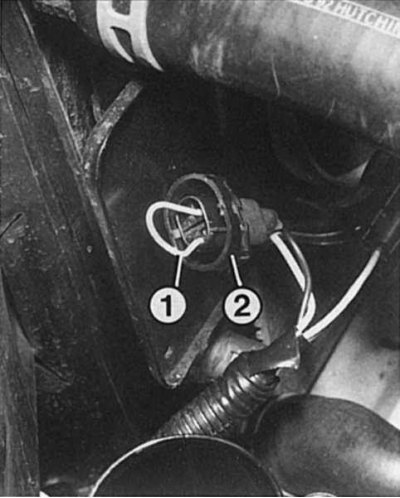
One way to determine the fault, if there is a suspicion of the fan motor, then disconnect the plug…


One way to determine the fault, if there is a suspicion of the fan motor, then disconnect the plug connection (2) of the thermal relay on the radiator and short-circuit both sockets of the plug with wire or a paper clip. The fan should work.
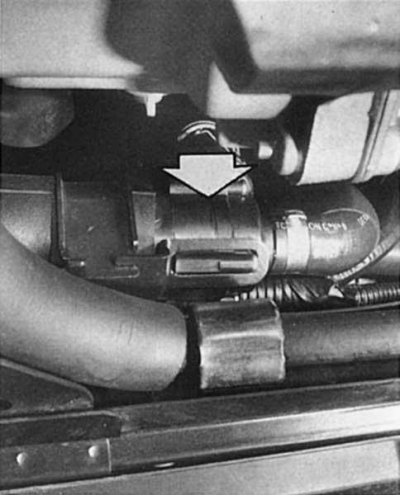
The 16-valve engine is equipped with an additional electric coolant pump (shown by arrow) in the…


The 16-valve engine is equipped with an additional electric coolant pump (shown by arrow) in the cooling system, which after the ignition is turned off continues to circulate the coolant through the cooling system for about 5 minutes. On an overheated engine, the engine cooling system fan also turns on.
This article is available on: russian, bulgarian, belarusian, ukrainian, serbian, croatian, romanian, polish, slovak, hungarian
Article has been reviewed by editor: Trofimova Anastasia
Share with friends:
Previous
19: Cooling system
Next

Checking the V-belt tension
Coolant pump — removal and installation
Removal, checking and installation the thermostat
Troubleshooting a Thermostat
Thermostat — description of the operating principle
Additional electric coolant pump
Possible malfunctions and their elimination
Other articles on other Renault models

➽ Engine cooling system Renault Duster 1 (2009-2017)
➽ Removal the electric fan of the engine cooling system Renault Fluence 1 (2009-2020, petrol)
➽ Removal and installation the electric fan of the engine cooling… Renault Laguna 2 (2001-2007)
➽ Removal and installation of the electric motor of the radiator… Renault Logan 1 (2004-2012, petrol)
➽ Engine cooling system K4M Renault Sandero 1 (2007-2012, petrol)
Link to this article in different formats
Reviews and comments of visitors
No comments yet


Add two numbers 43 + 11


Renault 19 (1988-1996) 
  • General information
  • Maintenance
  • Power unit
  • Engine repair
  • Exhaust system
  • Cooling system
  • Supply system
  • Single-point injection
  • Multi-point injection
  • Diesel injection system
  • Transmission
  • Clutch
  • Car gearbox
  • Chassis, running gear
  • Car suspension
  • Steering
  • Brake system
  • Wheels and tires
  • Body and interior
  • Exterior (external elements)
  • Interior (internal elements)
  • Heating and ventilation
  • Electrical equipment
  • Equipment and devices
  • Headlights and lighting
  • Ignition system
  • Power devices
  • Electrical circuits
Espace I and II (1984-1996) 
  • General information
  • Introduction to the guide
  • Troubleshooting
  • Power unit
  • Engine repair
  • Cooling system
  • Carburetor fuel system
  • Injection fuel system
  • Diesel fuel system
  • Ignition system
  • Transmission
  • Clutch
  • Car gearbox
  • Drive shafts
  • Chassis, running gear
  • Brake system
  • Steering
  • Front suspension
  • Rear suspension
  • Body and interior
  • Exterior (external elements)
  • Interior (internal elements)
  • Doors, locks and windows
  • Electrical equipment
  • Equipment and devices
  • Electrical circuits
Espace III (1996-2002) 
  • General information
  • Introduction to the manual
  • User manual
  • Power unit
  • Petrol engines F3R
  • Petrol engines Z7X
  • Diesel engines G8T
  • Diesel engines G9T
  • Transmission
  • Clutch
  • Mechanical gearbox
  • Automatic gearbox
  • Drive shafts
  • Chassis, running gear
  • Steering
  • Front suspension
  • Rear suspension
  • Brake system
  • Body and interior
  • Exterior (external elements)
  • Interior (internal elements)
  • Doors, locks and windows
  • Heating and ventilation
  • Electrical equipment
  • Equipment and instruments
  • Power devices
  • Electrical circuits
RenaultBook.ru © 2018–2026 | Mobile version | News and articles | Sitemap: EN BG BY UA RS HR RO PL SK HU | Administration | Site search | Bookmark
Duster 1 (2009-2017) | Fluence 1 (2009-2020, petrol) | Kangoo 1 (1997-2007) | Laguna 2 (2001-2007) | Logan 1 (2004-2012, petrol) | Logan 2 (2012-2020) | Megane 1 (1995-2002) | Megan 2 (2002-2009, petrol) | Sandero 1 (2007-2012, petrol) | Scenic 1 (1996-2003) | Symbol 1 (1999-2008, petrol) | Symbol 2 (2008-2013, petrol) | Renault 19 (1988-1996) | Espace I and II (1984-1996) | Espace III (1996-2002) | Clio 1 (1990-1998) |
We want your visit to be comfortable 😌 and use cookies 🍪 to do so.