



The seat belt system consists of the following components:
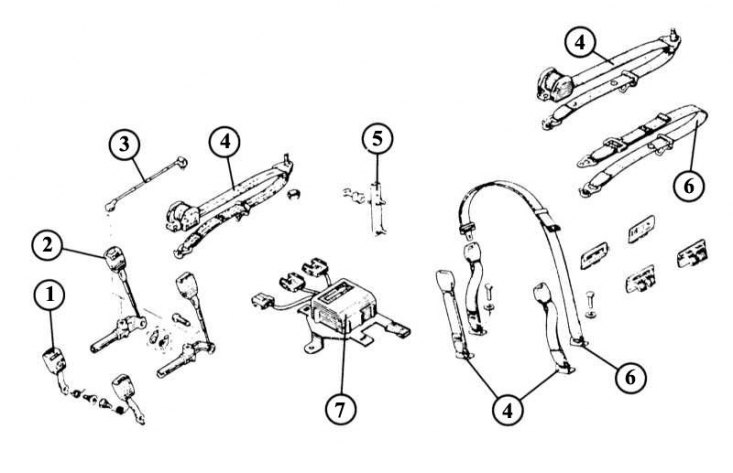
1 - regular seat belt buckle; 2 - seat belt buckle with emergency tensioner; 3 - electrical wire to the emergency tensioner; 4 - seat belt with tensioner and lock; 5 - height regulator; 6 - rear belt with lock; 7 - electronic control device.
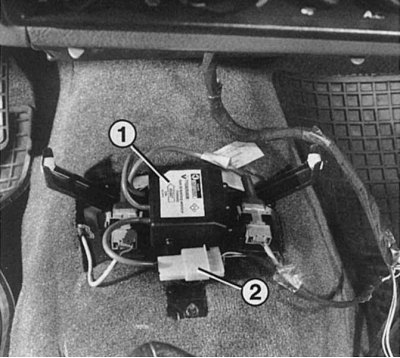
With the central console removed, you can see the control unit (1) for the emergency seat belt tensioner. It is installed with the arrow pointing in the direction of travel so that the pulse sensor can operate in time. The power connector is marked with the number 2.
Checking the operation of the belt
Your life and the lives of your car passengers will depend on the condition of your seat belts in the event of an accident. Therefore, we strongly recommend that you check the operation of your seat belts.
1. Checking the belt tape: pull the belt completely out of the reel.
(View the original source on this resource: www.renaultbook.ru)
2. Wash contaminated areas of the belt with soapy water; under no circumstances should you use chemicals for this purpose!
3. Are there any cut or torn areas on the seat belt?
4. Are there any loops on the belt fabric?
5. Are there any places burned by cigarettes?
6. If the above damage occurred as a result of an accident, replace the seat belt together with the buckle.
7. Stopper action: Try to pull the seat belt sharply out of the automatic retractor.
8. The automatic retractor should prevent the belt from being pulled out too quickly. If this does not happen, replace the seat belt together with the buckle.
9. If the belt does not pull out or return properly, check the automatic winder.
10. When test driving at a speed of about 20 km/h, brake sharply (only on an empty road without cars moving behind you!).
11. If the automatic retractor does not work, replace the seat belt together with the buckle.
12. Seat belt buckle: if there are scratches or chips, replace the seat belt together with the buckle.
13. When you insert the seat belt tongue into the buckle, you should hear a click. Pull the belt firmly to make sure the mechanism is locked.
14. Repeat the test at least 5 times. If the device does not work at least once, replace the seat belt together with the buckle.
16. Unlock: when pressed, the lock mechanism should release the seat belt.
17. The seat belt tongue should pop out of the buckle on its own.
18. Repeat the test at least 5 times. If the device does not work at least once, replace the seat belt together with the buckle.
19. If there is noise or heavy movement, do not apply lubricant under any circumstances!
20. Rotating frame and seat belt tongue: after an accident plastic swivel bearings (due to the load on the belt during the accident) have small parallel grooves. With normal wear, smooth, groove-free wear marks appear.
21. Check the plastic for deformation, chips and scratches. If the above damage is present, replace the belt together with the lock.
22. Attachment points: is the seat belt tongue deformed?
23. Are the mounting points on the seat, on the floor of the car, on the pillars of the passenger compartment damaged, or are the threads damaged?
24. If the damage is present, replace the belt together with the buckle. The attachment points must be repaired in a car repair shop.
25. If damage occurs during operation, you can simply replace the damaged elements.