



Contents: Removal the independent suspension…🠛 Removal the shock absorber strut 🠛 Removal the spring and shock absorber 🠛
Front suspension sectional view
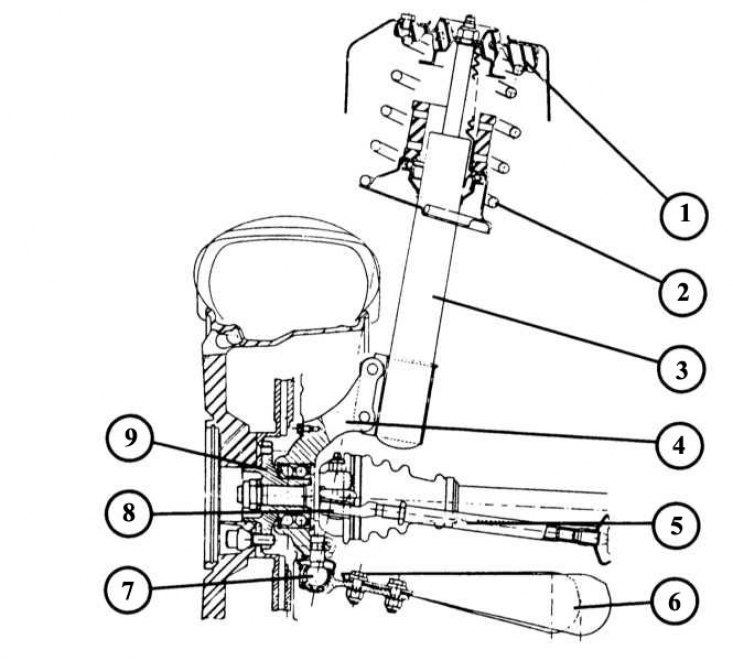
1 - upper shock absorber mount; 2 - coil spring; 3 - shock absorber strut assembly; 4 - steering pivot support; 5 - steering linkage rod with sealing cuff; 6 - independent suspension wishbone; 7 - ball joint of the transverse arm; 8 - tie rod end; 9 - wheel hub.
Many front suspension components can be disassembled and repaired independently. However, for some jobs it is necessary to use devices that are only available in a car repair shop.
Damaged suspension elements cannot be straightened out on your own; they simply need to be replaced.
1. With the vehicle parked on the ground, unscrew the nuts securing the stabilizer to the left and right of the suspension arm.
2. Raise the car from the front and secure it, remove the wheels if necessary.
3. Remove the front exhaust pipe (pants) of the muffler exhaust manifold.
4. Remove the control rod from the gear shift lever by loosening the bolt.
5. Before doing this, mark the position of the control rod relative to the gear shift lever, otherwise you will have to adjust the gear shift device.
6. Loosen both brackets of the holder on the longitudinal beam of the auxiliary frame.
7. Remove the anti-roll bar and disassemble the rubber support.
8. Before installing the rubber support, lubricate it with MoS2.
9. Install the anti-roll bar.
10. First tighten all fasteners by hand.
11. Install the exhaust pipe.
12. Install the control rod onto the gearshift lever and - if its position was not marked during disassembly - adjust if necessary.
13. Lower the vehicle and tighten all fasteners to 35 Nm.
Removal the independent suspension wishbone
1. With the vehicle parked on the ground, unscrew the nuts securing the stabilizer to the left and right of the suspension arm.
2. Raise the front of the vehicle, secure and remove the appropriate wheel.
3. Move the anti-roll bar downwards.
4. Remove the control arm ball joint retaining bolt from the steering knuckle.
5. Press the ball head out of the steering knuckle (if necessary with a puller).
6. Remove 2 bolts and nuts from the engine subframe (mark the sequence of removal!).
7. Remove the wishbone from the holder axle.
8. Always use new self-locking nuts when installing.
9. When the bushings are worn out (silent blocks) they need to be replaced (in the auto repair shop).
10. A deformed wishbone must be replaced completely, as it cannot be straightened.
11. Insert the axle bolt into the wishbone with the thread facing forward.
12. Tighten the bolt nut to a torque of 75 Nm. While doing this, hold the bolt with a wrench from the back side and tighten the nut.
13. Tighten the ball joint on the steering knuckle to 55 Nm.
14. Install the anti-roll bar.
15. Lower the vehicle.
16. Check the wheel alignment and adjust it if necessary.
Removal the shock absorber strut
1. Loosen the upper shock absorber strut mount (2 bolts). To simplify subsequent assembly, mark the position of the installation fasteners in the mounting holes. The rear holes are the mounting points for vehicles with power steering, the front holes are for vehicles without power steering.
2. Raise the vehicle, secure and remove the wheel or wheels, respectively.
3. To protect the outer sealing collar of the hinge, insert a wooden wedge between the sealing collar and the lower end of the shock absorber mount.
4. Remove both shock absorber strut mounting bolts from the steering pivot support (mark the position of the fasteners!).
5. Lower the steering knuckle until the shock absorber strut is released. Do not move the knuckle more than necessary to avoid damaging the constant velocity joints (CV joints).
6. To protect the drive cardan joints, support the wishbones from below or tie them to the wheel arch with wire.
7. When installing, use the correct mounting holes and tighten the upper mounting nuts (25 Nm) only when the steering knuckle with the spring leg is fixed in the correct position. The heads of the mounting bolts must face forward and must be tightened to a torque of 110 Nm.
Removal the spring and shock absorber
Shock absorber strut
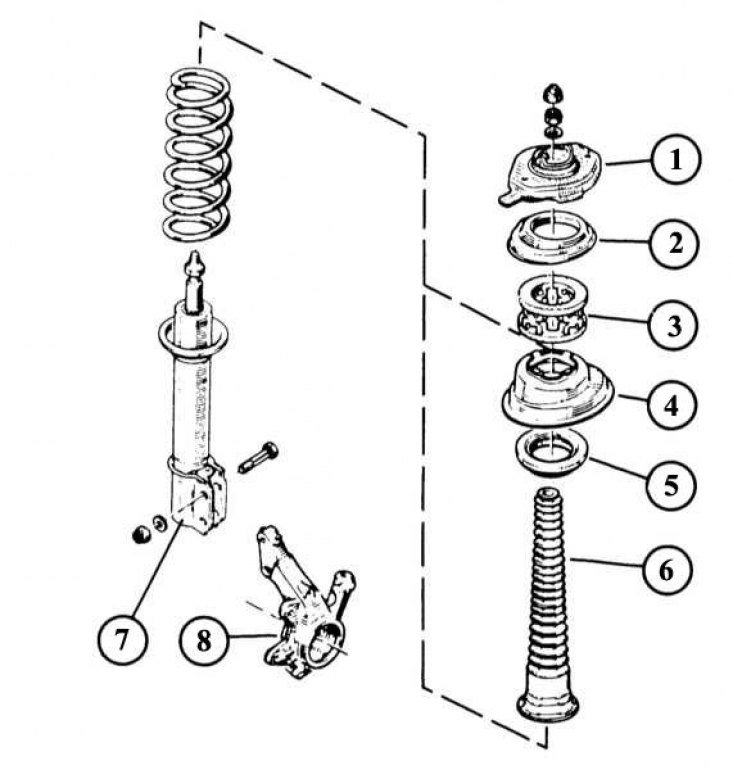
1 - tension plate; 2 - upper spring support; 3 - spring travel limiter; 4 - lower spring support; 5 - support on the pivot pin; 6 - dust cuff; 7 - shock absorber strut assembly; 8 - steering pivot support. To facilitate assembly, it is necessary to mark the installation locations.
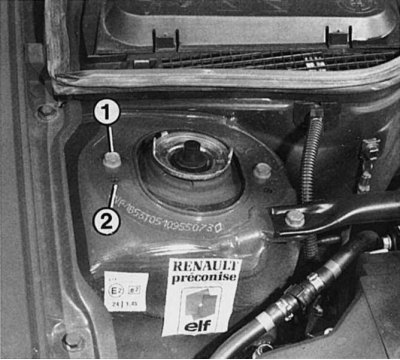
To facilitate subsequent installation, you must mark in which receiving holes the shock absorber strut was fixed, otherwise the entire geometry of the wheel and steering can be disrupted. Shock absorber strut mount "1" is designed for cars with a power steering, shock absorber strut mount "2" is designed for struts of cars without a power steering.
This requires a tensioning device (renault Sus.1052 tool) or at least 2 standard coil spring tensioners. Without them, there is a risk that the tightly tensioned coil spring will suddenly jump out of its mount after the central mounting bolt is loosened. Be careful, the risk of injury is very high!
1. Remove the shock absorber strut.
2. Clamp the shock absorber strut in a vice (don't forget about the protective cheeks) and slowly tighten it with a tightening device until the discs are unloaded (about 10 mm). To ensure that the spring is compressed evenly, tighten the clamps
3. Tighten the clamping device by screwing it alternately from different sides. At the same time, make sure that the spring sits precisely in the clamping device.
4. Remove the upper piston rod ring.
5. Remove the shock absorber strut disc, pivot pin support, spring support, dust seal and stop from the shock absorber strut.
6. If the spring needs to be replaced, slowly release it. If only the shock absorber needs to be replaced, leave the spring compressed.
7. When assembling, make sure that the spring supports are clean.
8. Check the shock absorber. It should move evenly, heavily and without jolts when compressed and stretched. A small amount of leaked shock absorber fluid can be ignored.
9. When assembling the upper spring support, make sure that the bearing is seated correctly and is not skewed.
10. Install a new (!) thrust upper ring.
11. Slowly release the spring.
Note: Recommendation: when replacing the spring, be sure to pay attention to the correct marking of the spring. It is applied to the spring coils.