



Renault 19 rear suspension elements with four torsion bars
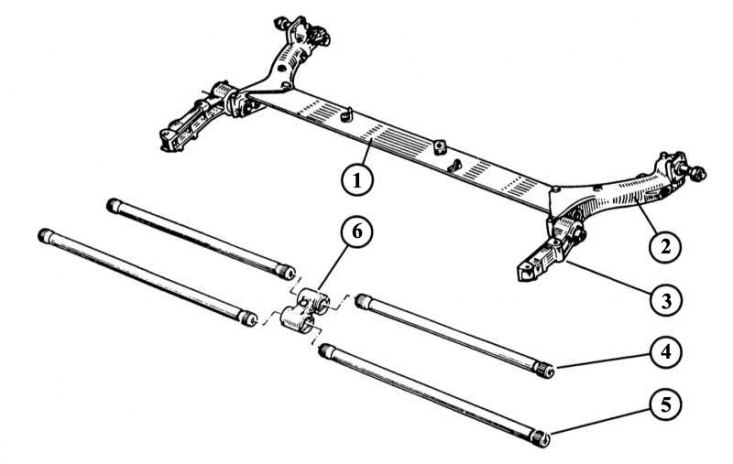
1 - V-profile cross beam; 2 - trailing arm suspension (welded to the cross beam); 3 - suspension trailing arm mount; 4 - transverse stabilizer; 5 - torsion; 6 - support for torsion bars and transverse stabilizers.
The illustration shows the elements of the rear suspension with a conical tube. It also shows the anti-roll bar mount
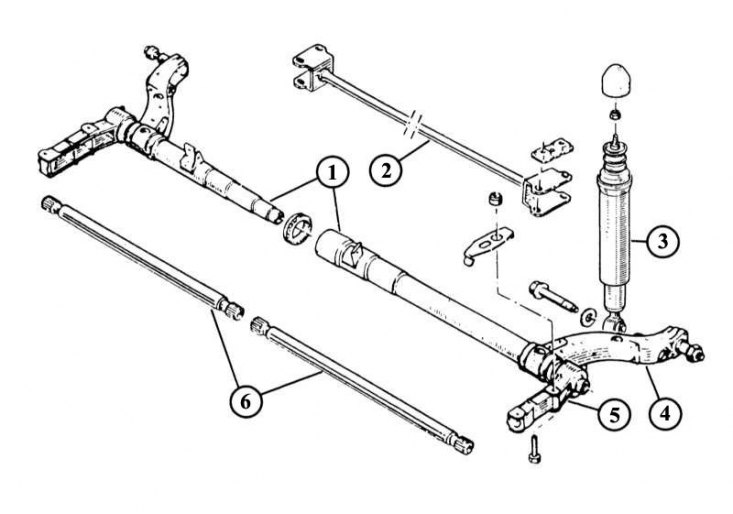
1 - engaging half-axles; 2 - anti-roll bar; 3 - shock absorber; 4 - trailing arm suspension; 5 - suspension trailing arm mount; 6 - torsion springs.
If the measurement of the rear wheel position shows too much deviation from the specified value, the rear axle must be completely replaced. Welding or straightening is not allowed. Replacing torsion bars requires extensive knowledge, qualifications and, above all, special tools. The same applies to replacing joints. For these reasons, we have refrained from describing these types of work.
Removal shock absorbers
1. In the trunk, remove the upper shock absorber mount cover.
2. Unscrew the top nut.
3. Remove individual components and mark the order of their removal for subsequent assembly.
4. Raise the car from behind and secure it.
5. Loosen the lower shock absorber mount and remove the bolt.
6. Remove the shock absorber.
7. Before installing the new shock absorber, compress and release it several times. This way, the oil that has accumulated in one place during storage will be evenly distributed and the shock absorber will be ready for use.
8. Lubricate the shock absorber mount with MoS22.
9. Install the shock absorber, threaded connections - at the top with a new self-locking nut - do not tighten completely yet.
10. Lower the vehicle.
11. Tighten the lower fastening to 60 Nm.
12. Tighten the upper fastening to 20 Nm.
Removal the anti-roll bar
1. Raise the car so that the wheels hang freely and secure them.
2. Unscrew the threaded connections of the anti-roll bar on the right and left of the longitudinal suspension arm.
3. Remove the parking brake cable guides.
4. Remove the anti-roll bar.
5. When installing, tighten the mounting bolts to a torque of 50 Nm.
Removal the wheel bearing
Both drawings show elements of the rear bearing
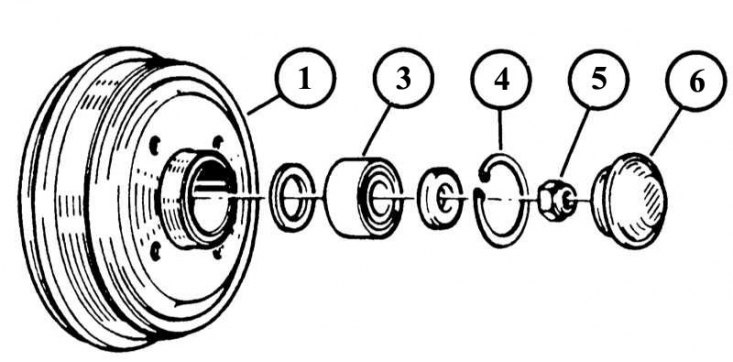 |
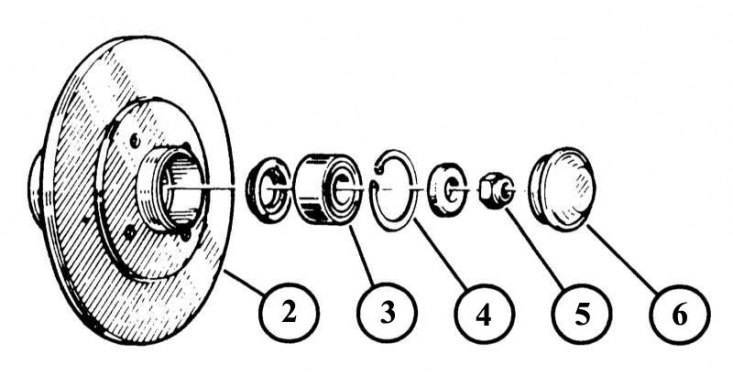 |
1 - brake drum; 2 - brake disc; 3 - wheel bearing; 4 - thrust retaining ring; 5 - wheel hub nut; 6 — hub cover.
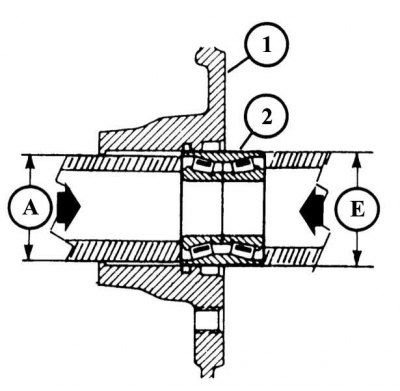
The figure shows the pressing out and pressing in of the wheel bearing in section. The pipe diameter should be A = 49 mm when pressing out, and E = 51 mm when pressing in.
1. Loosen the wheel mounting bolts and lift the vehicle so that the wheel hangs freely.
2. Disassemble the brake drum or, respectively, the brake mechanism of disc brakes.
3. Remove the safety thrust ring with pliers from the hole in the hub of the brake drum or, respectively, the brake disc.
4. Place the brake drum or brake disc respectively on a board or clamp it in a vice.
5. Press the wheel bearing out of the hub hole with a suitable short piece of pipe.
6. Clean the wheel hub and press or, respectively, press in the new bearing until it stops.
7. Install the new thrust ring.
8. Place the brake drum or brake disc on the axle. Before doing this, lubricate the axle with lithium grease (for example, LM-320 from Liqui Moly).
9. Install the new self-locking hub nut and, after the vehicle has been lowered, tighten it to 160 Nm.
10. Wheel bearings do not require adjustment, the rotating rings, hub and axle are made with such small tolerances that after tightening the nut they are installed with the prescribed clearance in the bearing for the wheel (the maximum axial clearance is 0.03 mm).
11. After installing the hub cover, return the brake components to their original position.
12. Adjust the parking brake if necessary.