



- Ball joints and tie rod ends. Check the dust caps.
- Steering. Check the condition and tightness of the protective cuffs.
- Power steering. Check the fluid level. Top up if necessary. Check the tightness of the steering gear, power steering pump, and all pipes and their connections.
Tie rod end and ball joint dust caps - check
1. Place the front of the vehicle on jack stands.
2. Shine a light on and check the condition of the right and left steering rod end boots, as well as the left and right suspension ball joints (see arrows in illustrations 17.0 and 17.0a).
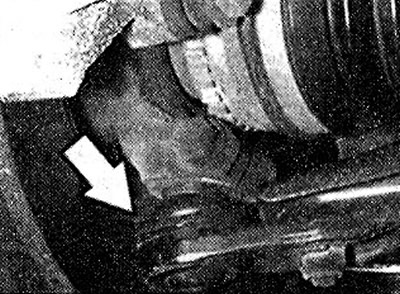
17.0 Tie rod end ball joint |
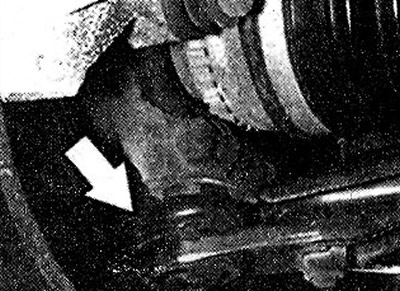
17.0a Front suspension ball joint |
3. Make sure that the rubber of the anthers is not damaged, has no cracks or cuts, and that the anthers themselves are firmly in place.
4. Replace damaged dust boots. For safety reasons, replace the corresponding ball joint together with the dust boot, because if dirt gets into it, it will certainly break the support.
Power Steering - Checking Fluid Level
Necessary tools and materials: oil "ELF RENAULT MATIC D2" or "MOBIL ATF 220D".
The power steering oil level should be checked with the engine turned off and cold, corresponding to the air temperature (approximately +20°C).
Attention! The shape and installation location of the power steering reservoir may differ from those shown in the illustrations. This is due to the configuration and engine type of the corresponding vehicle.
Cars with 1.4-/1.6-liter engines
5. Measure the oil level in the power steering reservoir using dipstick 2, which is attached to the reservoir cap 3. The oil level should be between marks A and B (see illustration).
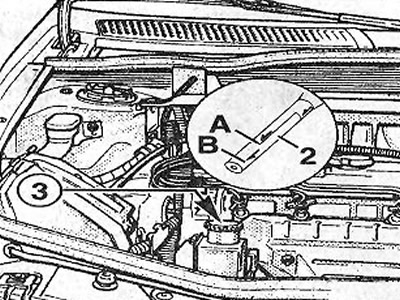
17.5 Measure the oil level in the power steering reservoir using dipstick 2, which is attached to the reservoir cap 3. The oil level should be between marks A and B
Cars with a 2.0 liter petrol engine, a diesel engine and a 16-valve engine
6. Visually check the oil level in the power steering reservoir. For cars with an engine capacity of 1.9 liters or more, the reservoir is transparent and the oil level should be between the MINI and MAXI marks, which are applied to the side wall of the reservoir (see illustrations 17.6 and 17.6a).
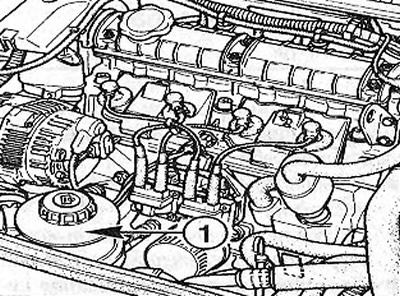
17.6 Visually check the oil level in the power steering reservoir. Cars with a 2.0-liter gasoline engine and a diesel engine |
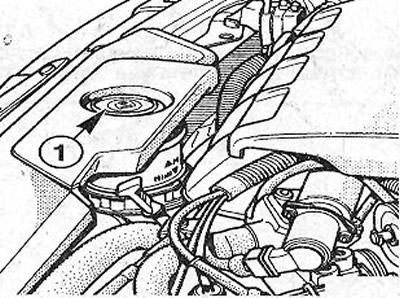
17.6a Visually check the oil level in the power steering reservoir. Cars with 16-valve engine |
7. Top up the fluid if necessary. Fill with fluid of the specification recommended by the vehicle manufacturer. Always fill with fresh oil, because the slightest contamination can damage the power steering.
8. Close the tank with the lid.
9. Start the engine after adding fluid and turn the steering wheel from side to side several times until it stops. This will remove air from the hydraulic booster.
If the power steering fluid volume had to be replenished, the steering mechanism should be checked for leaks.
Text of the original source on this website [Renaultbook.ru]