


Contents: Gearbox - visual inspection for leaks 🠛 Manual transmission - checking the…🠛 Automatic transmission - oil change 🠛 Automatic transmission. Checking the…🠛 CV joint seals (covers) of drive…🠛
- Perform a visual check of the gearbox for leaks.
- Manual transmission. Check the oil level and top it up if necessary.
- Drive shafts. Check the condition of the CV joint seals and make sure they are tight.
- Vehicles with automatic transmission/final drive. Check oil level or change oil.
Gearbox - visual inspection for leaks
Leaks may occur in the following places:
- a) at the junction between the cylinder block and the gearbox (flywheel seal/gearbox shaft seal);
- b) on the oil filler plug/on the threaded drain plug;
- c) at the junction of the gearbox and the front wheel drive axle shafts.
To locate leaks, follow these steps:
1. Clean the gearbox housing with cold cleaner.
2. Check the oil level and add oil if necessary.
3. Sprinkle lime or talc on suspected leak areas.
4. Perform a test drive. Since the oil becomes more fluid when the engine heats up and leaks faster in places where the seal is broken, the test drive should be about 30 km long.
5. Place the vehicle on jack stands after the test drive.
6. Inspect the gearbox using a flashlight and locate any leaks
Manual transmission - checking the oil level
No special tools required.
Materials required: API GL5 or MIL L2105 C or D specification transmission oil. The transmission oil must be the one recommended by RENAULT for use, for example ELF TRX 75W 80W.
1. Place the vehicle on jack stands or a horizontal surface.
2. Remove the engine and gearbox protection, if present.
The filler/inspection hole screw plug 2 is located on the front side of the gearbox (see illustration 14.0).
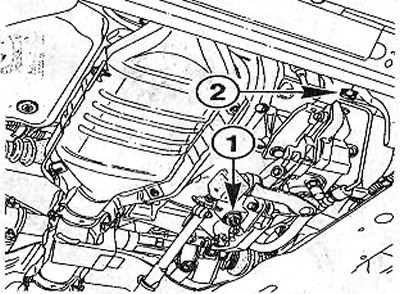
14.0 Threaded plug 2 filler/inspection hole
1 - drain plug
The illustration shows the power unit of a car with a 1.4-/1.6-liter engine. In other models, the indicated plugs are in the same places.
3. Unscrew plug 1 of the filler/inspection hole and check the oil level with your finger (see illustration). Its level should reach the edges of the filler hole. Add oil if necessary.
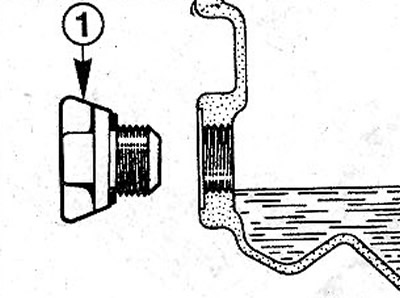
14.3 Unscrew plug 1 of the filler/inspection hole and check the oil level with your finger
Attention! Fill the oil using an oil can. Before filling, place a container under the gearbox to collect excess oil. Fill the oil in small portions, waiting each time until the oil drains into the crankcase. This is necessary because the oil is quite viscous.
The filling volume of transmission oil is about 3.40 liters. For cars with a 16-valve engine with a volume of 2.0 liters - 3.10 liters.
4. Replace the power block protection if necessary.
5. Lower the car onto its wheels.
Automatic transmission - oil change
Required tools: key with triangular socket, e.g. FACOM B.Vi. 1213.
Attention! To avoid adding too much transmission oil, its temperature is measured. In RENAULT workshops, a diagnostic device (tester) is connected for this purpose. For this reason, we recommend that you have the transmission oil changed by a workshop.
Necessary consumables: transmission oil ELF RENAULT MATIC D2 (D20104) or MOBIL ATP 220 D (D20104 or D21412) or TEXAMATIC 4011.
6. Place the vehicle horizontally on support stands.
7. Remove the engine and gearbox protection, if present.
8. Unscrew plug B and drain the oil completely (see illustration). After draining is complete, screw the plug back into place.
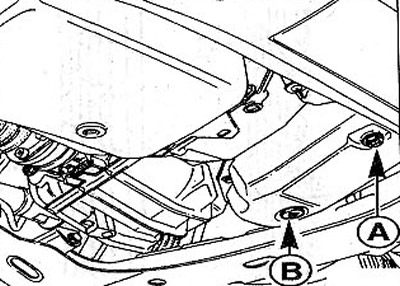
14.8 Unscrew plug B and drain the oil completely
Caution! Do not unscrew the screw plug A when performing this operation (see illustration 14.8).
9. Remove the cap from the tube and insert a funnel with a fine-mesh sieve into it. The sieve is essential to prevent contaminants from getting into the gearbox along with the oil (see illustration).
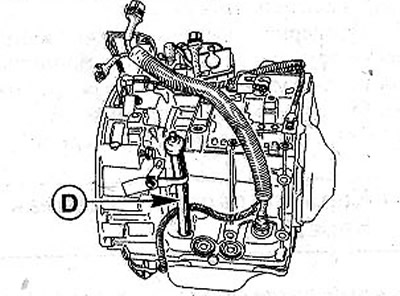
14.9 Remove the cap from tube D and insert a funnel with a fine mesh sieve into it. The illustration shows the AD4 gearbox
10. Pour approximately 3.5 liters of transmission oil into the gearbox.
Attention! The filling volume of the AD4 automatic transmission is approximately 5.7 liters, and the newer ORO model is about 6.0 liters. However, only 3.5 liters of oil should be added. The remaining amount of transmission oil is in the torque converter.
11. Start the engine. The automatic transmission control lever should be in position P, and the gearbox should be cold (approximately 20°C).
12. Leave the engine to idle until the transmission oil warms up to a temperature of +60°C. This temperature is measured in RENAULT workshops using a tester connected to the diagnostic connector on the fuse box.
13. When the oil reaches the specified temperature, unscrew plug A without turning off the engine (see illustration 14.8).
Warning! Oil will start to leak out, so place a suitable container underneath to collect it. Let the excess oil drain for about 20 seconds. The volume of leaked oil will be slightly more than 0.1 liters.
14. Screw plug A back into place.
If the volume of leaked oil is less than 0.1 liters, then the amount of oil filled into the box does not correspond to the norm. In this case, pour 1 liter of transmission oil into the box and wait until the box cools down. After that, completely repeat the procedure for checking the oil level.
15. Install power unit protection, if necessary.
Automatic transmission. Checking the oil level in the main gear
Automatic transmission AD4
No special tools required.
Materials required: transmission oil specification API GL 5 or MIL L 2105 C or D. The transmission oil must be recommended by RENAULT for use, for example ELFTRX 75W 80W.
16. Place the vehicle on jack stands or on a horizontal surface.
[View the original on the specified resource: renaultbook.ru]
17. Remove, if present, the engine and gearbox protection.
18. Unscrew the plug from the filler/inspection hole and check the oil level with your finger (see illustration). Its level should reach the edges of the filler hole. Add oil if necessary.
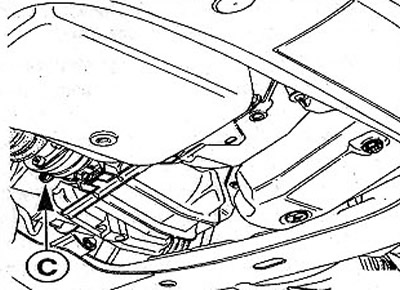
14.18 Unscrew the plug from the filler/inspection hole and check the oil level with your finger
Attention! Fill the oil using an oil can. Before filling, place a container under the gearbox to collect excess oil. Fill the oil in small portions, waiting each time until the oil drains into the crankcase. This is necessary because the oil is quite viscous.
19. Install power unit protection, if necessary.
CV joint seals (covers) of drive shafts - inspection
20. Place the car on jack stands.
21. Check the condition of the rubber cuffs 1. Pay special attention to the presence of traces of grease on the covers themselves and adjacent parts (see illustration).
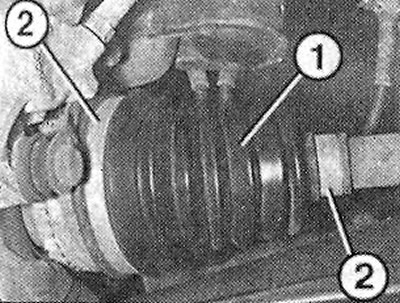
14.20 Check the condition of the rubber cuffs
22. Check the reliability of the fastening of the clamps of the 2 protective cuffs(see illustration 14.20).
23. Check the cuffs for porosity and cracks by illuminating them with a lamp. If such defects are found, replace the cuff. If the cover is bent inward or torn, replace it immediately.