


Contents: Brake lines - visual inspection 🠛 Brake fluid level and level…🠛 Brake fluid level warning light -…🠛 Remaining thickness of brake pads -…🠛 Brake fluid - replacement 🠛
- Brake system. Visually check the tightness and condition of the pipes, hoses, brake cylinders and their connections.
- Check the wear and remaining thickness of the brake pads and the brake fluid level.
- Drum brakes. Remove the brake drums and inspect them. If there are grooves on their surface, replace them or have them bored.
- Brake fluid. Replace
- Tires. Check the remaining tread depth of the tires, including the spare tire, and the tire pressure. Check the wear and damage of the tires.
- Tighten the wheel bolts, if necessary, to 90 Nm, working in a crisscross pattern. Do not lubricate the wheel bolts.
Brake lines - visual inspection
1. Place the vehicle on jack stands.
2. Clean the brake lines.
Attention! The brake system pipes are made of metal and are coated with a layer of polymer material to prevent corrosion. If the protective polymer layer is damaged, the pipe may rust. Therefore, cleaning the brake pipes with a metal brush and sandpaper is not allowed.
3. Check the tightness of the brake pipes running from the master cylinder to the wheel brakes using a flashlight. The master cylinder is located in the engine compartment under the brake fluid expansion tank.
The brake system pipes must not have any kinks, dents or breaks. They must not have any corrosion pits or worn areas. Otherwise, the pipe must be replaced with a new one up to the next joint.
Brake hoses connect the pipelines to the wheel brake cylinders and are laid near the moving parts of the car. They are made of a material that can withstand high pressure, but over time they can become porous, swell or cut on sharp objects. If at least one of the above defects is present, the hose must be replaced.
4. Identify the damaged areas by bending the brake hoses (see illustration). The hoses must not be twisted. Follow the color lines on the hoses, if any!
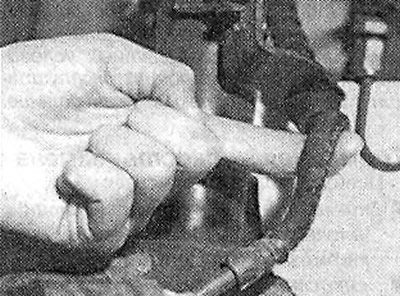
15.4 Identify the damaged areas by bending the brake hoses
5. Turn the steering wheel all the way to the left and then to the right. The brake hoses should not touch other parts of the car in any position of the wheels.
The joints of pipes and hoses should not be wet. The presence of moisture is evidence of a brake fluid leak.
Caution! If the expansion tank and its gaskets are wet, this does not necessarily indicate a defective master cylinder. Brake fluid is most likely leaking through the vent in the tank cap or through the cap gasket.
6. Lower the car onto its wheels.
Brake fluid level and level indicator light - checking
The expansion tank with brake fluid is located in the engine compartment. The tank consists of two chambers, one chamber for each brake drive circuit. The expansion tank cap has a ventilation hole that should not be clogged.
The tank is made of transparent material, which allows you to easily determine the level of brake fluid at any time. It is recommended to regularly check the level of brake fluid in the tank.
The brake fluid level in the expansion tank with the cap closed should not be above the MAXI mark, but should not fall below the MINI mark (see illustration 15.0).
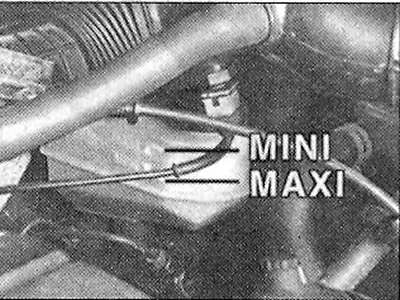
15.0 The brake fluid level in the expansion tank with the cap closed should not be above the MAXI mark, but should not fall below the MINI mark
7. Fill the system only with brake fluid meeting SAE J 1703, DOT 3 or DOT 4 specification.
Due to wear of the disc brake pads, a slight decrease in the brake fluid level in the expansion tank may occur. This is considered normal.
However, if the brake fluid level drops significantly over a short period of time, this indicates a brake fluid leak. In this case, you should immediately find the leak location. As a rule, the cause is wear of the wheel brake cylinder cuffs. For safety reasons, in such cases, you should contact a workshop to check the entire brake system.
Brake fluid level warning light - check
8. Turn on the ignition and release the parking brake lever.
9. Press the contact on the expansion tank cap with your finger.
10. Ask an assistant to watch the brake system warning light. It should light up. If not, check the power wires according to the electrical diagram.
Remaining thickness of brake pads - check
11. Mark the position of the front wheels on the hubs with paint. This will allow you to install the balanced wheel in its original position during assembly.
12. Loosen the wheel mounting bolts. The car must be on the ground.
13. Place the front of the car on jacks and remove the wheels.
14. Visually check the thickness of the brake pads together with the metal support plate (see arrows in the illustration) through the hole in the caliper. If in doubt, remove the pads and measure their remaining thickness with a caliper.
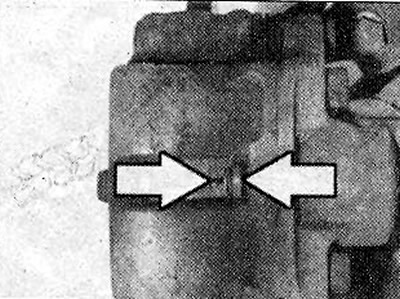
15.14 Visually check the thickness of the brake pads together with the metal backing plate (see arrows) through the hole in the caliper
15. To inspect the rear brake pads, remove the rubber cap from the inspection hole and shine a flashlight into the hole (see arrow in illustration). The wear limit of the brake pad linings is considered to be reached if the thickness of the pad excluding the metal base is 0.6 mm. If in doubt, remove the pads and measure their remaining thickness with a caliper.
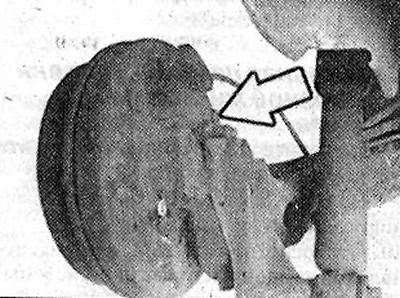
15.15 To inspect the rear brake pads, remove the rubber cap from the inspection hole and shine a flashlight into the hole
When the pads wear down to the minimum permissible thickness, they should be replaced. If only one brake pad is worn, all four on both wheels of the bridge should be replaced.
Note! As a rule of thumb, 1 mm of brake pad lining corresponds to at least 1,000 km of mileage. This rule can be applied when operating the vehicle in adverse conditions. Under normal operating conditions, brake pads last longer.
Brake fluid - replacement
Tools required:
- a socket wrench for unscrewing the bleed nipple of the brake hydraulic drive;
- container for collecting brake fluid.
Materials required:
- brake fluid specification SAE J 1703, DOT 3 or DOT 4.
Brake fluid absorbs moisture from the air through the pores in the brake hoses. Over time, this leads to a decrease in the boiling point of the brake fluid. In such cases, when the brakes are heavily loaded, vapor locks may form in the pipelines, which significantly impairs the functioning of the brake system.
Brake fluid should be replaced every 3 years, preferably in the spring.
16. Observe the rules for handling brake fluid, see the relevant chapter.
17. Siphon the brake fluid from the expansion tank, leaving a layer of liquid approximately 10 mm thick.
Caution! Do not remove all the brake fluid from the expansion tank or expose its bottom. This will allow air to enter the system.
18. Fill the expansion tank with new brake fluid up to the maximum mark on the tank.
Brake fluid draining sequence (system pumping):
- 1. Rear right wheel brake caliper.
- 2. Front left wheel brake caliper.
- 3. Rear left wheel brake caliper.
- 4. Front right wheel brake caliper.
Attention! This procedure for bleeding the brake system does not apply to vehicles equipped with ABS.
The procedure for bleeding the brake system in vehicles with TEVES ABS is as follows:
- 1. Front left wheel brake caliper.
- 2. Rear right wheel brake support.
- 3. Front right wheel brake caliper.
- 4. Rear left wheel brake support.
When equipping a vehicle with ABS from BOSCH, bleeding the brake system is performed in the following sequence:
- 1. Rear right wheel brake caliper;
- 2. Rear left wheel brake caliper;
- 3. Front left wheel brake caliper;
- 4. Front right wheel brake caliper.
19. Place a clean transparent hose on the nipple of the first brake cylinder and lower the free end of the hose into a container.
20. Ask an assistant to press the brake pedal several times until resistance is felt. Keeping the brake pedal pressed, unscrew the brake bleeder nipple of the right rear wheel with a 1 mm socket wrench (see illustration).
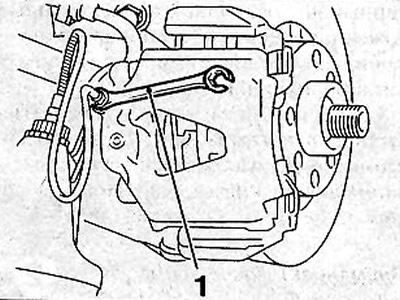
15.20 Keeping the brake pedal depressed, unscrew the brake bleed nipple of the right rear wheel using a 1-mm socket wrench
21. Tighten the nipple when the brake pedal reaches the forward extreme position and rests on the floor. Release the pedal.
22. Repeat this procedure several times (about 10), until freshly filled brake fluid starts to flow out of the hose. This fluid can be recognized by its lighter color.
In a similar manner, remove the old brake fluid from the remaining calipers, strictly adhering to the specified order for bleeding the hydraulic drive.
Attention! The leaking brake fluid must be clear and without air bubbles.