



Contents: Eliminating sticking of brake…🠛 Removal the brake caliper 🠛 Removal the brake shoe holders 🠛 Replacing a damaged piston seal 🠛 Removal brake discs 🠛
It is essential to change both brake pads. In this case, use only pads with ABE. Since the pistons in the brake caliper gradually move further and further out of the brake cylinders as the pads wear, they must be pressed out before installing new and, accordingly, thicker brake pads. In this case, the brake fluid will be squeezed out through the hoses into the brake fluid reservoir. If the brake fluid was added as the pads wore out, then it is necessary to remove its excess.
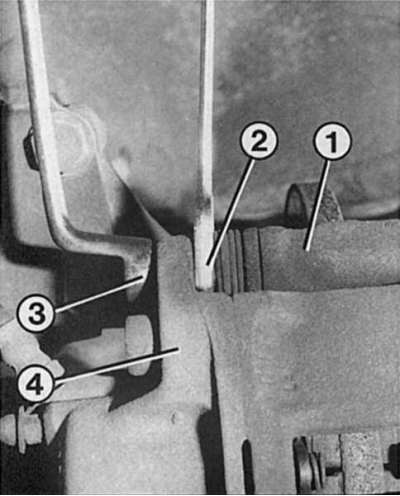
Left: Hold the guide bolt (2) with a spanner to loosen the lock bolt (3). The disc brake caliper (4) can then be removed from the brake pad carrier (1).
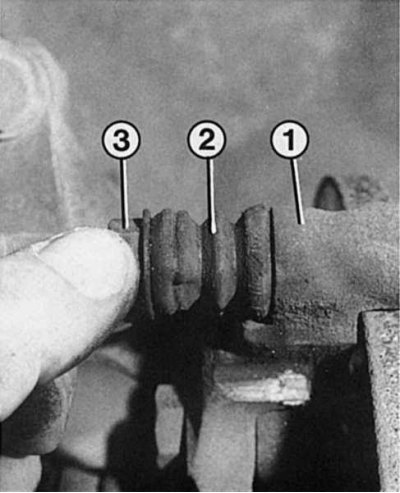
Right: A damaged or poorly installed dust seal (2) will quickly cause the guide bolt (3) to stick due to dirty water and salt. As a result, the brake caliper cannot move freely on the guide bolt, causing premature brake wear. Therefore, before installing the guide bolt into the brake shoe holder, (1) the bolt must be lubricated.
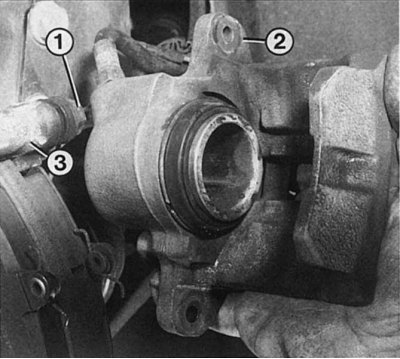
After removing the guide bolt stopper (1) of the brake caliper (3), remove the caliper (2) with the hose attached, which will allow easy removal of the brake pads. If only the lower stop bolt is removed, the brake caliper can be lifted, which will allow easy replacement of any pad.
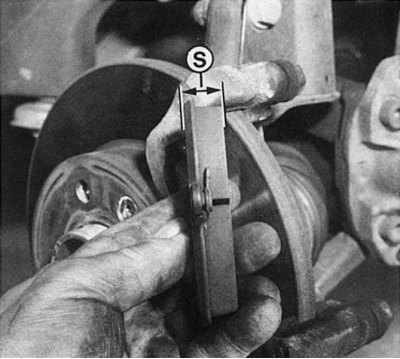
Brake shoe lining (together with its supporting part) should not be thinner than 6 mm, if the thickness is less than 6 mm, all 4 brake pads must be replaced. At the same time, make sure that the brake discs are not damaged or have deep scratches.
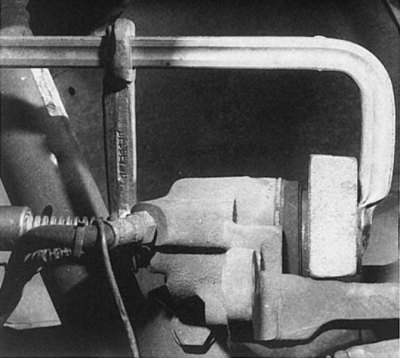
In our experience, the best way to move the brake cylinder piston into the housing is with a clamp and an old brake shoe or board inserted between them.
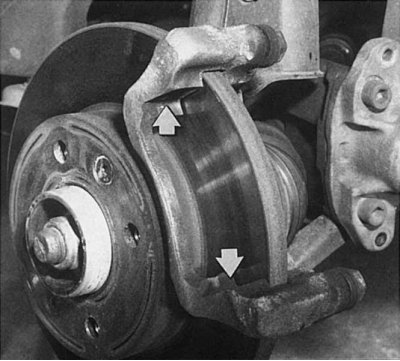
Before installing the brake pads, it is necessary to clean their seats (shown by arrows) and apply a little copper grease. Make sure that the grease does not get on the working surfaces of the brake discs and pads.
Use a clean pipette or syringe to remove excess brake fluid.
1. Raise the car from the front and secure it.
2. Remove the wheels.
3. Turn the steering wheel to provide good access to the pads.
4. Disconnect the brake pad wear sensor from the inner brake pad.
5. Bendix brake system (solid brake discs): Using a thin screwdriver, pull the retaining clip out of the wedge at the top of the brake mechanism.
6. Use a screwdriver to push out the brake caliper wedge. At the same time, lightly press the brake caliper inward against the tension spring.
7. Pull the brake caliper outward to press the brake cylinder piston into the hydraulic brake cylinder and thereby release the brake pads.
8. Pull the outer and inner brake shoes out of their sockets.
9. If necessary, remove both clamps. Remember the sequence of operations.
Girling brake system (solid and ventilated brake discs): Loosen the brake caliper retaining screws. To do this, hold the guide bolt with a wrench to prevent it from turning between the brake pad holder and the disc brake caliper.
Components of the Girling (top) and Bendix (bottom) brake system
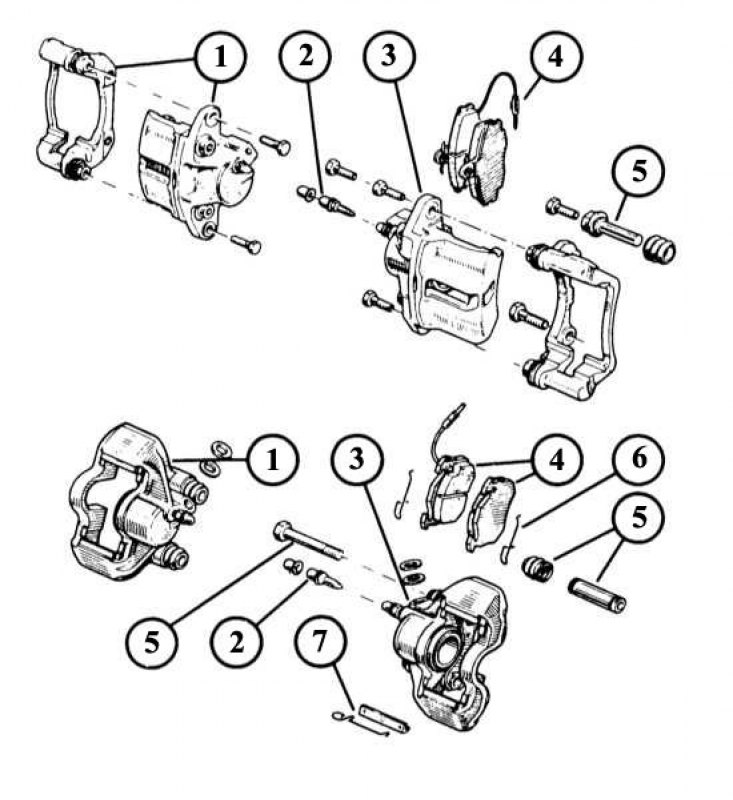
1 - right side of the caliper; 2 - gasket nipple with dust cap; 3 - left side of the caliper; 4 - external and internal (with wear sensor) brake pads; 5 - caliper guide bolts with locking screw; 6 - spring; 7 - wedge with spring stopper.
1. Remove the brake caliper.
2. Make sure that the brake hose is not stretched or twisted. Hang the brake caliper with wire in the wheel arch.
3. Remove the brake pads from their sockets. Mark the direction of installation of the springs.
4. Both types of brake systems: Press the pistons into the caliper using a clamp. To avoid damaging the piston or the sealing cup between the brake cylinder piston and the clamp, place an old brake pad or a hard board.
5. Clean the brake pad seats from dirt with alcohol (under no circumstances with gasoline) and a rag.
6. Remove any burnt residue with a screwdriver. Be careful not to damage the dust seal of the brake cylinder piston.
7. Check the integrity of the dust seal and sealing ring.
8. Make sure that the corrugated sealing cuffs of both guide bolts are intact.
9. Before installation, make sure that the brake disc is free of grease, dirt and scratches.
10. Bendix brake system: install springs on brake shoes.
11. Install the brake pads into the caliper sockets. Install the pad with the wear sensor wire on the inside.
12. Press the caliper against the wheel hub.
13. Insert the wedge and secure it with the safety clip.
14. Girling brake system: insert the brake pads into the sockets. Make sure that the pad with the friction lining wear sensor is installed on the inside and that the springs on both pads are installed correctly.
15. Install the disc brake caliper.
16. Install the locking bolt, using a means to prevent spontaneous loosening (e.g. Loctite "Frenbloc"). If the locking bolt is heavily worn, install a new one!
17. Tighten the locking screw to 35 Nm.
18. Press the caliper against the wheel hub, treat the upper screw with a liquid agent to prevent spontaneous loosening and tighten to a torque of 35 Nm.
19. Install the wheels and lower the car.
20. Press the brake pedal with your foot several times until it stops. Now the pads are pressed against the brake disc, and the car is ready for use.
Note. Recommendation: with new brake pads, you should brake very carefully during the first 500 km, if possible. Strong braking immediately after installing new brake pads leads to burning of the friction linings, which results in a change in their structure. After this, it will be impossible to achieve a normal braking effect, since the friction linings harden - "glass", as experts say.
Eliminating sticking of brake calipers and brake cylinder pistons
Dirt on the sliding surfaces of the caliper and brake pad holder can cause the caliper to stick and run hard. A damaged piston seal causes the piston to lock in the brake caliper. These causes lead to uneven braking.
1. Check whether the pads move easily along their guides, otherwise: clean the guides with a screwdriver. Be careful not to damage the piston sealing cuffs.
2. Remove the brake pads.
3. Check the mobility of the brake caliper and guide bolt. Clean the guides with a screwdriver.
4. To ensure that the guides continue to move, lubricate the rubbing surfaces and the wedge with a small amount of copper grease.
5. Check if the piston moves easily.
6. To prevent the brake cylinder piston from extending too far in the brake caliper, you can use a clamp with a small board or an old brake shoe inserted into it as a limiter.
7. Have an assistant gently press the brake pedal. Does the piston move?
8. If the piston does not move, press the brake pedal until the piston starts to move.
9. Return the piston to its original position using a clamp.
10. Repeat this process until the piston moves easily.
11. Lubricate the piston sides with ATE brake paste.
Removal the brake caliper
Bendix brake system
1. Remove the wheel.
2. Remove the brake pads.
3. Loosen the caliper mounting bolts and remove it from the brake cylinder piston housing.
4. When installing the disc brake caliper, tighten both mounting bolts to a torque of 100 Nm.
Removal the brake shoe holders
Brake shoe holder (girling brake system) and, accordingly, the entire caliper with the cylinder of the hydraulic brake drive of the wheel (bendix brake system) secured with 2 bolts to the shock absorber support steering knuckle.
1. Remove the wheel.
2. Bendix brake system: remove the brake pads.
3. Unscrew both steering pivot support mounting bolts on the inner side of the brake mechanism.
4. If necessary, unscrew the hose on the brake cylinder.
5. Remove the caliper assembly with the brake cylinder.
6. To replace the brake cylinder, it is necessary to remove the brake caliper.
7. When installing the caliper on the brake wheel cylinder, tighten both bolts to a torque of 100 Nm.
8. Girling brake system: remove the wheel brake caliper and brake pads.
9. Tie the caliper with the brake hose still attached to the shock absorber strut using wire so that the hose is not stretched or twisted.
10. Remove the brake shoe holder mounting bolts from the steering knuckle.
11. If the brake hose needs to be removed, tie the hose so that the opening is as high as possible and plug it to prevent brake fluid from leaking out.
12. When installing the brake shoe holder, insert both lock bolts into the pivot support and tighten to a torque of 35 Nm.
13. Clamp the brake hose with a small clamp or clip. Be careful not to damage the brake hose.
14. Unscrew the brake hose from the caliper.
15. Plug the brake hose to prevent brake fluid from leaking.
16. Make sure that both supporting surfaces (tight cone) brake hose
17. and the mounting holes of the brake cylinder were not damaged or contaminated, since the brake hose is installed without a sealing ring.
18. When installing, tighten the freely hanging and untwisted brake hose to a torque of 13 Nm.
19. While turning the wheels right and left, check if the brake hose is rubbing against anything.
20. Bleed the brakes.
21. If the brake hose cannot be removed, press the brake pedal several times to ensure that the brake pads are correctly positioned relative to the brake disc.
Replacing a damaged piston seal
A damaged piston seal must be replaced to prevent the brake piston from becoming loose due to dirt getting in.
1. Remove the caliper as described when replacing the pads.
2. Ask an assistant to gently press the brake pedal with their foot so that the piston slowly comes out of the brake cylinder. Insert a suitable board between the piston and the piston body so that the piston does not come out completely from the cylinder and its surface is not damaged.
3. Remove the dust seal and, if necessary, also the piston seal from the piston ring groove using a hook or a small screwdriver.
4. To avoid loss of brake fluid, unscrew and plug the brake caliper hose.
5. Clean the pistons and the inside of the cylinder with alcohol, spirits or clean brake fluid and check for scratches on the piston surface and inside the cylinder.
6. Install the new dust seal and piston seal ring into the groove and pull onto the piston.
7. Insert the pistons into the cylinder and push them in until they stop.
8. Place the dust seal on the cylinder body and press it evenly around the circumference.
9. After completing the work, bleed the brakes, check the brake fluid level and make sure that the brake system is sealed.
Removal brake discs
Brake discs should always be replaced on both wheels. Replacing discs on one side is not allowed.
1. Remove the brake caliper (bendix brake system) and brake shoe holder with brake caliper (girling brake system) and hang it on the shock absorber strut so that the brake hose is not twisted.
2. Remove both Phillips-head brake disc retaining screws. This is easier and more convenient to do with an impact screwdriver.
3. If this does not work, use a toothed puller.
4. Mark the position of the brake disc relative to the wheel hub for subsequent assembly.
5. Remove the brake disc from the wheel hub by hitting it with a rubber hammer.
6. Before installing a new brake disc, thoroughly clean the bearing surface of the wheel hub.