



With the rear wheel removed, you can see the following components of the disc brakes:
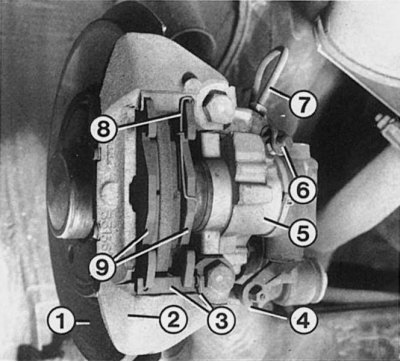
1 - brake disc; 2 - support; 3 - wedge with locking pin; 4 - parking brake lever with cable end; 5 - brake cylinder housing; 6 - bleed nipple with dust cap; 7 - brake mechanism pipeline; 8 - anti-vibration spring - for the outer brake shoe, not visible in the picture; 9 - brake pads.
Rear disc brake components:
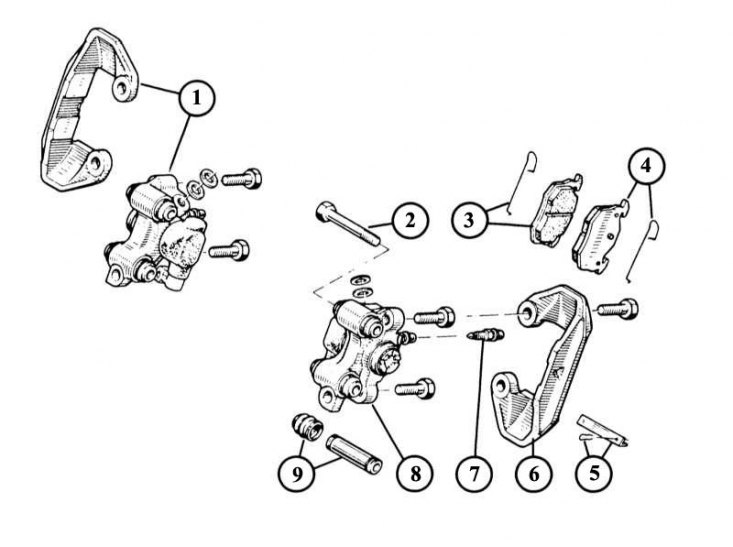
1 - left part of the caliper with the brake cylinder piston; 2 - lock bolt; 3 - inner brake shoe with anti-vibration spring; 4 - outer brake shoe with anti-vibration spring; 5 - wedge with locking pin; 6 - right side of the caliper; 7 - bleed nipple with dust cap; 8 - right piston housing of the brake cylinder; 9 - guide bolt with dust seal.
On the Renault 19 modifications with ABS, disc brakes are also installed on the rear wheels. As with the front wheels, we are talking about disc brakes with a floating caliper (Bendix), which have an absolutely identical design.
The rear wheels can also be locked using the parking brake.
Automatic adjustment
Regardless of the design, disc brakes are always self-adjusting. As the brake pad wears, the brake cylinder piston simply extends further out of the cylinder body, thus ensuring the correct positioning of the brake pads relative to the brake disc. In this case, it is necessary to monitor the level of brake fluid in the reservoir. The situation is different with the parking brake drive. Here, the plunger in the brake cylinder does not have enough piston extension due to wear of the brake pads. This condition of the brake system is prevented by an adjusting device that releases the plunger each time the brake pedal is pressed. The main element of this adjusting device is the thread, on which the second part of the device is located, which unscrews forward as the brake pad wears. Due to this, the plunger is "lengthened". When replacing the brake pads, the brake cylinder piston cannot simply be pressed in; for this, the adjusting device must be screwed in.