



With the wheel removed, you can see the following elements of the disc brake system:
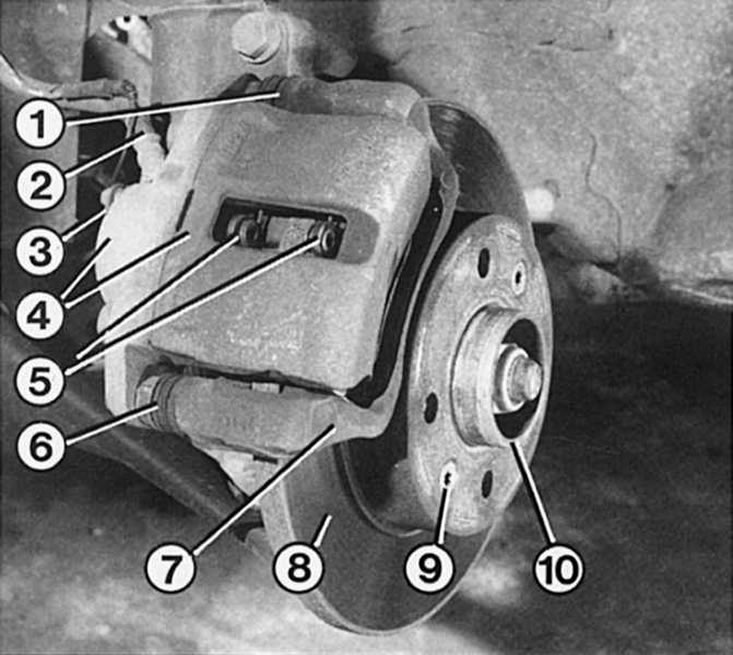
1 - dust seal for upper caliper mount; 2 - brake hose; 3 - bleed nipple with dust cap; 4 - caliper with brake cylinder piston housing; 5 - inner and outer brake pads with springs; 6 - dust seal for lower caliper mount; 7 - caliper mount; 8 - brake disc; 9 - brake disc lock screw; 10 - wheel hub.
Together with the front wheel, depending on the modification of Renault 19, a solid or ventilated steel brake disc rotates freely in the air flow. Saddle-shaped brake calipers cover the brake discs. When you press the brake pedal with your foot, the pistons press the brake pad linings to the brake disc - the disc is clamped by two brake pads - and thus the car is braked. The heat generated by braking from friction is removed by the air flow while driving. The air flow also removes particles worn off the brake pad lining. The brake pads on the discs do not require adjustment.
Note: Tip: When it rains, the brake disc gets wet, which slows down the brakes by a fraction of a second. This is because the water film between the brake disc and the pads must first evaporate.
In winter, when the roads are salted, the brakes do not work immediately, and sometimes the brake system does not work at all. First, the layer of salt must be wiped off the brake pads and brake discs. When driving through a puddle containing salt, the brakes need a few seconds to fully brake. Brakes that are wet from rain or melted water must be dried by briefly pressing the brake pedal several times. In addition, you can drive a few hundred meters, lightly pressing the brake pedal.
Renault 19 is equipped with a disc brake system with a floating caliper, i.e. the brake caliper is movably mounted on a guide bolt.
- When braking, the piston presses the inner brake pad against the brake disc. This pressure causes the caliper to move, thus evenly distributing the pressure on the outer and inner brake pads.
- When the brake pedal is released, the piston seal pulls the piston and caliper away from the brake disc, creating a small gap that allows the brake disc to rotate freely.