



Contents: Automatic brake adjustment 🠛 Removal brake drums 🠛 Checking the condition of the brake…🠛 Removal brake pads 🠛 Installation 🠛
Automatic brake adjustment mechanism
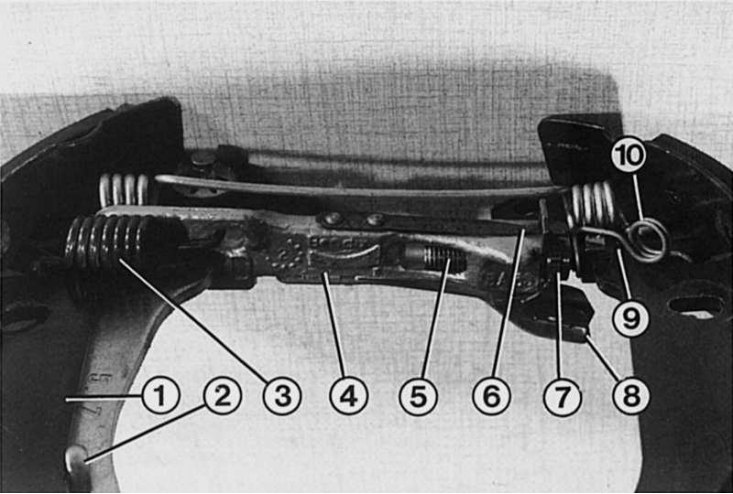
1 - passive brake shoe; 2 - manual brake pad drive lever with limiter; 3 - parking brake strut tension spring; 4 - braking mechanism adjusting device spacer; 5 - pusher thread; 6 - locking spring of the toothed adjusting nut; 7 - toothed adjusting nut; 8 - ratchet lever; 9 - pusher; 10 - clamping spring.
The figure shows the elements of the left brake drum
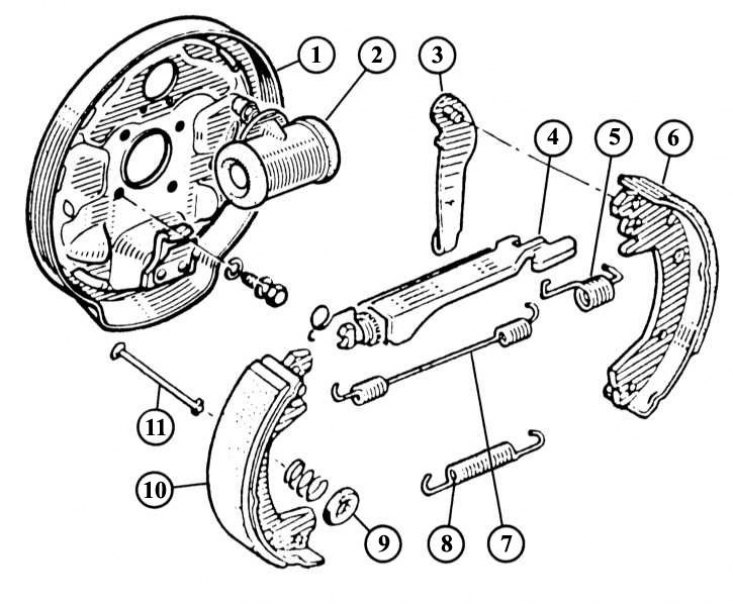
1 - brake mechanism shield; 2 - wheel brake cylinder; 3 - parking brake rocker; 4 - brake adjustment spacer; 5 - tension spring of the spacer; 6 - passive brake shoe; 7 - upper tension spring; 8 - lower tension spring; 9 - brake shoe clamp lock washer; 10 - active brake shoe; 11 - brake shoe clamp locking pin.
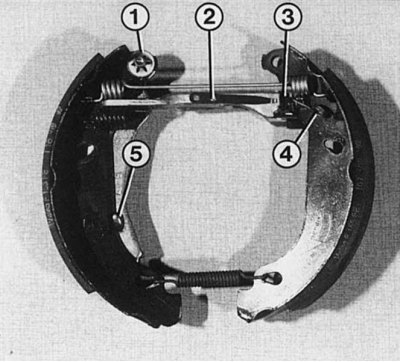
If the parking brake rocker arm (5) was separated from the passive shoe when removing the brake shoes, a new locking washer must be used for subsequent assembly. When installing the brake shoes, tilt the parking brake rocker arm toward the center of the hub and place the parking brake cable on it.
When the brake shoes are correctly installed on the shield, the toothed nut (3) of the spacer (2) must be installed so that the axis of inclination of the brake shoes is located inside the diameter of the brake drum. Before installing the brake drum, check whether the pressure plate moves freely
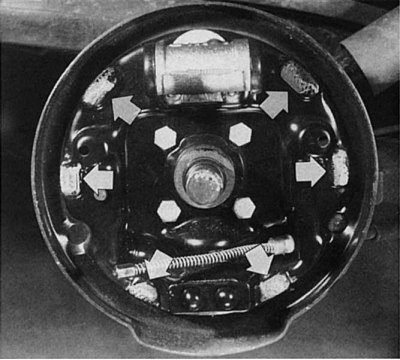
Before installing new brake pads, it is necessary to clean the brake shield. In addition, it is necessary to lubricate the 6 contact points of the brake pads (shown by arrows) copper paste.
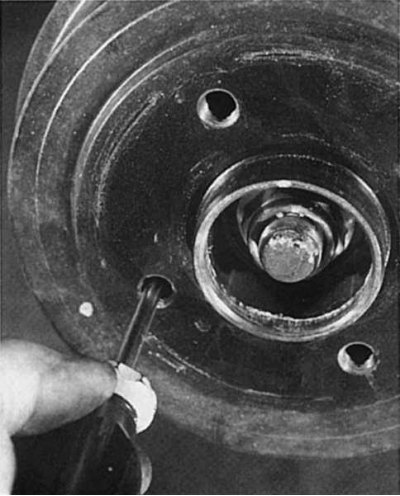
Left: In this position of the brake drum, the parking brake rocker stop of the passive brake shoe can be released. To do this, press the parking brake rocker towards the center in the direction of the car with a screwdriver inserted into the hole in the wheel bolt.
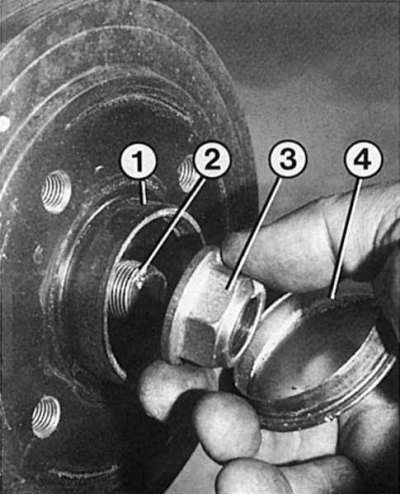
Right: After removing the hub cap (4) from the brake drum (1), the hub nut (3) can be unscrewed from the thread of the wheel hub (2). When removing the brake drum, do not lose the hub nut adjusting washer.
 |
 |
- The length of the idle pedal stroke should not exceed 1/3 of the total pedal stroke.
- More pedal travel means the brake pads need to be replaced.
- An increase in brake pedal travel may also be caused by a jammed brake shoe lining or a rusty wheel brake caliper.
Automatic brake adjustment
As the wear of the brake shoe linings increases, the spacer between the brake shoes should be lengthened. A toothed nut with a spring-loaded ratchet lever located on the spacer thread is designed for this purpose. The spring-loaded ratchet lever lengthens the compressed spacer during braking and thus moves the brake shoes to a new position. That is, the brake shoes are pushed outward, as a result of which a minimum distance is always maintained between the brake shoe and the drum.
Removal brake drums
1. Raise the vehicle, secure and remove the rear wheel.
2. Release the parking brake.
3. Using a screwdriver inserted into the hole in the brake drum under the wheel mounting bolt, press the parking brake rocker arm of the passive brake shoe inward toward the center of the vehicle. This will release the small limiting pin of the parking brake rocker arm.
4. Then use a screwdriver to push the parking brake rocker arm back until the brake shoes are completely released.
5. Carefully knock off the hub cap with a hammer, use a chisel if necessary.
6. Unscrew the hub nut and remove it together with the adjusting washer.
7. Remove the brake drum. If it does not move, then rotate the brake drum, tapping it with a rubber mallet or a hammer with a board placed against the drum. In a car repair shop, a puller is used for this.
8. Clean the brake mechanism. Wipe the brakes with either a clean rag and alcohol, or blow them with compressed air. Any dust remaining from the linings can be removed with a brush or vacuum cleaner.
Checking the condition of the brake drum
1. Check the brake drum for damage and cracks. At the same time, carefully inspect the working brake surfaces to detect the presence of scratches.
2. If there are deep scratches, the drums are bored on the machine. In this case, the internal diameter of the drum will become larger.
3. New brake drums have an internal diameter of 180.25 mm. If there are deep scratches, the brake drums can be bored to 181.25 mm. If the drums are worn more than 181.25 mm, both brake drums must be replaced.
Note: Recommendation: for uniform braking, both brake drums must have the same diameter. When boring one brake drum, the other must be bored by the same amount, even if it has no grooves.
Removal brake pads
Worn and oily brake pads must be replaced, as the friction linings are glued to the brake pads. Always replace all 4 brake pads.
1. Raise the car, secure and remove the wheel.
2. Remove the brake drum.
3. Bendix brake system: press the brake shoe pressure spring plate with pliers, turn it 90° (why is it necessary to fix the locking pin on the back of the brake shield so that it does not rotate) and remove the spring plate and the pressure spring. Remove the locking pin.
4. Unhook the lower tension spring located between the brake shoes using pliers.
5. Remove the brake pads from the support.
6. Press the brake shoes together at the bottom to release the brake cylinder.
7. Remove the brake shoes so that the parking brake cable can be disconnected.
8. To remove the active brake shoe from the spacer, tilt it outward from the bottom to release the threaded part of the spacer. Before doing this, unhook the small spring from the brake shoe.
9. Remove the upper tension spring between the brake shoes. To remove the spacer from the passive brake shoe, pull the spacer back, releasing the spring so that the spacer can be lowered down.
10. Remove the spring and spacer.
11. Before installing new brake pads, it is necessary to clean the brake shield. In addition, it is necessary to lubricate the 6 contact points of the brake pads (shown by arrows) copper paste.
12. Girling brake system: Remove the lower tension spring using pliers or a screwdriver.
13. Remove the upper tension spring.
14. Press the brake shoe pressure spring plate with pliers and turn it 90° (in this case, it is necessary to secure the locking pin at the back of the brake shield so that it does not rotate) and remove the spring plate, as well as the pressure plate. Remove the locking pin.
15. Loosen the parking brake cable.
16. Remove the passive brake shoe from the support and remove the parking brake cable from the rocker arm.
17. Remove the passive brake shoe and spacer.
18. Remove the active brake shoe.
19. When replacing the brake pads, also remove the adjusting lever with the spring from the active brake pad.
20. Both types of brake systems: When the brake pads are removed, do not press the brake pedal to prevent the pistons from coming out of the brake cylinder.
21. With the brake pads removed, check the brake cylinders for leaks. To do this, pull back the dust seal. If there is a leak of brake fluid underneath, repair or replace the brake cylinder. Make sure that the pistons of the wheel brake cylinder do not slip out of it, otherwise air will get into the brake system and you will have to bleed the brakes. If necessary, secure the pistons with a clamp.
22. Blow out the brake drum and brake shield with compressed air or clean them with a dry paint brush, while simultaneously using a powerful vacuum cleaner.
23. Before installation, check the mobility of the parking brake rocker arm and strut and, if necessary, lubricate them with Wolfracote or Liqui Moly Schmierfix.
24. Bendix Brake System: when replacing brake pads, install the parking brake rocker arm onto the new passive brake pad and secure it with a new clamping lock washer.
25. When installing the spacer, ensure that the spring is correctly installed relative to the brake shoe - it should be secured to the shorter hook of the brake shoe.
26. Place the spring on the downward facing spacer and pull it upward until it is in the correct position on the brake shoe.
27. When installing the adjusting device into the spacer hole, ensure that the spring is not pinched between the spacer and the toothed nut, and that there is a gap between the toothed nut and the spacer mount on the shoe.
28. Place the active brake shoe onto the spacer and install the upper spring between both brake shoes.
29. Move both brake pads towards each other at the bottom until the adjusting tool mount fits into the bridge of the active brake pad.
30. Place the tension spring on the active brake shoe.
31. Pull the parking brake rocker arm inward and install the brake shoes previously mounted on the spacers on the brake mechanism shield. At the same time, put the parking brake cable on the rocker arm.
32. Fully press the pistons into the brake cylinder.
33. From below, stack the brake shoes on top of each other so that they can be placed on top of the brake cylinder. Do not damage the dust seals.
Installation
1. Place the brake pads on the support from below.
2. Install the brake shoe clamps.
3. Install the lower spring between the brake shoes.
4. Girling Brake System: if you are installing new brake pads, install the adjuster lever and adjuster spring onto the active brake pad.
5. Attach the parking brake cable to the rocker arm and install the passive brake shoe on the brake shield.
6. Install the spacer on the active brake shoe so that the recess on the brake shoe faces the adjuster lever.
7. Install the active brake shoe together with the spacer onto the brake shield.
8. Fully press the pistons into the brake cylinder.
9. Install the brake shoe clamps.
10. Install the upper and lower spring between the brake shoes.
11. Both types of brake systems: Using a screwdriver, turn the toothed nut to set the inclination of the brake shoe axis so that they are positioned inside the diameter of the brake drum, which in a new drum is 179.2 mm.
12. Install the brake drum and tighten the new hub nut.
13. Then press the brake pedal several times (about 20) so that the brake shoes are centered in the drum and the adjusting device sets both shoes in the same position. At the same time, a click of the toothed nut of the automatic adjusting device should be heard.
14. Remove the brake drum again for final installation of the parking brake cable.
15. Adjust the parking brake cable so that when the parking brake is applied, between the first and second clicks, the parking brake rocker arm just begins to move, and at the second click it releases the brake shoes.
16. Put the brake drum back on and tighten the hub nut to 160 Nm.
17. Lubricate the new hub cap with wheel bearing grease and tap the hub mount with a rubber mallet.
18. Install the wheels and lower the vehicle.
Note. Recommendation: Before removing the brake pads, you should definitely remember or write down the sequence of work and the location of individual elements. Thanks to this, you will significantly simplify the subsequent assembly. If you work on both brakes at the same time, do not allow their mutual replacement of parts under any circumstances.
The spacers for the right and left brake systems are different. On the Bendix brake system, the spacer for the left side is designated "G" (French for "gauche") and "D" ("droite") for the right one. In addition, the toothed adjusting nut of the left strut has a left-hand thread, and the right one has a right-hand thread. Also, the toothed nut of the left strut has a groove, which is not present on the right nut. At the same time, the spring of the right strut is varnished.
On the Girling brake system, the threaded pushrod for the left side of the strut is silver and for the right side it is gold, with the pushrod on the left having a right-hand thread.