



Contents: Removal the brake lines 🠛 Removal the brake hose 🠛 Removal wheel brake cylinders 🠛 Removal the brake fluid reservoir 🠛 Removal the master brake cylinder 🠛 Removal the brake booster 🠛 Removal the low pressure hose 🠛 Bleeding the brake system 🠛
Brake booster
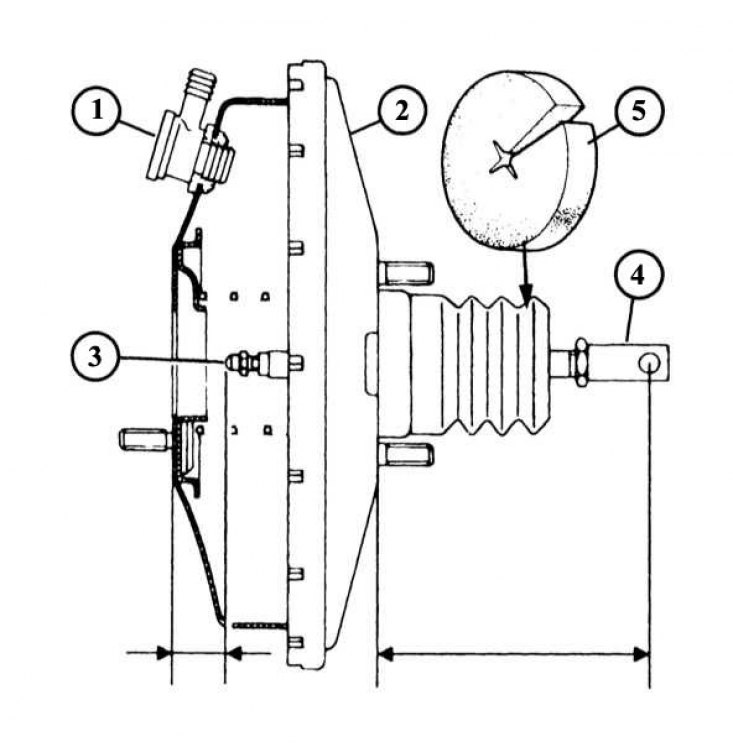
1 - check valve with rubber seal; 2 - brake booster membrane housing; 3 - pusher with adjusting device to the main brake cylinder; 4 - pusher with adjustment device to the brake pedal.
The dimension "X" is 22.3 mm, the dimension L is 124.5 mm. Under the rubber cuff is the air filter (5) - it can be replaced without removing the brake booster.
Front Brake Hose Holder Assembly
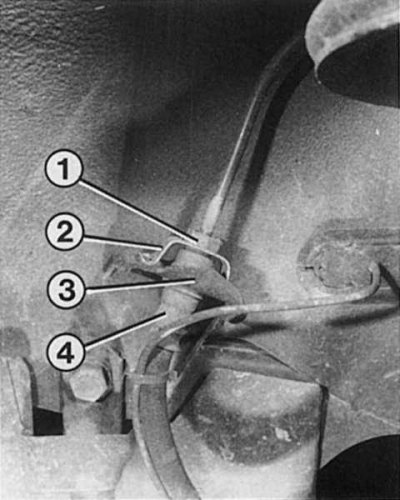
1 - union nut of the fixed brake drive pipeline; 2 - spring; 3 - Brake hose holder; 4 - brake hose fastening part.
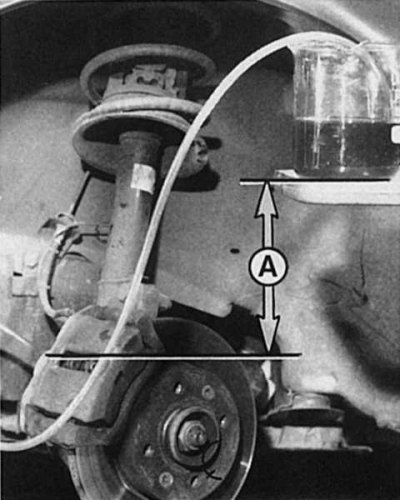
To bleed the brake system, remove the wheels and lift the car. It is shown here how high above the bleed nipple (A=30 mm) the container for receiving the brake fluid should be located. The air bleed hose should be lowered into the brake fluid. Do not forget to watch the reservoir in the engine compartment!
In all the work described below, you will be directly dealing with brake fluid. Therefore, here are some safety tips:
- Brake fluid is highly toxic and should never be allowed to enter the mouth or come into contact with open wounds.
- Brake fluid corrodes varnish. Therefore, do not place rags or tools soaked in brake fluid on the car.
- After work, wash away traces of brake fluid in the engine compartment, but only after all connections have been completely tightened.
- To loosen and tighten the brake lines you must have a 10 x 11 brake line wrench (for example, Hazet 05202). A regular wrench will work for the brake hoses.
- After finishing work in the hydraulic drive, it is necessary to remove air from the brake system. It is sufficient to remove air only from the brake drive circuit where the work was carried out.
Removal the brake lines
1. Unscrew the union nut of the brake line. While doing this, hold the element to be disconnected, such as the brake hose, from turning.
2. If the nut is rusted, causing the pipeline itself to twist, the pipeline must be replaced. Thin-walled tubes break quickly.
3. The following method can be used to loosen pipeline connections, especially if the relevant section of pipeline is to be replaced.
4. Cut off the brake line near the connection point, unscrew the union nut with a hex key.
5. If the new pipeline needs to be slightly bent, then this can only be done with a large radius. Otherwise, the thin tube may break.
6. Support the inside of the pipe being bent with your hands. This way you can gradually bend the pipe along the entire bending radius.
7. Try not to damage the outer coating of the pipeline.
8. Install the brake line into the holders.
9. Always use new O-rings when installing.
10. Bleed the brakes.
Removal the brake hose
1. Unscrew the union nut of the corresponding brake line. Be careful not to twist the line.
2. If the brake hose is attached to the body with a metal holder, in which it is fixed with a metal clamp. When assembling, do not forget about this hose holder, as it fixes the hose.
3. When installing, first tighten the end of the hose that has an external thread.
4. Then tighten the other connections.
5. The brake hose must not be twisted. A paint strip along the hose serves as a control.
6. Bleed the brakes.
7. After assembly, check if the hose rubs anywhere when turning the steering wheel or when the suspension is operating.
8. Repeat this check after a test drive.
Removal wheel brake cylinders
1. Remove the brake drum and brake shoes.
2. Clamp the appropriate brake hose with a clamp or clamp.
3. Unscrew the bleed nipple and the brake line on the rear surface of the brake shield and plug the holes.
4. Unscrew the brake cylinder mounting bolts and remove it.
5. After assembly, bleed the brakes.
Removal the brake fluid reservoir
1. Disconnect the brake fluid level indicator multi-pin connector.
2. Unscrew the lid.
3. Remove the brake fluid using a clean pipette or syringe.
4. Turn the reservoir sideways and remove it from the master cylinder.
5. When installing, install new sealing rings into the holes of the master cylinder, wiping them with brake fluid.
6. Bleed the brakes.
Note: Recommendation: When removing the reservoir cap, be careful not to let the brake fluid damage the electrical contacts.
Removal the master brake cylinder
1. Pump out the brake fluid from the reservoir.
2. Disconnect the brake fluid level indicator pin connector.
3. Unscrew all brake lines from the master cylinder. Before doing this, mark the location of each line.
4. Plug the connection holes to prevent dirt from getting in.
5. Unscrew the nuts securing the pipes to the brake booster and carefully remove the brake master cylinder.
6. If the booster pusher has moved, the correct values should be set.
7. When installing, do not forget about the seal between the master cylinder and the brake booster and make sure that the supporting surfaces are clean.
8. Bleed the brakes.
Removal the brake booster
1. Remove the brake master cylinder.
2. Disassemble the rod in the brake drive of the brake pedal fork (spring clip and pin).
3. Unscrew the 4 nuts securing the brake booster to the front wall of the engine compartment.
4. After assembly, bleed the brakes. On diesel, pay attention to the correct fastening of the low-pressure hose.
Removal the low pressure hose
For diesel only
1. Remove the low pressure hose from the pump and plug the holes to protect against dirt.
2. Remove the nut and bolt from the pump flange.
3. Carefully remove the vacuum pump together with the gasket.
4. Before installation, clean the contact surfaces of the vacuum pump and cylinder head.
5. When installing a new pump, it is also necessary to replace the drive fork.
6. If the pump was easily separated from the flange, install a new O-ring.
Bleeding the brake system
After repairs have been made, air must be removed from the brake hydraulics. A special device is used for this purpose in a car repair shop, but regular bleeding of the brakes is no less effective.
1. Before bleeding, equalize the pressure in the booster with atmospheric pressure by pressing the brake pedal several times.
2. The sequence of pumping should be as follows: right at the back - left at the front and left at the back - right at the front.
3. Fill the reservoir on the master cylinder with fresh brake fluid. When bleeding the brakes, you should constantly add brake fluid to the reservoir, otherwise air may get into the system.
4. Remove the rubber cap from the bleed nipple.
5. Put on the transparent hose (for example, from aquarium ventilation) on the nipple, place the free end of the hose in a container filled with brake fluid, which should be located at least 30 cm above the level of the bleeding nipple. Thanks to this, the bleeding nipple is also under fluid pressure, and air cannot get through it into the brake system.
6. Loosen the bleed screws by half a turn.
7. Ask your assistant to slowly press the brake pedal. This will cause brake fluid and trapped air to come out. You will see air bubbles in the transparent hose and in the container.
8. Tighten the bleed screw while the assistant holds the pedal pressed.
9. Have an assistant release the pedal, it will return to its original position, and wait 3 seconds for the master cylinder to fill again.
10. Repeat the process.
11. Wait for the main brake cylinder to fill and repeat the bleeding process until air stops escaping. You and your assistant should signal each other when to press the pedal and when to close the bleeding nipples again.
12. The brake pedal must be kept pressed all the way until the bleed screw is completely tightened.
13. Remove air from the remaining brake mechanisms in the same way.
14. After completing the bleeding process, check the efficiency of the brake system.