



Parking brake adjuster
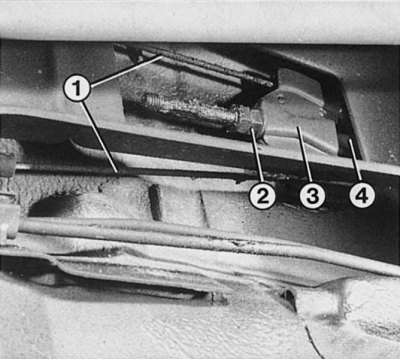
1 - parking brake tension cables going to the rear wheels; 2 - nut and lock nut of the adjusting device; 3 - parking brake cable balancer; 4 - threaded rod of the parking brake lever.
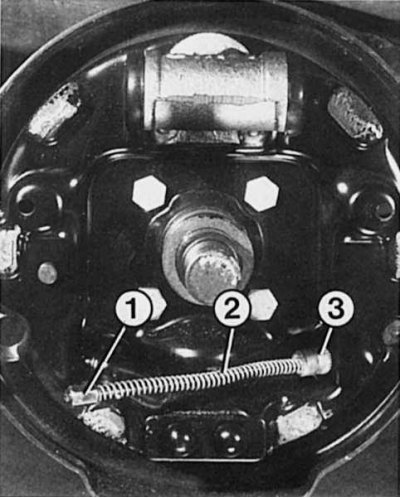
Left: After the brake cable (3) has been inserted into the drum brake shield, it is necessary to move the pressure spring (2) back so that the cable nipple (1) can be placed on the parking brake rocker arm.
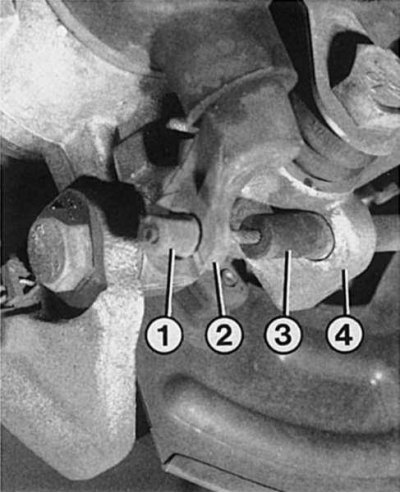
Right: For precise adjustment of the parking brake after replacing the cable, it is important that the cable (3) is correctly positioned in the support (4). After adjustment, the cable nipple (1) with the parking brake released should fit against the parking brake lever (2) without tension, but also without play.
 |
 |
- The parking brake action should begin with the third click of the lever.
- When the sixth click on the lever is recorded, but not later than the eighth click, the rear wheels should be locked.
- A longer lever stroke means increased wear on the rear brake pads or stretching of the parking brake cables.
- Often, the elements of the adjustment device become jammed after "winter salt"; in this case, the parking brake cables move with difficulty in damaged and dirty casings. To avoid this, it is necessary to regularly lubricate the rubbing open elements of the parking brake.
- Adjustment of the parking brake is necessary after replacing the parking brake cable or brake pads, and also when the cable is stretched.
Replacing the parking brake cable
1. First remove the heat shield.
2. Raise the rear of the vehicle and secure it in a stationary position.
3. Release the parking brake.
4. Loosen the nut and lock nut on the balancer until the cables are released.
5. Remove the brake drum and brake shoes to be able to disconnect the cable from the rocker arm.
6. On disc brakes, pull the cable nipple against the elastic force of the brake lever and the coil spring from the nipple mount and remove it. Remove the cable from the various mounts on the underbody of the car and remove it.
7. When installing, which is the reverse of the removal process, renew any fasteners and clamps that have become unusable, otherwise additional noise sources may appear.
8. Be sure to perform the basic installation.
Adjusting the parking brake
Adjustment should be made only after replacing the parking brake cable or after work on the brake system. Before adjustment, check whether the parking brake cable is correctly installed in the guides and adjusting devices in the rear wheel brake mechanism.
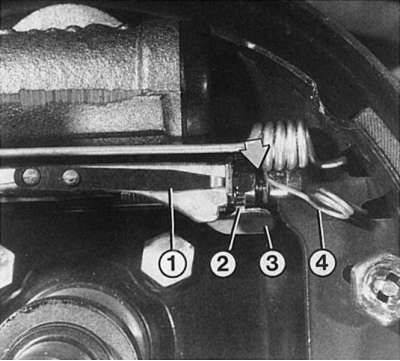
Before adjusting the parking brake, it is necessary to check the ease of movement of the toothed nut (2). It is also necessary to make sure that the spacer spring (4) is not pinched between the head of the spacer and the toothed nut. After the toothed nut has been unscrewed by 5-6 teeth, the brake drum can be installed again. To check the adjusting device after adjusting the parking brake, it is necessary to press the brake pedal many times and when turning the toothed nut, which is actuated by the ratchet lever (3), clicks produced by the ratchet latch (1) should be heard.
1. Release the parking brake.
2. Remove the heat shield where the traction rod passes.
3. Check the correct position and ease of movement of the cable.
4. Vehicles with drum brakes: remove the brake drum.
5. Check the ease of movement of the toothed nut and loosen it by 5-6 teeth.
6. Check that the parking brake rocker arm lock pins are in contact with the brake shoe.
7. Loosen the lock nut and tighten the adjusting nut on the balancer until the parking brake rocker arm lock pin begins to lift off the brake shoe when the parking brake lever is pulled between the first and second clicks, and is noticeably lifted when the second click is reached.
8. In this position, secure the balancer mounting nut with a lock nut.
9. Install the brake drums.
10. With the vehicle lowered, press the brake pedal several times with your foot to return the brake pads to their original position. You will hear clicks in the adjusting device.
11. Vehicles with disc brakes: With the parking brake on the wheel brake cylinders fully released, check the ease of movement of the brake levers and push them back as far as they will go.
12. Adjust the position of the tension cables on the balancer so that the brake levers begin to lift off the stop between the first and second click of the lever when the parking brake is applied. This should be monitored by an assistant.
13. To check, alternately press the brake levers on the right and left against the stop. If the brake lever of the opposite wheel moves, the brake cables are too tight.
14. In this case, loosen the brake cable adjusting nut until both levers rest against the stop.
15. Pull the parking brake lever and release it again.
16. Check the ease of movement of the rear wheels if necessary.
Note: Recommendation: If the free play of the parking brake increases again after some time, do not adjust the parking brake system any more, but remove the brake drums and restore the mobility of the adjustment mechanism. If the parking brake levers in the wheel brake mechanisms are not pulled by the tension cable, then the cable may be jammed somewhere.
Original publication on the portal www.renaultbook.ru