



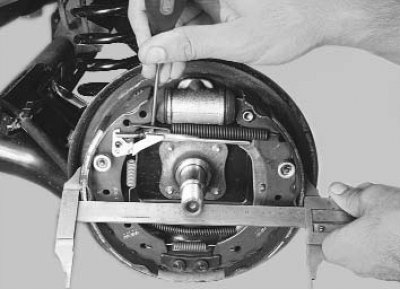
Replace the pads in the following cases:
- the thickness of the friction linings is less than the permissible value (the size measured by the diameter of the pads installed in the brake mechanism is less than specified);
- the surface of the linings is oily;
- the friction lining is not firmly connected to the base;
- the overlays have deep grooves and chips.
Caution! Do not use gasoline, diesel fuel or any other mineral solvents to clean the brakes. Replace the brake pads simultaneously in the brake mechanisms of both rear wheels.
You will need: a wheel lug wrench, pliers or a flat-blade screwdriver, sliding pliers.
1. Engage 1st gear and place chocks under the front wheels.
2. Check that the parking brake lever is lowered all the way down (the car is released).
3. Remove the wheel (see "Wheel change") and place the car on a support.
4. If the brake fluid level in the master cylinder reservoir is at or near the "MAX" mark, pump out some of the fluid from the reservoir. Otherwise, it may spill out when replacing the pads.
5. Remove the brake drum (see "Removing and installing the brake drum").
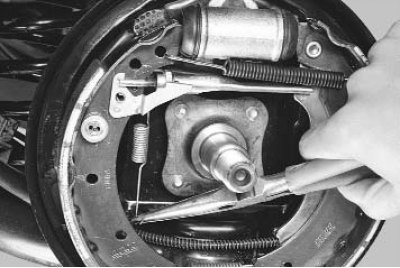
6. Disconnect the spring of the clearance adjuster lever from the front shoe...
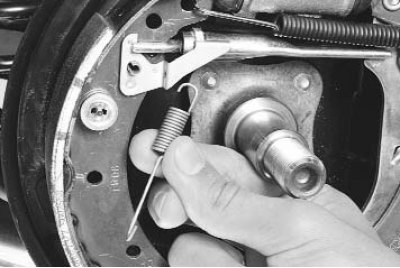
7. ...and remove the spring by disconnecting its other end from the regulator lever.
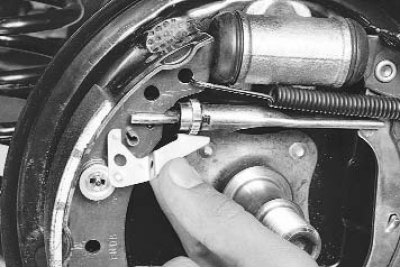
8. Remove the clearance adjuster lever.
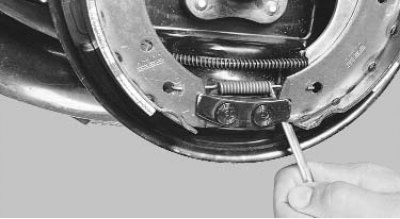
9. Using a screwdriver, pry the lower brake shoe tension spring out of the hole in the rear brake shoe...
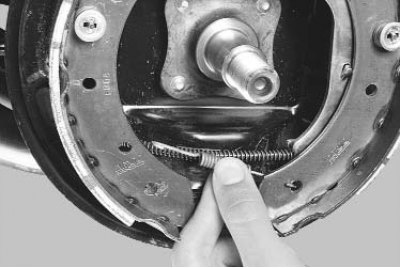
10. ...and remove the spring.
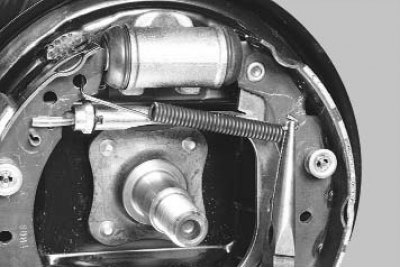
11. Use pliers to unhook the bent end of the upper tension spring from the rear shoe...
Attention! Be careful when working with pliers or a screwdriver. We recommend using special pliers for removing tension springs.
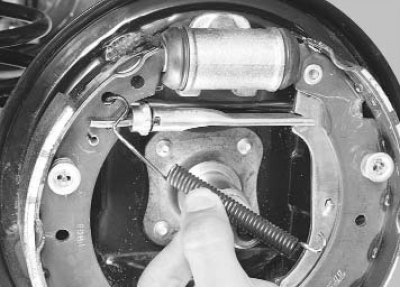
12. ...and, turning the second end of the spring in the hole in the front shoe, remove the spring.
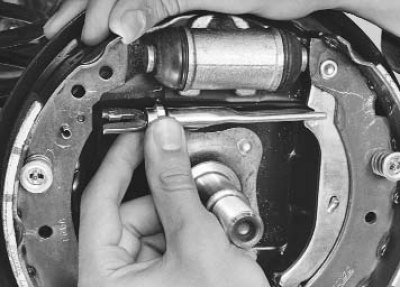
13. Move the front shoe forward a little...
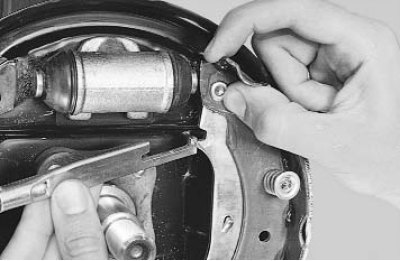
14. ...and, holding the rear shoe, remove the gap adjuster together with the spacer bar, turning the bar 90° along the axis.
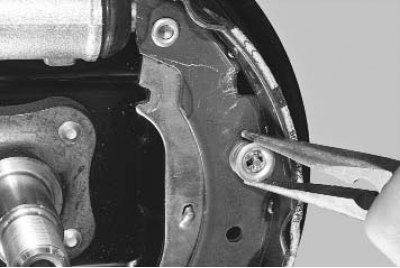
15. Holding the support post, press on the cup of the clamping spring mount, turn it a quarter of a turn...
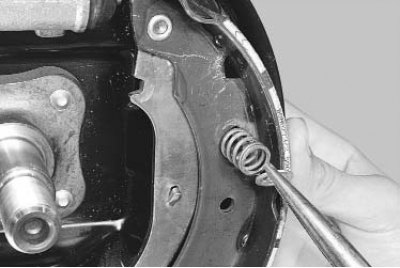
16. ...and remove the cup and spring, as well as the support post.
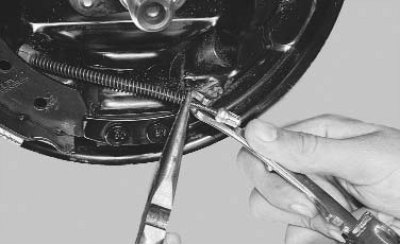
17. Move the rear shoe away from the brake shield, disconnect the release lever from the parking brake cable by pressing its spring with pliers, and remove the shoe.
18. Remove the front brake shoe pressure spring and support post in the same way as you did for the rear shoe (pp. 15 and 16), and remove the front shoe.
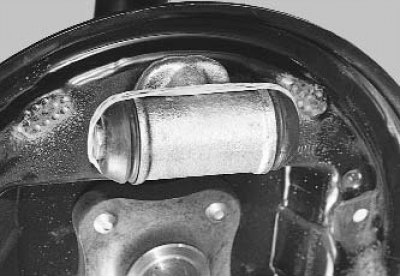
Attention! Immediately after removing the pads, secure the pistons of the working cylinder in any available way (for example, tie it with a rubber band or tie it with wire), otherwise, the pistons may be pushed out of the cylinder by the expansion spring and brake fluid will leak out of the hydraulic system.
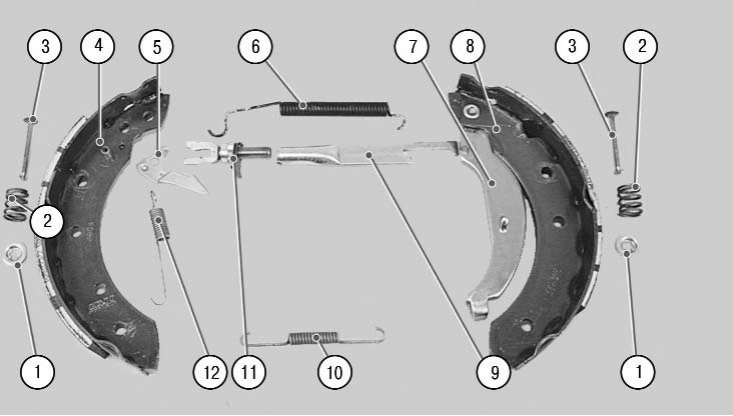
9.8. Rear wheel brake mechanism parts (shows brake mechanism parts on the left side): 1 – cups of pressure springs; 2 – pressure springs; 3 – support posts; 4 – front brake shoe of the rear wheel; 5 – clearance adjuster lever; 6 – upper tension spring; 7 – parking brake release lever; 8 – rear brake shoe of the rear wheel; 9 – spacer bar; 10 – lower tension spring; 11 – clearance adjuster; 12 – spring of the clearance adjuster lever
19. Clean and inspect the brake mechanism parts (figure 9.8). Replace deformed or heavily corroded parts. Replace heavily stretched, loose or bent springs.
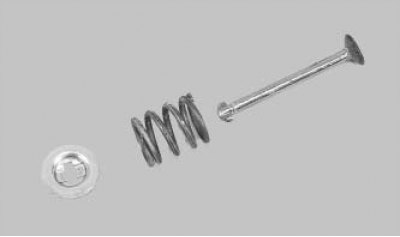
Note: Whenever the brake mechanism is disassembled, replace the pressure springs, spring cups and support legs with new ones.
Note: The left brake mechanism spacer bar and clearance adjuster parts are not interchangeable with the corresponding parts of the right brake mechanism, do not confuse them!
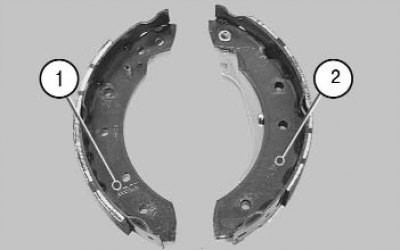
The front 1 and rear 2 pads of the rear brake mechanism are different in design. In addition, the brake pads are distinguished as left and right.
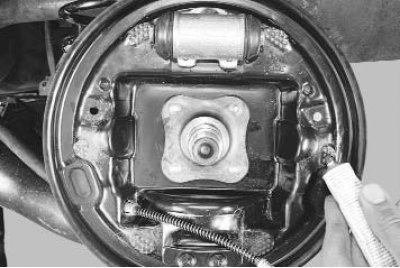
20. Apply high-melting grease for brake mechanisms to the friction areas of the front and rear brake pads on the brake shield.
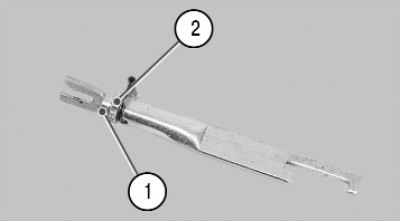
21. Lubricate the thread of rod 1 of the spacer bar with high-melting grease for brake mechanisms and screw nut 2 onto it until it reaches the end, but do not tighten it.
Note: We recommend replacing the spacer bars and clearance adjusters each time the brake pads are replaced.
22. Release the pistons of the working cylinder from the locking device, use sliding pliers to squeeze the pistons of the working cylinder and install the brake pads in the reverse order of removal.
Caution! Keep in mind that when the pistons are pressed into the cylinder, the brake fluid level in the master cylinder reservoir increases. If necessary, pump out the fluid.
23. Install the brake drum (see "Removing and installing the brake drum").
24. Adjust the clearance between the brake shoes and the drum by pressing the brake pedal 10-15 times. Each time you press it, you should hear the adjuster click. If the clicking stops, the clearance is set.
25. Replace the wheel. Check that it rotates easily.
26. Replace the brake pads of the brake mechanism of the other wheel in the same way.
27. After installing the brake pads, adjust the parking brake system (see "Adjusting the Parking Brake Drive").