English Русский
Български
Беларускі
Український
Српски
Hrvatski
Română
Polski
Slovenský
Magyar
Bookmark Contacts Articles Sitemap
Company vehicles Peugeot Company vehicles Opel Company vehicles Skoda Company vehicles Land Rover Company vehicles Mitsubishi Company vehicles Volkswagen Company vehicles Honda
RenaultBook.ru


Duster   Fluence   Kangoo   Laguna   Logan   Megane   Sandero   Scenic   Symbol   Clio   Other
Logan 1 (2004-2012, petrol) Logan 2 (2012-2020)

Replacing a punctured tire (Renault Logan 1)

  • Main
  • Logan
  • Logan 1 (2004-2012, petrol)
  • General information
  • Faults en route
  • Replacing a punctured tire
0
Warning! Be careful when changing a flat tire. It may have been punctured by criminals in order to steal valuables from the car while you are busy changing it.

Warning! Be careful when changing a flat tire. It may have been punctured by criminals in order to…


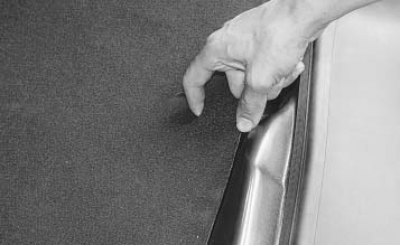
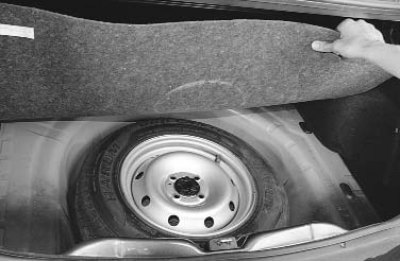
1. Open the trunk (it contains everything you need to change a wheel) and, using your finger to pry the trunk floor mat through the hole...
1. Open the trunk (it contains everything you need to change a wheel) and, using your finger to pry…


2. ...fold back the mat.

2. ...fold back the mat.


3. Unscrew the spare wheel retainer...
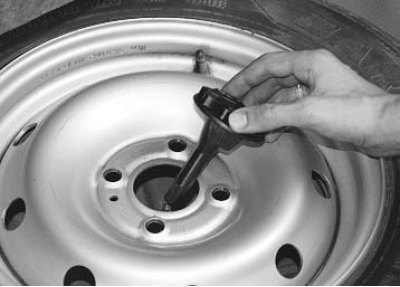


3. Unscrew the spare wheel retainer...


4. ...and remove the retainer.
4. ...and remove the retainer.


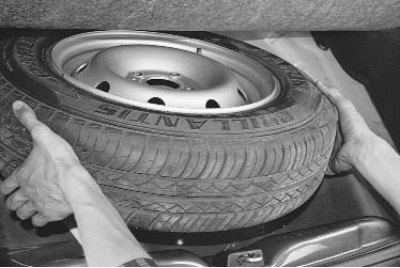
5. Remove the spare tire from the trunk and place it next to the tire being replaced.
5. Remove the spare tire from the trunk and place it next to the tire being replaced.


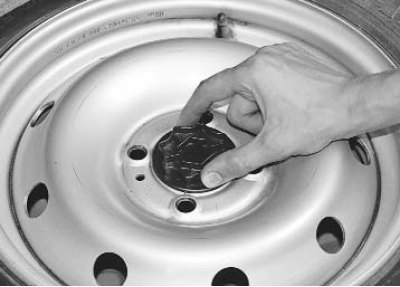
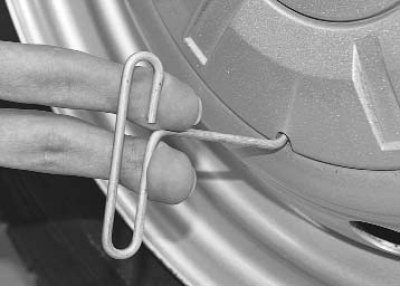
6. Use the hook attached to the car to pry up the edge of the decorative cap...
6. Use the hook attached to the car to pry up the edge of the decorative cap...


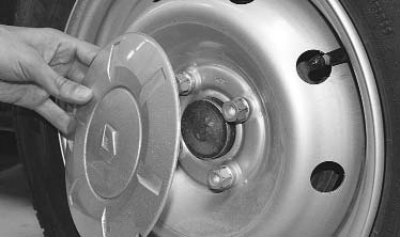
7. ...and remove the cap.


7. ...and remove the cap.


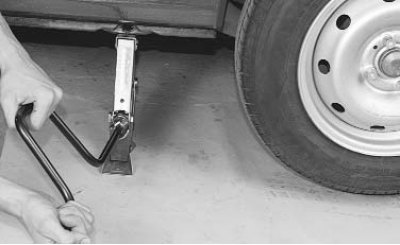
8. Engage first gear and apply the parking brake. Place a jack under the vehicle next to the wheel to be replaced (see "Using a jack").

Note: To avoid getting dirty when changing a tire, wear gloves and protective clothing if your vehicle has them.


9. On the opposite side, the car must be secured by placing wheel chocks under the front and rear wheels so that the raised car cannot move forward or backward.
9. On the opposite side, the car must be secured by placing wheel chocks under the front and rear…


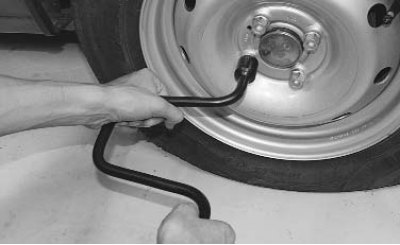
10. Using a jack, lift the car slightly, but so that the wheel that needs replacing does not come off the road. Using a wheel brace, loosen the four wheel mounting bolts.

Note: To make it easier to unscrew the bolts, we recommend purchasing a special wheel wrench with a telescopic handle. It is also convenient to work with a cross-shaped wheel wrench.


Note: To make it easier to unscrew the bolts, we recommend purchasing a special wheel wrench with a…


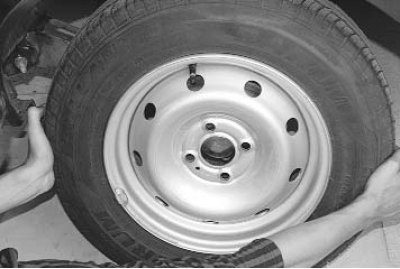
11. Jack up the car until the wheel is clear of the road, then completely remove the bolts and remove the wheel.

Attention! Try to keep the car suspended with the wheel removed for as little time as possible.


Raise the vehicle with a jack only to the height necessary to remove and install the wheel.

If you are working on soft ground, place a thick board under the base of the jack. Do not use bricks for this purpose - they easily split and the car may fall off the jack, seriously injuring you.
If you are working on soft ground, place a thick board under the base of the jack. Do not use…


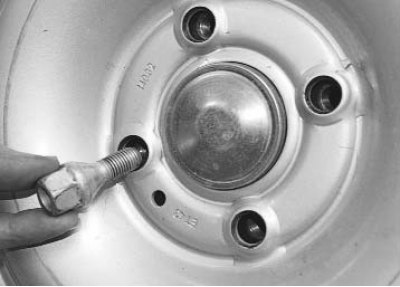
12. Install the spare wheel in place of the removed one, screw in the mounting bolts until they stop, but do not tighten them...

Attention! When screwing in the bolts, make sure that their conical parts are aligned with the conical surfaces of the holes in the wheel disk, otherwise the bolts will loosen while driving and the wheel may be lost.


13. ...lower the vehicle and tighten the bolts completely. Tighten the wheel bolts in a crisscross pattern.

Note: To feel the required tightening force for the wheel mounting bolts, use a torque wrench at first (tightening torque 105 Nm). Do not lubricate the mounting bolts - this may cause the bolts to loosen on their own while the car is moving.


14. Install the decorative cap.

15. Before continuing driving, be sure to check the air pressure in the tire of the installed wheel.

Note: The car has tubeless tires. If you do not have enough skills to install tires, we advise you not to try this job yourself. One sidewall damage and you will have to buy a new tire or install a tube.
In a desperate situation, you can use a special first aid kit for repairing tubeless tires without dismounting or tire sealant. They must be used in accordance with the attached instructions.
Why is a tubeless tire better than a tubed tire? Firstly, a tubeless tire "deflates" very slowly when punctured: you can drive for weeks with a nail in the wheel, pumping it up, until you have an opportunity to repair it. Secondly, when, after a very significant mileage, wires of the metal cord start to stick out of the tubeless tire, it can still be used as a spare wheel. There is no point in inserting a tube into such a tire - it will be punctured already during the first inflation.
This article is available on: russian, bulgarian, belarusian, ukrainian, serbian, croatian, romanian, polish, slovak, hungarian
Article has been reviewed by editor: Podkrepilov Maxim
Share with friends:
Previous
Logan 1: Faults en route
 

Puncture of the tire
Checking the brake system
Bleeding the brake system
Brake problems
Extraneous knocking sounds appeared
 
Other articles on other Renault models

➽ Replacing filter elements Renault Duster 1 (2009-2017)
➽ Replacing the air filter Renault Fluence 1 (2009-2020, petrol)
➽ Replacing incandescent lamps Renault Kangoo 1 (1997-2007)
➽ Tire pressure Renault Laguna 2 (2001-2007)
➽ Dimensions, weight and tire pressure Renault Megane 1 (1995-2002)
Link to this article in different formats
Reviews and comments of visitors
No comments yet


Add two numbers 20 + 11


Logan 2 (2012-2020) 
  • General information
  • Faults en route
  • Daily checks
  • Governing bodies
  • Maintenance
  • Power unit
  • Petrol engines 1.2 l
  • Petrol engines 1.6 l
  • Diesel engines 1.5 l
  • Cooling system
  • Lubrication system
  • Power and control system
  • Intake and exhaust system
  • Engine electrical equipment
  • Transmission
  • Clutch
  • Car gearbox
  • Drive shafts
  • Chassis, running gear
  • Suspension and wheels
  • Brake system
  • Steering
  • Body and interior
  • Exterior (external elements)
  • Interior (internal elements)
  • Safety system
  • Heating and air conditioning
  • Electrical equipment
  • Equipment and devices
  • Wiring diagrams (sedan)
  • Wiring diagrams (wagon)
Logan 1 (2004-2012, petrol) 
  • General information
  • Vehicle device
  • User manual
  • Faults en route
  • Daily maintenance
  • First maintenance
  • Second maintenance
  • Driver tips
  • Power unit
  • Engine repair
  • Lubrication system
  • Cooling system
  • Power and exhaust system
  • Transmission
  • Clutch
  • Car gearbox
  • Drive shafts
  • Chassis, running gear
  • Front suspension
  • Rear suspension
  • Steering
  • Brake system
  • Wheels and tires
  • Body and interior
  • Exterior (external elements)
  • Interior (internal elements)
  • Doors, locks and windows
  • Body Care
  • Electrical equipment
  • Equipment and devices
  • Headlights and lighting
  • Power devices
  • Electrical circuits
RenaultBook.ru © 2018–2026 | Mobile version | News and articles | Sitemap: EN BG BY UA RS HR RO PL SK HU | Administration | Site search | Bookmark
Duster 1 (2009-2017) | Fluence 1 (2009-2020, petrol) | Kangoo 1 (1997-2007) | Laguna 2 (2001-2007) | Logan 1 (2004-2012, petrol) | Logan 2 (2012-2020) | Megane 1 (1995-2002) | Megan 2 (2002-2009, petrol) | Sandero 1 (2007-2012, petrol) | Scenic 1 (1996-2003) | Symbol 1 (1999-2008, petrol) | Symbol 2 (2008-2013, petrol) | Renault 19 (1988-1996) | Espace I and II (1984-1996) | Espace III (1996-2002) | Clio 1 (1990-1998) |
We want your visit to be comfortable 😌 and use cookies 🍪 to do so.