English Русский
Български
Беларускі
Український
Српски
Hrvatski
Română
Polski
Slovenský
Magyar
Bookmark Contacts Articles Sitemap
Company vehicles Peugeot Company vehicles Opel Company vehicles Skoda Company vehicles Land Rover Company vehicles Mitsubishi Company vehicles Volkswagen Company vehicles Honda
RenaultBook.ru


Duster   Fluence   Kangoo   Laguna   Logan   Megane   Sandero   Scenic   Symbol   Clio   Other
Logan 1 (2004-2012, petrol) Logan 2 (2012-2020)

Starting the engine from external power sources (Renault Logan 1)

  • Main
  • Logan
  • Logan 1 (2004-2012, petrol)
  • General information
  • Faults en route
  • Starting the engine from external power sources
0
If you cannot start the engine due to a partially or completely discharged battery, you can use another car's battery to start it. Use special connecting cables with crocodile clips to connect the "donor" battery.

Warning! When starting the engine with an additional battery, carefully follow the operating sequence described in this subsection. Otherwise, a fire or explosion may occur, resulting in damage to both vehicles.
Before connecting the external battery, make sure the ignition is off. Also turn off all electrical consumers (headlights, car radio, windshield wipers, etc.).
When connecting or disconnecting wires, do not allow them to touch each other or allow wires to come into contact with fans, drive belts or other rotating parts.
Do not disconnect the booster battery cables until the engine is running at normal idle speed.
If you leave the audio system on while jump starting the engine with an additional battery, it may be seriously damaged. Always turn off the audio system before jumping the engine with another vehicle's battery.


1. Place the vehicle with the discharged battery next to the donor vehicle within reach of the jumper cables.

Warning! The cars must not touch each other under any circumstances. Otherwise, an unwanted short circuit to ground may occur, as a result of which you will not be able to start the engine of a car with a discharged battery, and the electrical systems of both cars may be damaged.


2. Apply the parking brake on both vehicles.

Original publication on the website Renaultbook.ru


3. Check the electrolyte level in the discharged battery.

Warning! If the electrolyte level is very low or the electrolyte appears frozen, do not attempt to jump start the engine using the booster battery! In this case, the discharged battery may explode.

Warning! If the electrolyte level is very low or the electrolyte appears frozen, do not attempt to…

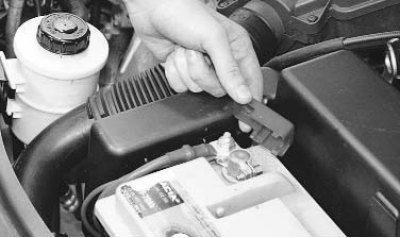
4. Remove the protective cover of the positive terminal of the discharged battery.

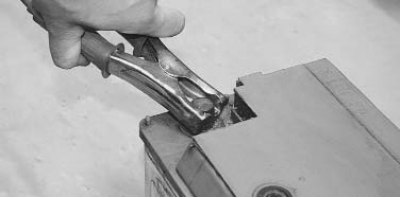
5. Connect the jumper cable clamp with red handles to the positive terminal of the discharged battery.
5. Connect the jumper cable clamp with red handles to the positive terminal of the discharged…


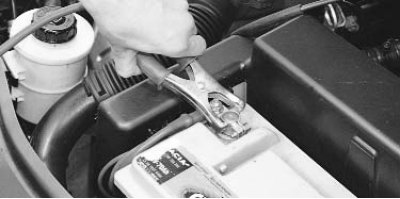
6. Connect the second cable clamp with red handles to the positive terminal of the donor battery.


Note: For clarity, the operation is shown with the battery removed.
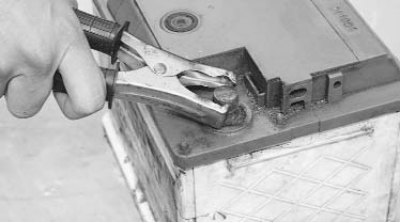

Note: For clarity, the operation is shown with the battery removed.

7. Clamping the second cable (with black handles) connect to the negative terminal of the donor battery...

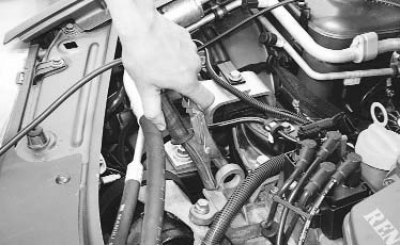
8. ...and the second clamp of the cable with black handles - to the "ground" of the car with a discharged battery in a place located at the maximum possible distance from the battery. It is most convenient to attach the clamp to the transport eye of the engine.

Note: The requirement to connect the wire at the maximum distance from the battery is explained by the possibility of sparking at the moment of connection.
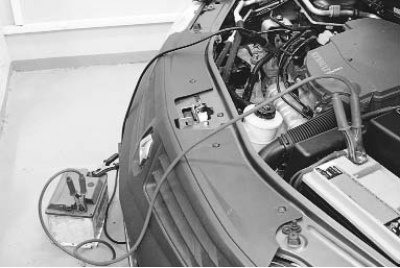

Note: The requirement to connect the wire at the maximum distance from the battery is explained by…


9. Make sure you connect the cables in the correct sequence and that they do not come into contact with moving parts of the engine.


10. When using a battery installed in a donor vehicle, start the engine of that vehicle and let it idle for a few minutes until it runs smoothly.

11. Start the engine of the car with a discharged battery and let it run until it reaches a stable idle speed.

12. Disconnect the cables in the exact reverse order of their connection.
This article is available on: russian, bulgarian, belarusian, ukrainian, serbian, croatian, romanian, polish, slovak, hungarian
Article has been reviewed by editor: Podkrepilov Maxim
Share with friends:
Previous
Logan 1: Faults en route
Next

Checking electrical equipment
The battery is not recharging
Engine overheating
Oil pressure dropped
The engine stalled while driving
Electrical equipment faults
Extraneous knocking sounds appeared
Brake problems
Bleeding the brake system
Checking the brake system
Other articles on other Renault models

➽ Starting the engine from external power sources Renault Sandero 1 (2007-2012, petrol)
➽ Starting the engine from an auxiliary power source Renault Megane 1 (1995-2002)
➽ Starting and stopping the engine Renault Duster 1 (2009-2017)
➽ Starting the engine with an additional battery Renault Fluence 1 (2009-2020, petrol)
➽ Starting the engine from an auxiliary battery Renault Kangoo 1 (1997-2007)
Link to this article in different formats
Reviews and comments of visitors
No comments yet


Add two numbers 31 + 49


Logan 2 (2012-2020) 
  • General information
  • Faults en route
  • Daily checks
  • Governing bodies
  • Maintenance
  • Power unit
  • Petrol engines 1.2 l
  • Petrol engines 1.6 l
  • Diesel engines 1.5 l
  • Cooling system
  • Lubrication system
  • Power and control system
  • Intake and exhaust system
  • Engine electrical equipment
  • Transmission
  • Clutch
  • Car gearbox
  • Drive shafts
  • Chassis, running gear
  • Suspension and wheels
  • Brake system
  • Steering
  • Body and interior
  • Exterior (external elements)
  • Interior (internal elements)
  • Safety system
  • Heating and air conditioning
  • Electrical equipment
  • Equipment and devices
  • Wiring diagrams (sedan)
  • Wiring diagrams (wagon)
Logan 1 (2004-2012, petrol) 
  • General information
  • Vehicle device
  • User manual
  • Faults en route
  • Daily maintenance
  • First maintenance
  • Second maintenance
  • Driver tips
  • Power unit
  • Engine repair
  • Lubrication system
  • Cooling system
  • Power and exhaust system
  • Transmission
  • Clutch
  • Car gearbox
  • Drive shafts
  • Chassis, running gear
  • Front suspension
  • Rear suspension
  • Steering
  • Brake system
  • Wheels and tires
  • Body and interior
  • Exterior (external elements)
  • Interior (internal elements)
  • Doors, locks and windows
  • Body Care
  • Electrical equipment
  • Equipment and devices
  • Headlights and lighting
  • Power devices
  • Electrical circuits
RenaultBook.ru © 2018–2026 | Mobile version | News and articles | Sitemap: EN BG BY UA RS HR RO PL SK HU | Administration | Site search | Bookmark
Duster 1 (2009-2017) | Fluence 1 (2009-2020, petrol) | Kangoo 1 (1997-2007) | Laguna 2 (2001-2007) | Logan 1 (2004-2012, petrol) | Logan 2 (2012-2020) | Megane 1 (1995-2002) | Megan 2 (2002-2009, petrol) | Sandero 1 (2007-2012, petrol) | Scenic 1 (1996-2003) | Symbol 1 (1999-2008, petrol) | Symbol 2 (2008-2013, petrol) | Renault 19 (1988-1996) | Espace I and II (1984-1996) | Espace III (1996-2002) | Clio 1 (1990-1998) |
We want your visit to be comfortable 😌 and use cookies 🍪 to do so.