Contents: Knocking in the engine 🠛 Knocking in suspension and…🠛 Possible causes of knocking in the…🠛 Possible transmission knocks…🠛 Vibration and shock on the steering…🠛 Possible causes of vibration and…🠛
Knocking in the engine
If you feel that the engine is making sounds that were not there before, immediately check if everything is OK with the engine. Most often, engine knocking is associated with serious malfunctions, for the diagnosis and elimination of which you will have to disassemble the engine in a service center or garage. However, you can try to independently determine the cause of the knocking in order to decide whether to drive to the car service on your own or be towed.
Warning! If you have the slightest doubt about the results of your self-diagnosis, get out the tow rope. Serious repairs to a damaged engine will cost more than a towing service.
Knocking of main bearings (can be heard at the very bottom of the cylinder block) - very dangerous; stop the engine immediately, you will have to go to a car service or garage by tow. Low-pitched knocking, noticeably intensifies under load and with an increase in crankshaft speed. Often its appearance is accompanied by a drop in oil pressure (the oil pressure warning light is on almost constantly).
Knocking of connecting rod bearings (can be heard in the middle part of the cylinder block) - very dangerous; stop the engine immediately, you will have to tow it to a car service or garage. The sound is rhythmic, ringing, metallic, medium tone. It increases significantly with increasing load and completely disappears when the spark plug is disconnected.
Knocking of piston pins (can be heard in the upper part of the cylinder block) - dangerous; without loading the engine, you can drive to the car service or garage on your own. Rhythmic, high-pitched, with a sharp metallic tint, audible in all engine operating modes and intensifies with increasing engine load. Completely disappears when the spark plug is disconnected.
Knocking of worn pistons and cylinders (can be heard in the same part of the engine as the knocking of the piston pins) - not dangerous; without putting too much load on the engine, you can drive to the car service or garage yourself. A sound reminiscent of the clatter of clay pottery. It is especially audible on an unheated engine, and decreases or disappears as it warms up.
Valve knocking (can be heard in the upper part of the engine in the area of the cylinder head cover) - not dangerous, you can get to the car service or garage yourself. Metallic knocking against the background of a general dull noise. It is clearly audible at low and medium crankshaft speeds from the cylinder head side above the valve locations.
Detonation knocks are dangerous, but are usually eliminated by replacing the knock sensor or filling with high-quality fuel. Avoiding heavy engine loads, you can drive to a car service or garage yourself. Ringing metallic knocks that usually occur when accelerating the car. The cause is a failure of the knock sensor, the use of low-octane fuel, engine overload when switching on a higher gear too early, significant carbon formation in the combustion chambers. It is necessary to use a special fuel additive to remove carbon deposits on the valves and in the combustion chambers.
Knocking in suspension and transmission
If extraneous knocking sounds appear in the suspension of a moving vehicle, it is necessary to immediately determine their source, regardless of whether the knocking is constant or appears only when driving over uneven surfaces.
Warning! Faults in the vehicle's suspension can lead to a serious accident!
Check the suspension according to the procedure described in section. "Maintenance" (cm. "Checking the technical condition of the front suspension parts on the car" and "Checking the technical condition of the rear suspension parts on the car").
Note: It is better to check the condition of the suspension by placing the car on a ramp, inspection pit or lift, and if this is not possible, you can do this work on a free level area, although with less convenience. In any case, you will need an assistant.
It is quite difficult to diagnose the serviceability of transmission components based on the noise they make. If you are unable to accurately determine the source of the noise, contact a qualified specialist.
Repair or replace any faulty transmission components (see section. "Transmission").
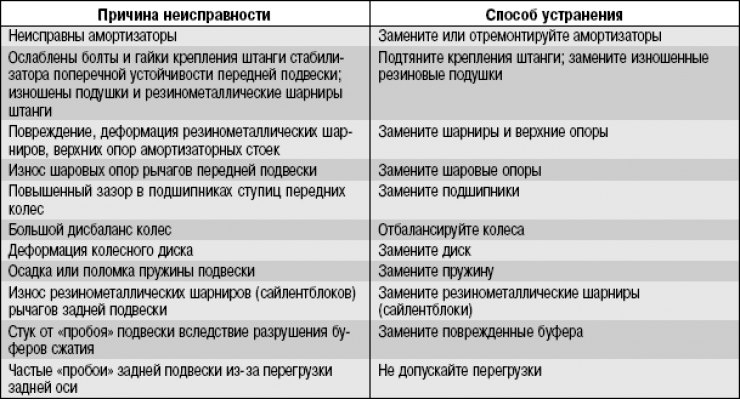
Possible causes of knocking in the suspension and ways to eliminate them
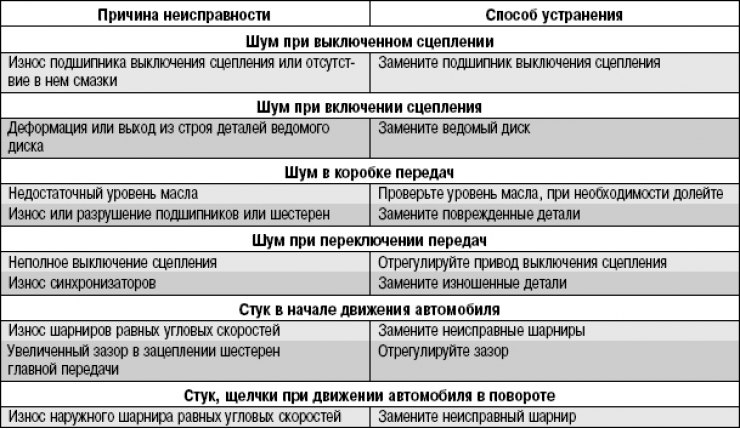
Possible transmission knocks (noises), their causes and methods of elimination
Vibration and shock on the steering wheel
Knocking sounds from below may be caused not only by faults in the suspension, but also in the vehicle's steering.
Attention! The condition of the steering significantly affects not only the ease of driving, but also the safety of the vehicle.
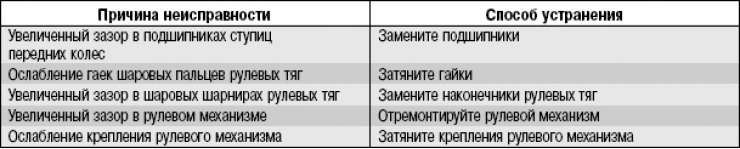
Knocks and vibrations on the steering wheel may be caused by faulty ball joints of the steering rods and steering gear, wheels of the car. Check the steering according to the method described in the subsection "Inspection and testing of the steering system on a car".
Note: A possible cause of vibration and shock on the steering wheel when driving at speeds above 70–80 km/h may be an imbalance of the front wheels. Contact a car service or tire service center to check the balance of the front wheels.
If shocks and vibrations on the steering wheel occur when the brake pedal is pressed, the brake pads must be replaced, and the front brake discs must be repaired or replaced (see "Front wheel brake mechanisms").
Possible causes of vibration and shocks on the steering wheel and how to eliminate them