
English Русский
Български
Беларускі
Український
Српски
Hrvatski
Română
Polski
Slovenský
Magyar
Bookmark Contacts Articles Sitemap
Company vehicles Peugeot Company vehicles Opel Company vehicles Skoda Company vehicles Land Rover Company vehicles Mitsubishi Company vehicles Volkswagen Company vehicles Honda
RenaultBook.ru


Duster   Fluence   Kangoo   Laguna   Logan   Megane   Sandero   Scenic   Symbol   Clio   Other
Logan 1 (2004-2012, petrol) Logan 2 (2012-2020)

Checking the condition of the front suspension parts on the car (Renault Logan 1)

  • Main
  • Logan
  • Logan 1 (2004-2012, petrol)
  • General information
  • First maintenance
  • Checking the condition of the front suspension parts on the car
0
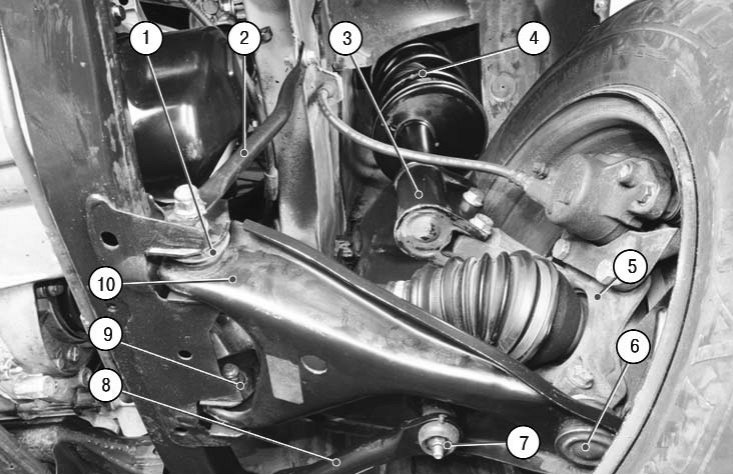
This is how the front suspension elements are located on the car: 1 – front hinge (silent block)…

This is how the front suspension elements are located on the car: 1 – front hinge (silent block) front suspension arm; 2 – subframe connecting rod; 3 – shock absorber strut; 4 – front suspension spring; 5 – steering knuckle; 6 – ball joint of the rack; 7 – anti-roll bar mounting bolt; 8 - transverse stabilizer bar; 9 – rear hinge (silent block) front suspension arm; 10 – front suspension arm.


All checks and work should be carried out from underneath the vehicle, installed on a lift or inspection pit (with front wheels up).

During each maintenance and repair, it is necessary to check the condition of the protective covers of the suspension ball joints; there should be no mechanical damage on the covers.

Find out if there are any cracks or traces of contact with road obstacles or the body on the suspension parts, deformation of the levers, connecting rods, stabilizer bar and its struts, parts of the front of the body in the places where the suspension units and parts are attached.

Check the condition of the rubber-metal hinges, rubber cushions, suspension ball joints, as well as the condition (settlement) of the upper supports of the telescopic suspension struts.


Rubber-metal hinges and rubber cushions are subject to replacement in case of ruptures and one-sided bulging of the rubber, as well as in case of cutting of their end surfaces.

The following is not allowed on rubber suspension parts:
  • signs of rubber aging;
  • mechanical damage.

The following are not permitted on rubber-metal hinges:

[The original can be found on the website: Renaultbook.ru]
  • signs of aging, cracks, one-sided bulging of the rubber mass;
  • separation of the rubber mass from the reinforcement.

Replace faulty parts.

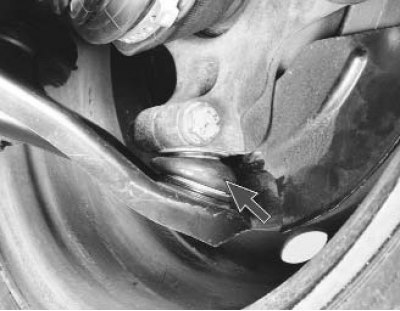
Attention! Pay special attention to mechanical damage (deformations, cracks, etc.) suspension elements, especially levers.

Attention! Pay special attention to mechanical damage (deformations, cracks, etc.) suspension…


1. Check the condition of the ball joint protective boots. If the boots are damaged, replace the ball joints as a whole.
1. Check the condition of the ball joint protective boots. If the boots are damaged, replace the…


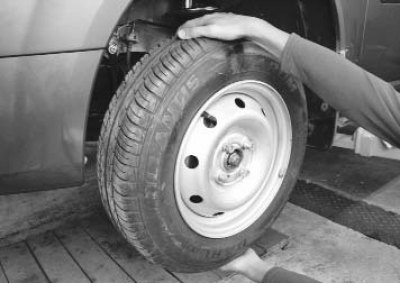
2. By rocking the wheel in a vertical plane, check the ball joints for play. If there is play in the ball pins, replace the supports.


Note: When swinging the front wheel, it is difficult to distinguish play in the hub bearings and in the ball joints. Ask an assistant to press the brake pedal: if you still feel play, then the ball joints are faulty.

Note: When swinging the front wheel, it is difficult to distinguish play in the hub bearings and in…


3. Check the rubber bushings and silent blocks where the levers are attached to the body.
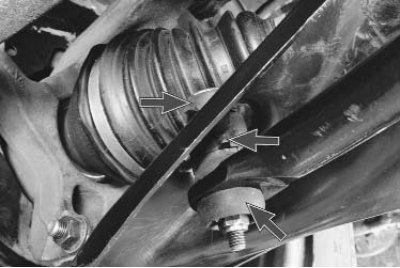
3. Check the rubber bushings and silent blocks where the levers are attached to the body.


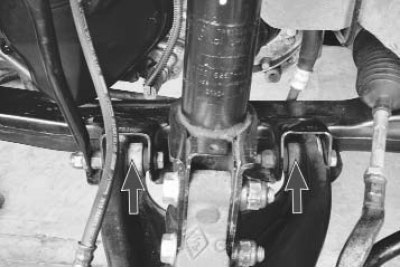
4. Check the condition of the rubber bushings where the anti-roll bar is attached to the suspension arms.
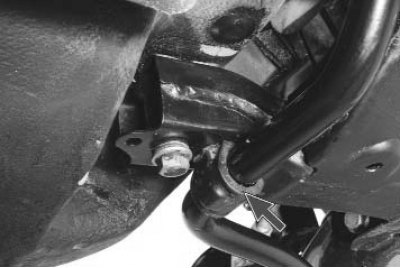
4. Check the condition of the rubber bushings where the anti-roll bar is attached to the suspension…


5. ...and also rubber cushions in the places where the stabilizer bar is attached to the subframe.

6. Check the condition of the shock absorber strut protective cover.
This article is available on: russian, bulgarian, belarusian, ukrainian, serbian, croatian, romanian, polish, slovak, hungarian
Article has been reviewed by editor: Podkrepilov Maxim
Share with friends:
Previous
Logan 1: First maintenance
Next

Checking the front wheel drive protective covers
Checking the level and adding oil to the gearbox
Checking the tightness of fuel lines
Checking the air filter element
Checking the cooling system hoses and connections
Checking the condition of the rear suspension parts on the car
Inspection and testing of the steering system on the vehicle
Checking the free play (play) of the steering wheel
Checking the tightness of the hydraulic brake drive
Checking the operation of the brake booster
Other articles on other Renault models

➽ Checking the technical condition of the vehicle's front… Renault Sandero 1 (2007-2012, petrol)
➽ Checking the ball joint of the lower arm of the front suspension Renault Duster 1 (2009-2017)
➽ Checking the condition of the front brake pads and discs (30,000… Renault Symbol 1 (1999-2008, petrol)
➽ Checking the suspension and technical condition of the exhaust… Renault 19 (1988-1996)
➽ Front suspension anti-roll bar Renault Fluence 1 (2009-2020, petrol)
Link to this article in different formats
Reviews and comments of visitors
No comments yet


Add two numbers 24 + 20


Logan 2 (2012-2020) 
  • General information
  • Faults en route
  • Daily checks
  • Governing bodies
  • Maintenance
  • Power unit
  • Petrol engines 1.2 l
  • Petrol engines 1.6 l
  • Diesel engines 1.5 l
  • Cooling system
  • Lubrication system
  • Power and control system
  • Intake and exhaust system
  • Engine electrical equipment
  • Transmission
  • Clutch
  • Car gearbox
  • Drive shafts
  • Chassis, running gear
  • Suspension and wheels
  • Brake system
  • Steering
  • Body and interior
  • Exterior (external elements)
  • Interior (internal elements)
  • Safety system
  • Heating and air conditioning
  • Electrical equipment
  • Equipment and devices
  • Wiring diagrams (sedan)
  • Wiring diagrams (wagon)
Logan 1 (2004-2012, petrol) 
  • General information
  • Vehicle device
  • User manual
  • Faults en route
  • Daily maintenance
  • First maintenance
  • Second maintenance
  • Driver tips
  • Power unit
  • Engine repair
  • Lubrication system
  • Cooling system
  • Power and exhaust system
  • Transmission
  • Clutch
  • Car gearbox
  • Drive shafts
  • Chassis, running gear
  • Front suspension
  • Rear suspension
  • Steering
  • Brake system
  • Wheels and tires
  • Body and interior
  • Exterior (external elements)
  • Interior (internal elements)
  • Doors, locks and windows
  • Body Care
  • Electrical equipment
  • Equipment and devices
  • Headlights and lighting
  • Power devices
  • Electrical circuits
RenaultBook.ru © 2018–2026 | Mobile version | News and articles | Sitemap: EN BG BY UA RS HR RO PL SK HU | Administration | Site search | Bookmark
Duster 1 (2009-2017) | Fluence 1 (2009-2020, petrol) | Kangoo 1 (1997-2007) | Laguna 2 (2001-2007) | Logan 1 (2004-2012, petrol) | Logan 2 (2012-2020) | Megane 1 (1995-2002) | Megan 2 (2002-2009, petrol) | Sandero 1 (2007-2012, petrol) | Scenic 1 (1996-2003) | Symbol 1 (1999-2008, petrol) | Symbol 2 (2008-2013, petrol) | Renault 19 (1988-1996) | Espace I and II (1984-1996) | Espace III (1996-2002) | Clio 1 (1990-1998) |
We want your visit to be comfortable 😌 and use cookies 🍪 to do so.