



During each maintenance and repair, it is necessary to check the condition of the protective covers of the suspension ball joints; there should be no mechanical damage on the covers.
Find out if there are any cracks or traces of contact with road obstacles or the body on the suspension parts, deformation of the levers, connecting rods, stabilizer bar and its struts, parts of the front of the body in the places where the suspension units and parts are attached.
Check the condition of the rubber-metal hinges, rubber cushions, suspension ball joints, as well as the condition (settlement) of the upper supports of the telescopic suspension struts.
Rubber-metal hinges and rubber cushions are subject to replacement in case of ruptures and one-sided bulging of the rubber, as well as in case of cutting of their end surfaces.
Possible faults of the front suspension, their causes and methods of elimination
| Cause of malfunction | Method of elimination |
| Noise and knocking when the car is moving | |
| Loosening of the fastening of the stabilizer bar brackets to the car body and its struts to the lower suspension arm | Tighten loose threaded connections |
| Wear of rubber elements of the stabilizer and its struts | Replace worn parts |
| Wear of the rubber element of the upper support of the shock absorber strut | Replace the upper shock absorber mount |
| Worn lower ball joint or tie rod joints | Replace worn out hinges |
| Worn front wheel hub bearings or loose hub nut | Replace the bearing or tighten the nut |
| Front suspension spring failure | Replace the spring |
| Destruction of the compression buffer of the shock absorber strut | Replace the compression buffer |
| Unacceptable imbalance of the front wheels | Balance the wheels |
| Deviation of a vehicle from straight-line movement on a horizontal road | |
| Uneven tire pressure | Set the tire pressure to normal |
| Violation of the longitudinal tilt angles of the front wheel steering axis | The design of the vehicle does not provide for adjustment of the longitudinal tilt angles of the front wheel pivot axis. If the angle values are not within the permissible ranges, it is necessary to tighten all fasteners of the front suspension and replace damaged or worn parts, repair the damaged body |
| Front wheel camber angles misalignment | Same |
| Uneven spring settlement | Replace the sagging spring |
| Significant difference in tire tread wear | Replace a worn tire |
| Uneven tire bead stiffness | Move the tire to the other side |
| Excessive or uneven wear of treaded tires | |
| The toe-in and installation angles of the front wheels are incorrect | Adjust the toe-in and eliminate the causes of wheel alignment problems |
| Increased wear of ball joints, steering rod joints and suspension silent blocks | Replace worn parts |
| Unacceptable wheel imbalance | Balance the wheels |
| The body is deformed or the suspension parts are damaged | Repair the body and replace damaged suspension parts |
| The shock absorber strut is malfunctioning | Replace the shock absorber strut |
The following is not allowed on rubber suspension parts:
- signs of rubber aging;
- mechanical damage.
The following are not permitted on rubber-metal hinges:
- signs of aging, cracks, one-sided bulging of the rubber mass;
- separation of the rubber mass from the reinforcement.
Replace faulty parts.
Warning: Pay special attention to mechanical damage (deformations, cracks, etc.) suspension elements, especially levers.
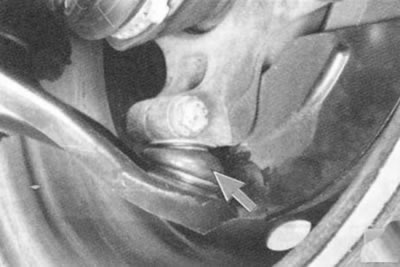
1. Check the condition of the ball joint protective boots. If the boots are damaged, replace the ball joints as an assembly.
Text provided by an online resource (www.renaultbook.ru)
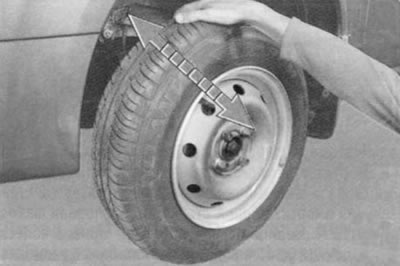
2. By rocking the wheel in a vertical plane, check the ball joints for play. If there is play in the ball pins, replace the lower arms as a whole.
Helpful advice: When rocking the front wheel while it is suspended, it is difficult to distinguish between play in the hub bearings and play in the ball joints. Ask an assistant to press the brake pedal: if you still feel play, the ball joints are faulty.
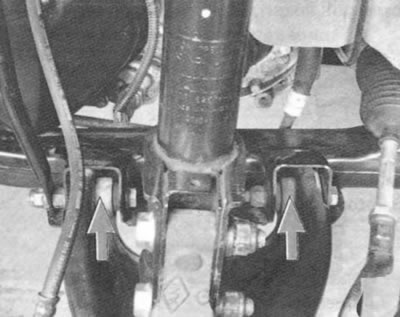
3. Check the rubber bushings and silent blocks where the levers are attached to the body.
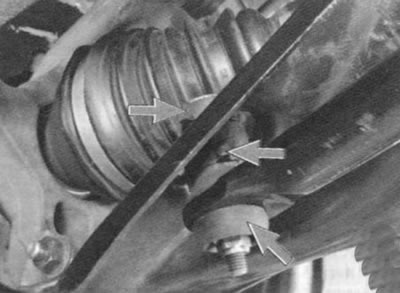
4. Check the condition of the rubber bushings at the anti-roll bar mounting points (on vehicles equipped with a stabilizer) to the suspension arms...
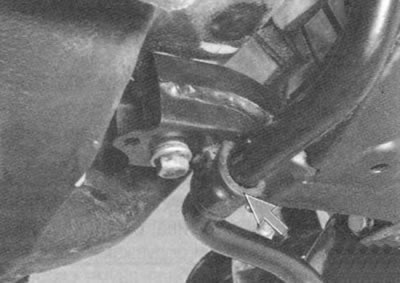
5. ...and also rubber cushions of the stabilizer in the places where the rod is attached to the subframe
6. Check the condition of the shock absorber strut protective cover.