English Русский
Български
Беларускі
Український
Српски
Hrvatski
Română
Polski
Slovenský
Magyar
Bookmark Contacts Articles Sitemap
Company vehicles Peugeot Company vehicles Opel Company vehicles Skoda Company vehicles Land Rover Company vehicles Mitsubishi Company vehicles Volkswagen Company vehicles Honda
RenaultBook.ru


Duster   Fluence   Kangoo   Laguna   Logan   Megane   Sandero   Scenic   Symbol   Clio   Other
Logan 1 (2004-2012, petrol) Logan 2 (2012-2020)

Checking the brake system (Renault Logan 1)

  • Main
  • Logan
  • Logan 1 (2004-2012, petrol)
  • General information
  • Faults en route
  • Checking the brake system
0
Checking the brake system

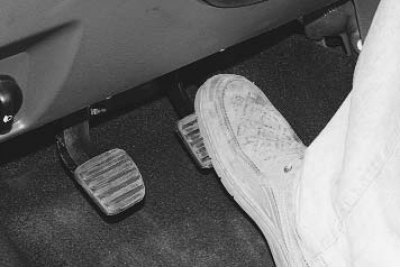
1. The reason for the loss of braking efficiency may be poor operation of the vacuum booster. To quickly check it, press the brake pedal several times with the engine off to remove the vacuum in the booster, and then, holding the pedal, start the engine. If the pedal drops slightly after starting the engine, the vacuum booster is working properly.

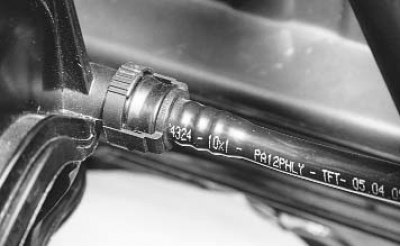
2. If the pedal remains motionless, check the integrity and reliability of the connection of the vacuum booster hose to the fitting on the engine intake pipe...
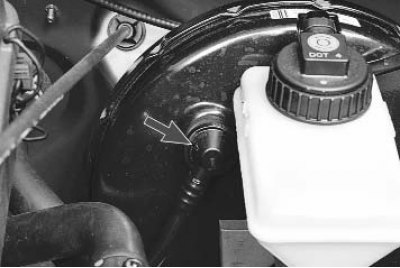
2. If the pedal remains motionless, check the integrity and reliability of the connection of the…


3. ...and with the booster. Replace or repair the faulty hose. If the hose is OK, the vacuum booster must be replaced (see "Replacing the vacuum booster").


Note: The vacuum booster hose is made in one piece with the check valve. Check its functionality (see "Checking the operation of the brake booster"). If the check valve is faulty, replace the vacuum booster hose assembly.


If braking is accompanied by beating and pulsation of the brake pedal, you should first check the condition of the front disc brakes.

Note: Pulsation of the brake pedal of a vehicle equipped with an anti-lock braking system is not a sign of a malfunction, as it is part of the design.


Text published on the website RENAULTBOOK
Note: Pulsation of the brake pedal of a vehicle equipped with an anti-lock braking system is not a…

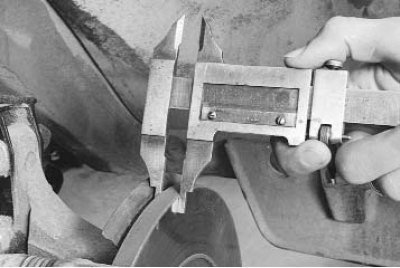
4. After jacking up the car, remove the front wheels one by one and inspect the brake discs. The thickness of the brake disc should be at least 10.6 mm, the disc surface should be even and smooth on both sides. If the disc surface is covered with rust in places, which usually happens after the car has been parked for a long time with un-dried brakes, try cleaning the working surface with fine sandpaper. If this procedure does not help, you will have to send the discs for grinding or replace them with new ones.


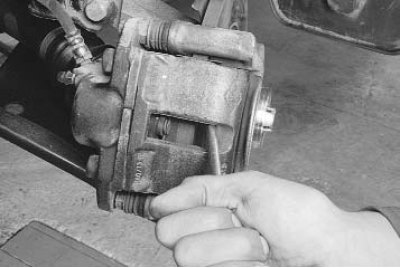
5. Check the mobility of the brake piston. To do this, try to move the brake caliper with a screwdriver. If the caliper cannot be moved, then the piston is jammed in the brake cylinder.

Attention! Jamming of the brake cylinder piston leads to constant braking of the corresponding wheel when the pedal is released and skidding of the car when braking.


If braking is accompanied by jerking of the car and creaking in the area of the rear wheels, and also if the rear of the car skids during intensive braking, check the condition of the drum brakes of the rear wheels.
If braking is accompanied by jerking of the car and creaking in the area of the rear wheels, and…


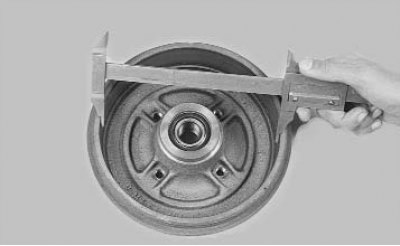
6. After placing the car on a jack, remove the rear wheels one by one, remove the brake drums (see "Removing and installing the brake drum") and measure the diameters of their working surfaces. The inner diameter of the drum should be no more than 204.45 mm, the working surface of the drum should be even and smooth, without ring marks and clearly visible ovality (ovality can be determined by the unevenly worn working surface of the drum). If the internal diameter of the drum is larger than the permissible value, the ring marks are very deep, or uneven wear of the working surface is clearly visible, the drum will have to be replaced with a new one.

Note: The parking brake operates the rear brakes via a cable that connects the parking brake lever and the brake shoe control mechanism. Many drivers try to use the parking brake as little as possible to extend its "life", and achieve the opposite result. If you do not use the parking brake, dirt and moisture stagnate in the cable sheaths, the cable becomes covered with rust, stops moving and breaks. Therefore, use the parking brake when necessary, but do not forget to adjust its drive from time to time (see "Adjusting the Parking Brake Drive").
This article is available on: russian, bulgarian, belarusian, ukrainian, serbian, croatian, romanian, polish, slovak, hungarian
Article has been reviewed by editor: Podkrepilov Maxim
Share with friends:
Previous
Logan 1: Faults en route
Next

Bleeding the brake system
Brake problems
Extraneous knocking sounds appeared
Electrical equipment faults
Starting the engine from external power sources
Puncture of the tire
Replacing a punctured tire
Other articles on other Renault models

➽ Checking the brake system for leaks and damage Renault 19 (1988-1996)
➽ Checking the cooling system using the Mot. 1700 tool Renault Duster 1 (2009-2017)
➽ Checking the tightness of the cooling system Renault Fluence 1 (2009-2020, petrol)
➽ Checking the tightness of the cooling system Renault Kangoo 1 (1997-2007)
➽ Checking the tightness of the system Renault Laguna 2 (2001-2007)
Link to this article in different formats
Reviews and comments of visitors
No comments yet


Add two numbers 26 + 42


Logan 2 (2012-2020) 
  • General information
  • Faults en route
  • Daily checks
  • Governing bodies
  • Maintenance
  • Power unit
  • Petrol engines 1.2 l
  • Petrol engines 1.6 l
  • Diesel engines 1.5 l
  • Cooling system
  • Lubrication system
  • Power and control system
  • Intake and exhaust system
  • Engine electrical equipment
  • Transmission
  • Clutch
  • Car gearbox
  • Drive shafts
  • Chassis, running gear
  • Suspension and wheels
  • Brake system
  • Steering
  • Body and interior
  • Exterior (external elements)
  • Interior (internal elements)
  • Safety system
  • Heating and air conditioning
  • Electrical equipment
  • Equipment and devices
  • Wiring diagrams (sedan)
  • Wiring diagrams (wagon)
Logan 1 (2004-2012, petrol) 
  • General information
  • Vehicle device
  • User manual
  • Faults en route
  • Daily maintenance
  • First maintenance
  • Second maintenance
  • Driver tips
  • Power unit
  • Engine repair
  • Lubrication system
  • Cooling system
  • Power and exhaust system
  • Transmission
  • Clutch
  • Car gearbox
  • Drive shafts
  • Chassis, running gear
  • Front suspension
  • Rear suspension
  • Steering
  • Brake system
  • Wheels and tires
  • Body and interior
  • Exterior (external elements)
  • Interior (internal elements)
  • Doors, locks and windows
  • Body Care
  • Electrical equipment
  • Equipment and devices
  • Headlights and lighting
  • Power devices
  • Electrical circuits
RenaultBook.ru © 2018–2026 | Mobile version | News and articles | Sitemap: EN BG BY UA RS HR RO PL SK HU | Administration | Site search | Bookmark
Duster 1 (2009-2017) | Fluence 1 (2009-2020, petrol) | Kangoo 1 (1997-2007) | Laguna 2 (2001-2007) | Logan 1 (2004-2012, petrol) | Logan 2 (2012-2020) | Megane 1 (1995-2002) | Megan 2 (2002-2009, petrol) | Sandero 1 (2007-2012, petrol) | Scenic 1 (1996-2003) | Symbol 1 (1999-2008, petrol) | Symbol 2 (2008-2013, petrol) | Renault 19 (1988-1996) | Espace I and II (1984-1996) | Espace III (1996-2002) | Clio 1 (1990-1998) |
We want your visit to be comfortable 😌 and use cookies 🍪 to do so.