
English Русский
Български
Беларускі
Український
Српски
Hrvatski
Română
Polski
Slovenský
Magyar
Bookmark Contacts Articles Sitemap
Company vehicles Peugeot Company vehicles Opel Company vehicles Skoda Company vehicles Land Rover Company vehicles Mitsubishi Company vehicles Volkswagen Company vehicles Honda
RenaultBook.ru


Duster   Fluence   Kangoo   Laguna   Logan   Megane   Sandero   Scenic   Symbol   Clio   Other
Logan 1 (2004-2012, petrol) Logan 2 (2012-2020)

Replacing the brake booster (Renault Logan 1)

  • Main
  • Logan
  • Logan 1 (2004-2012, petrol)
  • Chassis, running gear
  • Brake system
  • Replacing the brake booster
0
The vacuum brake booster is a complex structure that is difficult to disassemble. Its adjustment and repair require qualified personnel and special equipment. In addition, the booster is a device that directly affects traffic safety; poor-quality repairs can lead to serious consequences, so if there is a malfunction, replace the entire booster. Methods for checking the performance of the vacuum brake booster are described in Section 4 "Maintenance" (see "Checking the Operation of the Vacuum Brake Booster").

You will need: a flat-blade screwdriver, a 13 mm socket head.
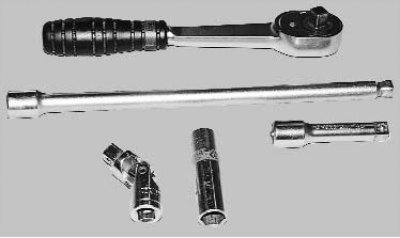
You will need: a flat-blade screwdriver, a 13 mm socket head.


Note: To loosen the hard-to-reach vacuum booster mounting nuts, you will need a set of socket heads, extensions and ratchets similar to the one shown in the photo.


1. Disconnect the wire from the negative terminal of the battery.
1. Disconnect the wire from the negative terminal of the battery.


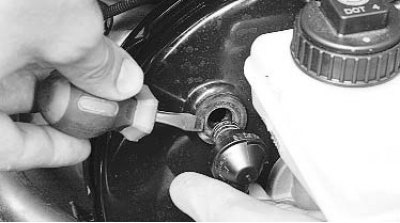
2. Disconnect the hose from the vacuum booster to the inlet pipe by prying off the hose check valve with a screwdriver.


3. Remove the brake master cylinder (see "Replacing the master brake cylinder").
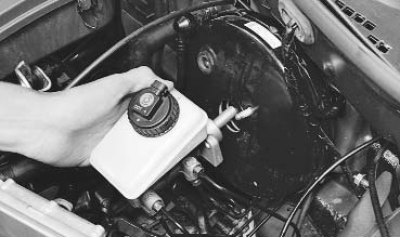
3. Remove the brake master cylinder (see «Replacing the master brake cylinder»).


Note: If the operator has sufficient skills, the master brake cylinder does not need to be removed completely; it is enough to disconnect it from the brake booster and move it forward without disconnecting the pipes from it.
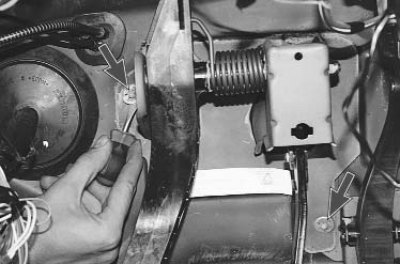

Note: If the operator has sufficient skills, the master brake cylinder does not need to be removed…


4. Using a screwdriver, remove the two soundproofing holders...
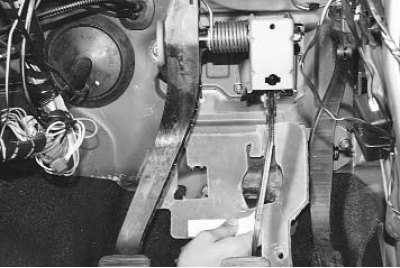
4. Using a screwdriver, remove the two soundproofing holders...


5. ...and remove the cover.
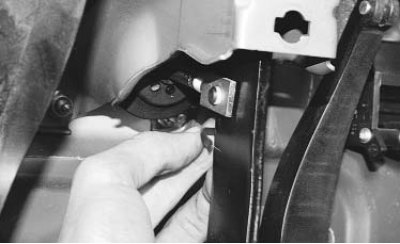


5. ...and remove the cover.


Source link is located on: RENAULTBOOK

6. Disconnect the brake booster pushrod from the brake pedal by unfastening the spring pin retainer from the pedal...
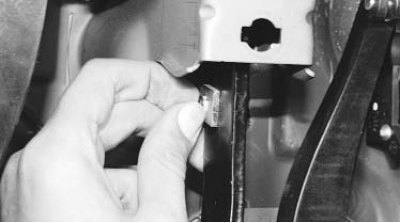
6. Disconnect the brake booster pushrod from the brake pedal by unfastening the spring pin retainer…


7. ...and, squeezing the plastic retaining ring...
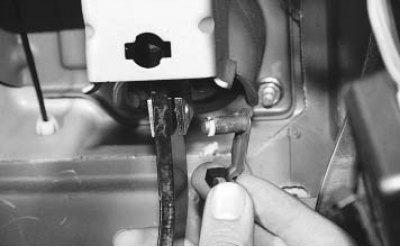
7. ...and, squeezing the plastic retaining ring...


8. ... remove the pin from the holes in the pedal and pusher fork.
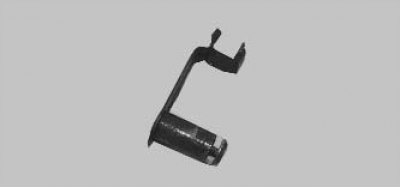
8. ... remove the pin from the holes in the pedal and pusher fork.


Note: Replace the brake booster pushrod pin if it is worn or if the spring clip and snap ring are damaged.
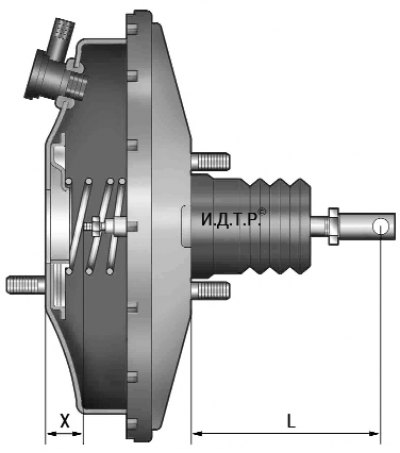


Note: Replace the brake booster pushrod pin if it is worn or if the spring clip and snap ring are…


9.7. Adjustment dimensions of the brake booster: X=22.3 mm; L=145.8 mm
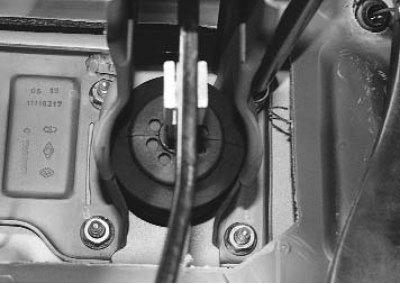
9.7. Adjustment dimensions of the brake booster: X=22.3 mm; L=145.8 mm


9. Unscrew the four nuts securing the brake booster to the front shield...
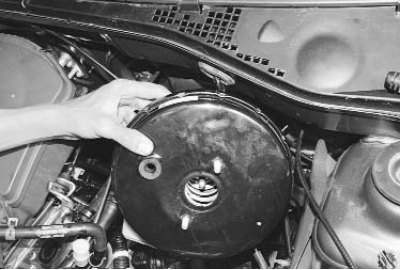
9. Unscrew the four nuts securing the brake booster to the front shield...


10. ...and remove the vacuum booster.

11. Install the vacuum booster and all removed parts in the reverse order of removal. Before installation, check the adjustment dimensions of the booster (figure 9.7) and, if necessary, restore them by turning the booster rod adjusting bolt (dimension X) and the pusher fork with the lock nut (dimension L) loosened.


Note: The booster rod adjusting bolt is secured against loosening during operation with anaerobic thread lock.


12. If the master cylinder was completely removed, fill the brake fluid and bleed the air from the system (see "Bleeding the hydraulic brake system").
This article is available on: russian, bulgarian, belarusian, ukrainian, serbian, croatian, romanian, polish, slovak, hungarian
Article has been reviewed by editor: Podkrepilov Maxim
Share with friends:
Previous
Logan 1: Brake system
Next

Replacing the master brake cylinder
Replacing the brake master cylinder reservoir
Checking and adjusting the brake pedal
Bleeding the hydraulic brake system
Possible malfunctions of the brake system
Replacing the brake force regulator in the rear brake hydraulic drive
Replacing brake hoses
Replacing brake pipes
Replacing the brake pads of the front wheel brake mechanism
Replacing the front wheel brake caliper
Other articles on other Renault models

➽ Brake booster check valve Renault Duster 1 (2009-2017)
➽ Checking the operation of the brake booster check valve Renault Fluence 1 (2009-2020, petrol)
➽ Vacuum brake booster Renault Kangoo 1 (1997-2007)
➽ Brake booster (manual transmission JH3-JR5) — removal Renault Laguna 2 (2001-2007)
➽ Replacing the rear brake pads Renault Megane 1 (1995-2002)
Link to this article in different formats
Reviews and comments of visitors
No comments yet


Add two numbers 40 + 20


Logan 2 (2012-2020) 
  • General information
  • Faults en route
  • Daily checks
  • Governing bodies
  • Maintenance
  • Power unit
  • Petrol engines 1.2 l
  • Petrol engines 1.6 l
  • Diesel engines 1.5 l
  • Cooling system
  • Lubrication system
  • Power and control system
  • Intake and exhaust system
  • Engine electrical equipment
  • Transmission
  • Clutch
  • Car gearbox
  • Drive shafts
  • Chassis, running gear
  • Suspension and wheels
  • Brake system
  • Steering
  • Body and interior
  • Exterior (external elements)
  • Interior (internal elements)
  • Safety system
  • Heating and air conditioning
  • Electrical equipment
  • Equipment and devices
  • Wiring diagrams (sedan)
  • Wiring diagrams (wagon)
Logan 1 (2004-2012, petrol) 
  • General information
  • Vehicle device
  • User manual
  • Faults en route
  • Daily maintenance
  • First maintenance
  • Second maintenance
  • Driver tips
  • Power unit
  • Engine repair
  • Lubrication system
  • Cooling system
  • Power and exhaust system
  • Transmission
  • Clutch
  • Car gearbox
  • Drive shafts
  • Chassis, running gear
  • Front suspension
  • Rear suspension
  • Steering
  • Brake system
  • Wheels and tires
  • Body and interior
  • Exterior (external elements)
  • Interior (internal elements)
  • Doors, locks and windows
  • Body Care
  • Electrical equipment
  • Equipment and devices
  • Headlights and lighting
  • Power devices
  • Electrical circuits
RenaultBook.ru © 2018–2026 | Mobile version | News and articles | Sitemap: EN BG BY UA RS HR RO PL SK HU | Administration | Site search | Bookmark
Duster 1 (2009-2017) | Fluence 1 (2009-2020, petrol) | Kangoo 1 (1997-2007) | Laguna 2 (2001-2007) | Logan 1 (2004-2012, petrol) | Logan 2 (2012-2020) | Megane 1 (1995-2002) | Megan 2 (2002-2009, petrol) | Sandero 1 (2007-2012, petrol) | Scenic 1 (1996-2003) | Symbol 1 (1999-2008, petrol) | Symbol 2 (2008-2013, petrol) | Renault 19 (1988-1996) | Espace I and II (1984-1996) | Espace III (1996-2002) | Clio 1 (1990-1998) |
We want your visit to be comfortable 😌 and use cookies 🍪 to do so.