
English Русский
Български
Беларускі
Український
Српски
Hrvatski
Română
Polski
Slovenský
Magyar
Bookmark Contacts Articles Sitemap
Company vehicles Peugeot Company vehicles Opel Company vehicles Skoda Company vehicles Land Rover Company vehicles Mitsubishi Company vehicles Volkswagen Company vehicles Honda
RenaultBook.ru


Duster   Fluence   Kangoo   Laguna   Logan   Megane   Sandero   Scenic   Symbol   Clio   Other
Logan 1 (2004-2012, petrol) Logan 2 (2012-2020)

Replacing the rear wheel brake slave cylinder (Renault Logan 1)

  • Main
  • Logan
  • Logan 1 (2004-2012, petrol)
  • Chassis, running gear
  • Brake system
  • Replacing the rear wheel brake slave cylinder
0
If during operation there are leaks of brake fluid on the brake drum and the inner side of the wheel, or the pistons in the cylinder are jammed, replace the slave cylinder.

You will need: key "for 10" (a socket head is more convenient), special key "11" for pipeline nuts, key for wheel bolts.

1. Engage 1st gear and place chocks under the front wheels.

2. Remove the appropriate wheel (see "Wheel change").
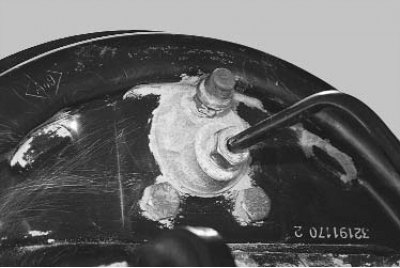
2. Remove the appropriate wheel (see «Wheel change»).


3. Clean the brake pipe mounting location and the working cylinder mounting bolts from dirt on the back side of the brake shield.

4. Remove the brake drum (see "Removing and installing the brake drum").

5. Raise the parking brake lever – the upper ends of the pads will move away from the piston stops of the working cylinder.
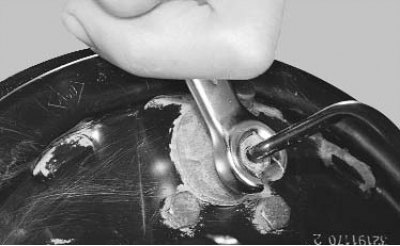
5. Raise the parking brake lever – the upper ends of the pads will move away from the piston stops…


6. Unscrew the nut securing the brake pipe to the working cylinder...
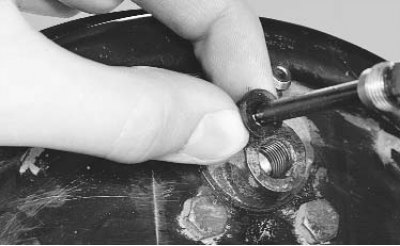


6. Unscrew the nut securing the brake pipe to the working cylinder...


7. ... and plug the opening of the tube, for example with an air release valve cap.

Note. After long-term use, the brake pipe nut "grows together" with the pipe into one whole; when you try to unscrew the nut, the pipe twists and breaks. In this case, just slightly move the pipe nut, then unscrew the cylinder mounting bolts and disconnect it from the pipe, unscrewing the cylinder from its nut. After disconnecting the cylinder from the pipe, the mobility of the released nut can be restored by wetting it with brake fluid and turning it with a wrench alternately in both directions.
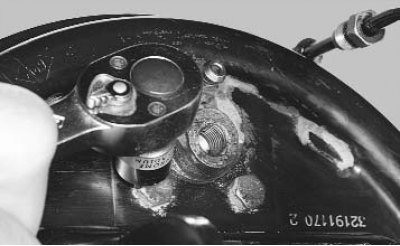

Note. After long-term use, the brake pipe nut «grows together» with the pipe into one whole; when…


8. Unscrew the two bolts securing the working cylinder, holding it from the other side...
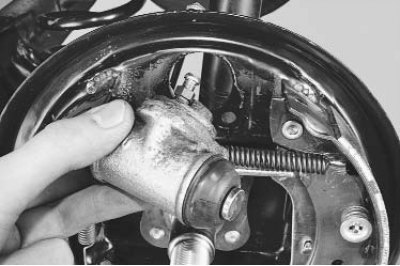
8. Unscrew the two bolts securing the working cylinder, holding it from the other side...


9. ...and remove the slave cylinder.


Note: If the new cylinder's bleeder valve does not have a protective cap, remove the cap from the old valve.


10. Install the slave cylinder in the reverse order of removal.

11. Remove air from the brake system (see "Bleeding the hydraulic brake system").

12. Press the brake pedal sharply several times to bring the brake shoes to the drum.
This article is available on: russian, bulgarian, belarusian, ukrainian, serbian, croatian, romanian, polish, slovak, hungarian
Article has been reviewed by editor: Podkrepilov Maxim
Share with friends:
Previous
Logan 1: Brake system
Next

Replacing the brake pads of the rear wheel brake mechanism
Removal and installation the brake drum
Replacing the brake disc
Replacing the front wheel brake caliper
Replacing the brake pads of the front wheel brake mechanism
Adjusting the parking brake drive
Replacing the parking brake cables
Removal and installation the parking brake lever
Other articles on other Renault models

➽ Replacing the rear wheel brake slave cylinder Renault Sandero 1 (2007-2012, petrol)
➽ Removal and installation the rear wheel brake cylinder Renault Symbol 1 (1999-2008, petrol)
➽ Rear drum brake slave cylinder Renault Espace III (1996-2002)
➽ Rear brake service cylinder Renault Duster 1 (2009-2017)
➽ Replacing rear brake pads Renault Fluence 1 (2009-2020, petrol)
Link to this article in different formats
Reviews and comments of visitors
No comments yet


Add two numbers 24 + 20


Logan 2 (2012-2020) 
  • General information
  • Faults en route
  • Daily checks
  • Governing bodies
  • Maintenance
  • Power unit
  • Petrol engines 1.2 l
  • Petrol engines 1.6 l
  • Diesel engines 1.5 l
  • Cooling system
  • Lubrication system
  • Power and control system
  • Intake and exhaust system
  • Engine electrical equipment
  • Transmission
  • Clutch
  • Car gearbox
  • Drive shafts
  • Chassis, running gear
  • Suspension and wheels
  • Brake system
  • Steering
  • Body and interior
  • Exterior (external elements)
  • Interior (internal elements)
  • Safety system
  • Heating and air conditioning
  • Electrical equipment
  • Equipment and devices
  • Wiring diagrams (sedan)
  • Wiring diagrams (wagon)
Logan 1 (2004-2012, petrol) 
  • General information
  • Vehicle device
  • User manual
  • Faults en route
  • Daily maintenance
  • First maintenance
  • Second maintenance
  • Driver tips
  • Power unit
  • Engine repair
  • Lubrication system
  • Cooling system
  • Power and exhaust system
  • Transmission
  • Clutch
  • Car gearbox
  • Drive shafts
  • Chassis, running gear
  • Front suspension
  • Rear suspension
  • Steering
  • Brake system
  • Wheels and tires
  • Body and interior
  • Exterior (external elements)
  • Interior (internal elements)
  • Doors, locks and windows
  • Body Care
  • Electrical equipment
  • Equipment and devices
  • Headlights and lighting
  • Power devices
  • Electrical circuits
RenaultBook.ru © 2018–2026 | Mobile version | News and articles | Sitemap: EN BG BY UA RS HR RO PL SK HU | Administration | Site search | Bookmark
Duster 1 (2009-2017) | Fluence 1 (2009-2020, petrol) | Kangoo 1 (1997-2007) | Laguna 2 (2001-2007) | Logan 1 (2004-2012, petrol) | Logan 2 (2012-2020) | Megane 1 (1995-2002) | Megan 2 (2002-2009, petrol) | Sandero 1 (2007-2012, petrol) | Scenic 1 (1996-2003) | Symbol 1 (1999-2008, petrol) | Symbol 2 (2008-2013, petrol) | Renault 19 (1988-1996) | Espace I and II (1984-1996) | Espace III (1996-2002) | Clio 1 (1990-1998) |
We want your visit to be comfortable 😌 and use cookies 🍪 to do so.