English Русский
Български
Беларускі
Український
Српски
Hrvatski
Română
Polski
Slovenský
Magyar
Bookmark Contacts Articles Sitemap
Company vehicles Peugeot Company vehicles Opel Company vehicles Skoda Company vehicles Land Rover Company vehicles Mitsubishi Company vehicles Volkswagen Company vehicles Honda
RenaultBook.ru


Duster   Fluence   Kangoo   Laguna   Logan   Megane   Sandero   Scenic   Symbol   Clio   Other
Logan 1 (2004-2012, petrol) Logan 2 (2012-2020)

Replacing the brake pads of the front wheel brake mechanism (Renault Logan 1)

  • Main
  • Logan
  • Logan 1 (2004-2012, petrol)
  • Chassis, running gear
  • Brake system
  • Replacing the brake pads of the front wheel brake mechanism
0
Check the condition of the brake pads at every maintenance (see "Checking the degree of wear of brake pads, discs and drums").

Brake pads must be replaced if the linings are worn, the linings are not firmly connected to the base, the working surfaces are oily, or there are deep grooves or chips.

Caution! Replace front brake pads only as a set of 4. (two on each side). Before replacing the brake pads, check the brake fluid level in the master cylinder reservoir. If the level is close to the upper mark, you need to pump out some of the fluid: after replacing the worn pads with new ones, the fluid level will rise.


You will need: keys "13", "17", screwdriver.

1. Remove the left front wheel.
1. Remove the left front wheel.


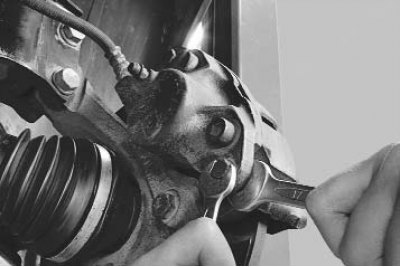
2. Unscrew the bolt securing the lower guide pin of the caliper...
2. Unscrew the bolt securing the lower guide pin of the caliper...


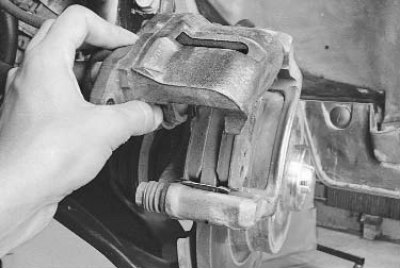
3. ...and lift the caliper up.


3. ...and lift the caliper up.


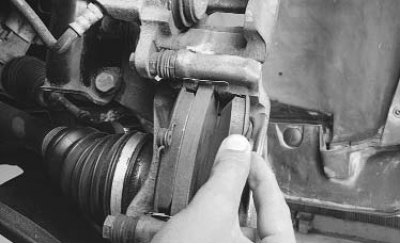
4. Remove the outer brake shoe from the guide.
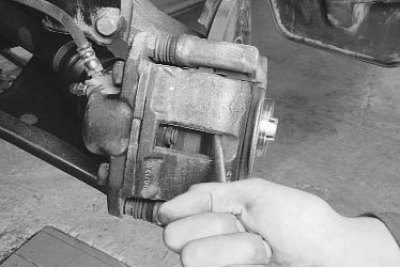
4. Remove the outer brake shoe from the guide.


5. Lower the caliper into place and depress the slave cylinder piston by inserting a screwdriver between the caliper and the brake disc and sliding the caliper outward.

6. Fold the caliper upward and remove the inner brake pad from the guide.

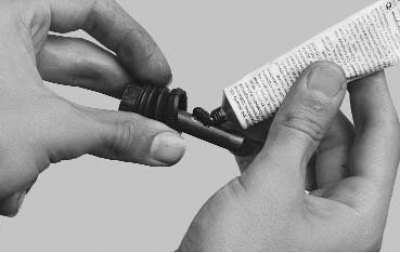
Note. Every time you replace the brake pads, be sure to check the condition of the protective rubber boots of the guide pin, as well as the movement of the caliper relative to the brake pad guide. If movement is difficult, lubricate the caliper guide pins with grease. To do this...
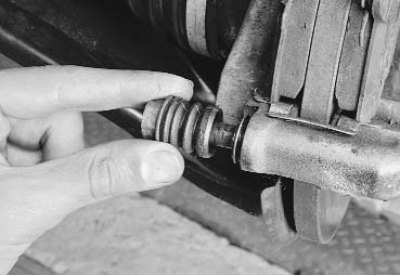

Note. Every time you replace the brake pads, be sure to check the condition of the protective…


...remove the guide pin...


...remove the guide pin...


...lubricate it with consistent grease and put grease into the inner cavity of the boot. Install the pin into the pad guide in the reverse order of removal. If signs of rubber aging appear, replace the protective boots of the guide pins.

7. Install the brake pads into the guides in the reverse order of removal. To prevent the caliper guide pin mounting bolt from loosening on its own, lubricate its threads with anaerobic thread locker before installation. Tighten the bolt to a torque of 34 N·m (3.4 kgf·m).

8. Press the brake pedal several times to bring the brake pads to the disc.

9. Install the wheel.

10. Similarly, replace the brake pads of the right wheel brake mechanism.

11. Check and, if necessary, restore the brake fluid level in the master cylinder reservoir.

Note. After replacing worn brake pads with new ones, do not rush to drive on busy highways. It is possible that during the first intensive braking you will be unpleasantly surprised by the low efficiency of the brakes, despite the fact that the original pads are installed. Brake discs also wear out, and new pads only touch them with the edges, practically without braking. Choose a quiet street or a passage without cars and brake smoothly several times so that the pads rub in and begin to fit over the entire surface. At the same time, evaluate the efficiency of the brakes.
Try not to brake sharply for at least the first 100 km. If the brake pads are too hot, the top layer of their linings will burn and the brakes will not be as effective as possible for a long time.
This article is available on: russian, bulgarian, belarusian, ukrainian, serbian, croatian, romanian, polish, slovak, hungarian
Article has been reviewed by editor: Podkrepilov Maxim
Share with friends:
Previous
Logan 1: Brake system
Next

Replacing brake pipes
Replacing brake hoses
Replacing the brake force regulator in the rear brake hydraulic drive
Replacing the brake booster
Replacing the master brake cylinder
Replacing the front wheel brake caliper
Replacing the brake disc
Removal and installation the brake drum
Replacing the brake pads of the rear wheel brake mechanism
Replacing the rear wheel brake slave cylinder
Other articles on other Renault models

➽ Replacing the brake pads of the front wheel brake mechanism Renault Sandero 1 (2007-2012, petrol)
➽ Replacing the front brake pads Renault Fluence 1 (2009-2020, petrol)
➽ Replacing the front brake pads Renault Megane 1 (1995-2002)
➽ Replacing the front brake pads Renault Symbol 1 (1999-2008, petrol)
➽ Replacing the front brake pads Renault Espace III (1996-2002)
Link to this article in different formats
Reviews and comments of visitors
No comments yet


Add two numbers 22 + 11


Logan 2 (2012-2020) 
  • General information
  • Faults en route
  • Daily checks
  • Governing bodies
  • Maintenance
  • Power unit
  • Petrol engines 1.2 l
  • Petrol engines 1.6 l
  • Diesel engines 1.5 l
  • Cooling system
  • Lubrication system
  • Power and control system
  • Intake and exhaust system
  • Engine electrical equipment
  • Transmission
  • Clutch
  • Car gearbox
  • Drive shafts
  • Chassis, running gear
  • Suspension and wheels
  • Brake system
  • Steering
  • Body and interior
  • Exterior (external elements)
  • Interior (internal elements)
  • Safety system
  • Heating and air conditioning
  • Electrical equipment
  • Equipment and devices
  • Wiring diagrams (sedan)
  • Wiring diagrams (wagon)
Logan 1 (2004-2012, petrol) 
  • General information
  • Vehicle device
  • User manual
  • Faults en route
  • Daily maintenance
  • First maintenance
  • Second maintenance
  • Driver tips
  • Power unit
  • Engine repair
  • Lubrication system
  • Cooling system
  • Power and exhaust system
  • Transmission
  • Clutch
  • Car gearbox
  • Drive shafts
  • Chassis, running gear
  • Front suspension
  • Rear suspension
  • Steering
  • Brake system
  • Wheels and tires
  • Body and interior
  • Exterior (external elements)
  • Interior (internal elements)
  • Doors, locks and windows
  • Body Care
  • Electrical equipment
  • Equipment and devices
  • Headlights and lighting
  • Power devices
  • Electrical circuits
RenaultBook.ru © 2018–2026 | Mobile version | News and articles | Sitemap: EN BG BY UA RS HR RO PL SK HU | Administration | Site search | Bookmark
Duster 1 (2009-2017) | Fluence 1 (2009-2020, petrol) | Kangoo 1 (1997-2007) | Laguna 2 (2001-2007) | Logan 1 (2004-2012, petrol) | Logan 2 (2012-2020) | Megane 1 (1995-2002) | Megan 2 (2002-2009, petrol) | Sandero 1 (2007-2012, petrol) | Scenic 1 (1996-2003) | Symbol 1 (1999-2008, petrol) | Symbol 2 (2008-2013, petrol) | Renault 19 (1988-1996) | Espace I and II (1984-1996) | Espace III (1996-2002) | Clio 1 (1990-1998) |
We want your visit to be comfortable 😌 and use cookies 🍪 to do so.