English Русский
Български
Беларускі
Український
Српски
Hrvatski
Română
Polski
Slovenský
Magyar
Bookmark Contacts Articles Sitemap
Company vehicles Peugeot Company vehicles Opel Company vehicles Skoda Company vehicles Land Rover Company vehicles Mitsubishi Company vehicles Volkswagen Company vehicles Honda
RenaultBook.ru


Duster   Fluence   Kangoo   Laguna   Logan   Megane   Sandero   Scenic   Symbol   Clio   Other
Symbol 1 (1999-2008, petrol) Symbol 2 (2008-2013, petrol)

Checking the brake booster (Renault Symbol 1)

  • Main
  • Symbol
  • Symbol 1 (1999-2008, petrol)
  • Chassis, running gear
  • Brake system
  • Checking the brake booster
0
Without starting the engine, press the brake pedal several times to remove the vacuum in the booster chamber and, holding the pedal pressed all the way down, start the engine. Simultaneously with the engine running, the brake pedal should "fall" slightly, this means that the vacuum brake booster is working properly.

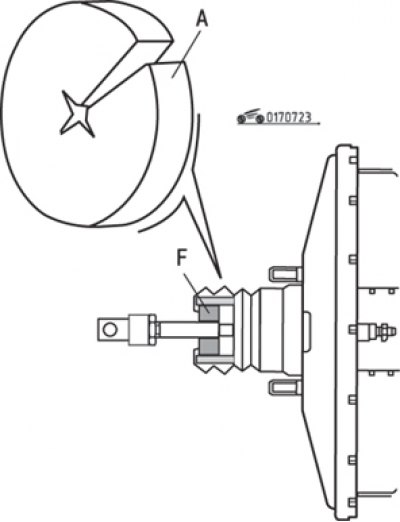
If the pedal does not "fall through", you should check the booster air filter. To do this, remove the rubber cover in the rear of the booster in the passenger compartment near the brake pedal and slide the cover along the rod.

Fig. 7.23. Replacing the brake booster air filter: A – air filter cut area; F – air filter…

Fig. 7.23. Replacing the brake booster air filter: A – air filter cut area; F – air filter installation location


Using a screwdriver, as shown in Fig. 7.23, remove the old air filter. Then, having made a cut in the new filter, install it in its proper place, making sure that it covers all the holes. Install the rubber cover and check the operation of the amplifier again.

Fig. 7.24. Brake booster check valve: 1 – valve; 2 – rubber seal

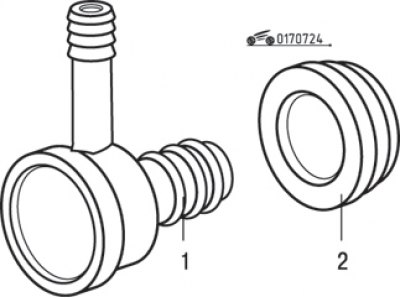
Fig. 7.24. Brake booster check valve: 1 – valve; 2 – rubber seal


If the result is unsatisfactory, try replacing the booster check valve. To do this, disconnect the vacuum hose from the vacuum booster. Pull out the check valve (Fig. 7.24), rotating it to remove it from the rubber seal.

Blow the valve, air should flow only in one direction - from the booster side. If the valve does not blow or blows in both directions, replace it. Check the condition of the rubber seal. Assemble the unit, connect the vacuum hose and check the operation of the booster.

If the amplifier still does not work, replace it, as the company does not supply a repair kit of parts.
This article is available on: russian, bulgarian, belarusian, ukrainian, serbian, croatian, romanian, polish, slovak, hungarian
Article has been reviewed by editor: Podkrepilov Maxim
Share with friends:
Previous
Symbol 1: Brake system
Next

Removal, installation and inspection of the brake booster
Removal and installation the master brake cylinder
Removal and installation the rear wheel brake cylinder
Removal, checking and installation rear brake pads
Removal and installation rear brake drums
Replacing brake hoses
Removal and installation the parking brake lever
Removal, installation and adjusting the brake light switch
Bleeding air from the hydraulic brake system
Operating principle of the ABS system
Other articles on other Renault models

➽ Checking the operation of the brake booster check valve Renault Fluence 1 (2009-2020, petrol)
➽ Checking the tightness of the brake booster Renault Laguna 2 (2001-2007)
➽ Checking the operation of the brake booster Renault Logan 1 (2004-2012, petrol)
➽ Checking the brake booster check valve Renault Megan 2 (2002-2009, petrol)
➽ Checking the operation of the brake booster Renault Sandero 1 (2007-2012, petrol)
Link to this article in different formats
Reviews and comments of visitors
No comments yet


Add two numbers 40 + 48


Symbol 2 (2008-2013, petrol) 
  • General information
  • User manual
  • Maintenance
  • Power unit
  • Engine repair
  • Cooling system
  • Fuel system
  • Exhaust system
  • Ignition system
  • Transmission
  • Clutch
  • Mechanical gearbox
  • Automatic gearbox
  • Drive shafts
  • Chassis, running gear
  • Front suspension
  • Rear suspension
  • Steering
  • Brake system
  • Body and interior
  • Exterior (external elements)
  • Interior (internal elements)
  • Doors, locks and windows
  • Heating and ventilation
  • Electrical equipment
  • Equipment and devices
  • Headlights and lighting
  • Power devices
  • Electrical circuits
Symbol 1 (1999-2008, petrol) 
  • General information
  • User manual
  • Car care
  • Maintenance
  • Power unit
  • Engine repair
  • Cooling and lubrication system
  • Supply system
  • Exhaust system
  • Ignition system
  • Transmission
  • Clutch
  • Mechanical gearbox
  • Automatic gearbox
  • Drive shafts
  • Chassis, running gear
  • Car suspension
  • Steering
  • Brake system
  • Body and interior
  • Exterior (external elements)
  • Interior (internal elements)
  • Doors, locks and windows
  • Restoration and repair
  • Electrical equipment
  • Equipment and devices
  • Headlights and lighting
  • Power devices
  • Heating and ventilation
  • Electrical circuits
RenaultBook.ru © 2018–2026 | Mobile version | News and articles | Sitemap: EN BG BY UA RS HR RO PL SK HU | Administration | Site search | Bookmark
Duster 1 (2009-2017) | Fluence 1 (2009-2020, petrol) | Kangoo 1 (1997-2007) | Laguna 2 (2001-2007) | Logan 1 (2004-2012, petrol) | Logan 2 (2012-2020) | Megane 1 (1995-2002) | Megan 2 (2002-2009, petrol) | Sandero 1 (2007-2012, petrol) | Scenic 1 (1996-2003) | Symbol 1 (1999-2008, petrol) | Symbol 2 (2008-2013, petrol) | Renault 19 (1988-1996) | Espace I and II (1984-1996) | Espace III (1996-2002) | Clio 1 (1990-1998) |
We want your visit to be comfortable 😌 and use cookies 🍪 to do so.