
English Русский
Български
Беларускі
Український
Српски
Hrvatski
Română
Polski
Slovenský
Magyar
Bookmark Contacts Articles Sitemap
Company vehicles Peugeot Company vehicles Opel Company vehicles Skoda Company vehicles Land Rover Company vehicles Mitsubishi Company vehicles Volkswagen Company vehicles Honda
RenaultBook.ru


Duster   Fluence   Kangoo   Laguna   Logan   Megane   Sandero   Scenic   Symbol   Clio   Other
Megane 1 (1995-2002) Megan 2 (2002-2009, petrol)

Starting the engine from an auxiliary power source (Renault Megane 1)

  • Main
  • Megane
  • Megane 1 (1995-2002)
  • General information
  • User manual
  • Starting the engine from an auxiliary power source
0
When starting the engine from an external source, remember to meet the following requirements:
  • a) Before connecting the booster battery, make sure the ignition key is turned to the "St" (Off) position.
  • b) Turn off all lights, heater and other electrical loads.
  • c) Take care to protect your eyes. It is best to use protective glasses.
  • d) Make sure the booster battery is rated for the same voltage as your vehicle's battery.
  • e) Two vehicles must not touch each other under any circumstances!
  • f) Make sure the transmission is in neutral (manual transmission) or "P" (automatic transmission).
  • g) If the booster battery is not a maintenance-free type, remove the vent caps and cover the vents with rags.

Connect the heavy gauge red jump start cable from the jump start kit to the positive (+) terminals of both batteries. Connect one end of the black jump start cable from the kit to the negative (-) terminal of the booster battery and the other end to a properly grounded point on the vehicle you are trying to jump start (for example, a bolt or bracket on an engine block). Make sure the wires do not touch the fan blades, drive belts or other moving parts of the engine.

Start the car, then, leaving the engine running at idle speed, turn on the heater voltmeter motor (at maximum speed) or a rear window defroster to smooth out voltage surges that may occur when the wires are disconnected (do not turn on lighting fixtures, as sudden voltage peaks may cause the lamps to burn out). Disconnect the wires in the reverse order of their connection.
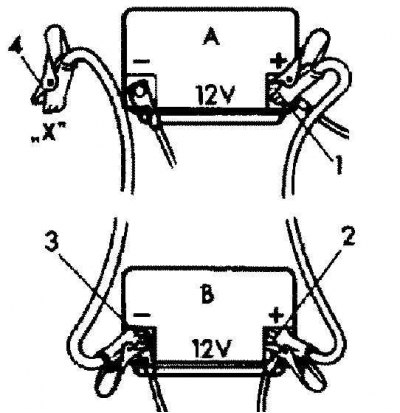


Start the car, then, leaving the engine running at idle speed, turn on the heater voltmeter motor…


Connect the jump start wires in the order shown in the illustration by the numbers (please note that the wire coming from the negative terminal of the auxiliary battery is not connected to the negative terminal of the dead battery).

(The original can be found on the website: www.RENAULTBOOK.ru)
This article is available on: russian, bulgarian, belarusian, ukrainian, serbian, croatian, romanian, polish, slovak, hungarian
Article has been reviewed by editor: Fedoseev Denis
Share with friends:
Previous
Megane 1: User manual
Next

Jacking and towing a car
Tools required for maintenance
Car maintenance and repair technologies
Purchase of spare parts
Vehicle Identification Numbers
Checking the vehicle's readiness for operation
Automotive chemicals, oils and lubricants
Car fault diagnostics
Dimensions, weight and tire pressure
Keys and remote control of a single door lock
Other articles on other Renault models

➽ Starting the engine from an auxiliary battery Renault Kangoo 1 (1997-2007)
➽ Starting the engine from external power sources Renault Logan 1 (2004-2012, petrol)
➽ Starting the engine from external power sources Renault Sandero 1 (2007-2012, petrol)
➽ Starting and stopping the engine Renault Duster 1 (2009-2017)
➽ Starting the engine with an additional battery Renault Fluence 1 (2009-2020, petrol)
Link to this article in different formats
Reviews and comments of visitors
No comments yet


Add two numbers 12 + 25


Megan 2 (2002-2009, petrol) 
  • User manual
  • Introduction to manual
  • Controls and instruments
  • Salon equipment
  • Operation and driving
  • Maintenance and care
  • Power unit
  • Engine repair
  • Fuel system
  • Injection system
  • Intake and exhaust system
  • Starting and charging system
  • Cooling system
  • Decreased toxicity
  • Transmission
  • Clutch
  • Mechanical gearbox
  • Automatic gearbox
  • Wheel drive mechanism
  • Chassis, running gear
  • Suspension and wheels
  • Steering
  • Brake system
  • Body and interior
  • Exterior (external elements)
  • Interior (internal elements)
  • Doors, locks and windows
  • Heating and air conditioning
  • Electrical equipment
  • Equipment and devices
  • Headlights and lighting
  • Electrical circuits
Megane 1 (1995-2002) 
  • General information
  • User manual
  • Maintenance
  • Power unit
  • Petrol engines 1.4/1.6 l
  • Petrol engines 2.0 l
  • Diesel engines 1.9 l
  • Overhaul of engines
  • Cooling system
  • Fuel system (petrol)
  • Fuel system (diesel)
  • Decreased toxicity
  • Charge and launch systems
  • Ignition system (petrol)
  • Preheat system (diesel)
  • Transmission
  • Clutch
  • Mechanical gearbox
  • Automatic gearbox
  • Drive shafts
  • Chassis, running gear
  • Brake system
  • Car suspension
  • Steering
  • Body and interior
  • Exterior (external elements)
  • Interior (internal elements)
  • Doors, locks and windows
  • Electrical equipment
  • Equipment and devices
  • Electrical circuits
RenaultBook.ru © 2018–2026 | Mobile version | News and articles | Sitemap: EN BG BY UA RS HR RO PL SK HU | Administration | Site search | Bookmark
Duster 1 (2009-2017) | Fluence 1 (2009-2020, petrol) | Kangoo 1 (1997-2007) | Laguna 2 (2001-2007) | Logan 1 (2004-2012, petrol) | Logan 2 (2012-2020) | Megane 1 (1995-2002) | Megan 2 (2002-2009, petrol) | Sandero 1 (2007-2012, petrol) | Scenic 1 (1996-2003) | Symbol 1 (1999-2008, petrol) | Symbol 2 (2008-2013, petrol) | Renault 19 (1988-1996) | Espace I and II (1984-1996) | Espace III (1996-2002) | Clio 1 (1990-1998) |
We want your visit to be comfortable 😌 and use cookies 🍪 to do so.