



Contents: Removal 🠛 Installation 🠛
Note: It is necessary to replace the "Nylstop" type nut with an "Enko" nut (installed without the use of a gripping compound). If the vehicle is already equipped with an "Enko" type nut, there is no need to replace it - it can be used four times. On models with a manual transmission, new roll pins securing the drive shaft to the differential will be required during installation.
Note: The outer CV joint grooves are coated with a gripping compound. Therefore, a puller will be required to remove the hub assembly from the end of the drive shaft.
Removal
1. Remove the hub cap/wheel cover (depending on the model), then loosen the drive shaft nut and wheel bolts.
2. Block the rear wheels of the car, set the handbrake, then jack up the front of the car and place it on axle stands. Remove the front wheel.
3. On models equipped with ABS, unscrew the wheel speed sensor bolts, move it away from the hub assembly and tie it to the body (refer to Chapter Brake system). Please note that there is no need to disconnect the wiring.
4. Remove the drive shaft retaining nut. If the nut was not loosened while the vehicle was unjacked, install the two wheel bolts into the hub and tighten them securely. Have an assistant firmly depress the brake pedal to lock the hub, then use a socket and extension bar to loosen and remove the nut. Alternatively, make a forked tool from two pieces of steel strip (one long, one short), connecting them with a bolt and nut. Attach the tool to the hub using two wheel bolts and, holding it thus stationary, unscrew the drive shaft mounting nut.
5. Loosen and remove the nut securing the tie rod end to the steering knuckle, then separate the ball joint from the hub using a special puller.
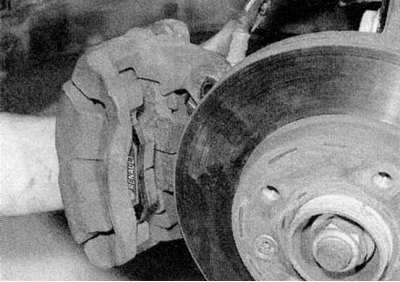
6. If it is necessary to remove the hub bearings, remove the brake disc as described in Chapter Brake system. Otherwise, remove the two bolts securing the caliper bracket assembly to the steering knuckle and remove the caliper from the disc (refer to the accompanying illustration). Use a piece of wire or twine to tie the caliper to the front suspension spring so as not to stretch the brake hose. If necessary, remove the wiring/brake hose bracket bolts from the strut.
7. Remove the nut and tie bolt securing the lower arm to the steering knuckle. Carefully pry the ball joint away from the steering knuckle, being careful not to damage the ball joint or the drive shaft boots. Note the plastic protective plate installed on the ball joint rod.
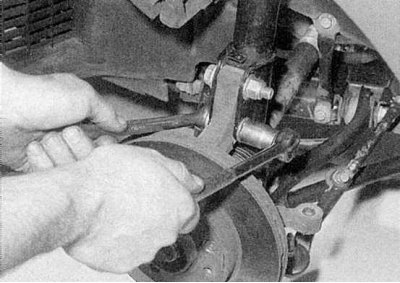
8. Remove the two nuts/washers from the bolts securing the steering knuckle to the strut, making sure the nuts are installed on the rear side of the strut (refer to the accompanying illustration). Remove the bolts and support the steering knuckle assembly.
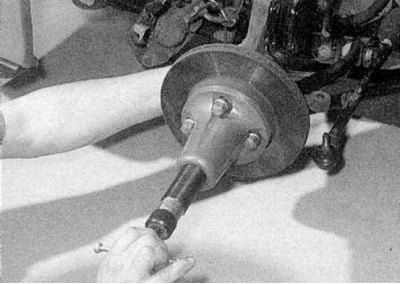
9. Release the drive shaft CV joint from the hub and remove the steering knuckle assembly. Note that the CV joint grooves have a gripping compound applied to them. Use a hammer and a soft metal punch or puller to force the joint out of the hub (refer to the accompanying illustration). Support the drive shaft to avoid damaging the CV joints and their boots.
Installation
1. Clean and dry the CV joint grooves and hub, then apply a gripping compound to the CV joint shaft (Renault recommends Lostite Scelbloc).
Article reprinted from the website [Renaultbook.ru]
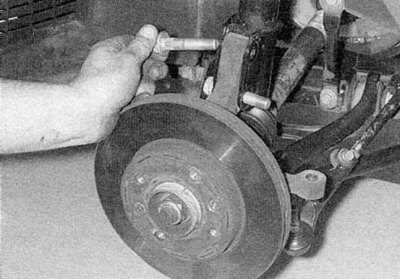
2. Align the grooves of the CV joint and the hub and move the hub along the drive shaft to the working position. Insert the two bolts securing the steering knuckle to the suspension strut (from the front of the rack), then install washers and nuts on them and tighten them to the specified Specifications by effort (refer to the accompanying illustration).
3. Install the washer and press in a new "Enko" type drive shaft nut (see note above).
4. Make sure the plastic protective plate is still on the lower control arm ball joint, then install the ball joint rod into the steering knuckle. Insert the ball joint pinch bolt and tighten the retaining nut to the specified Specifications effort.
5. Insert the ball joint of the tie rod end into the steering knuckle and tighten the mounting nut to the specified Specifications effort.
6. Insert the tie rod end ball joint into the steering knuckle and tighten the retaining nut to the specified torque Specifications effort.
7. On models equipped with ABS, install the sensor into the hub and tighten the mounting bolt to the specified tightening torque (refer to Chapter Brake system).
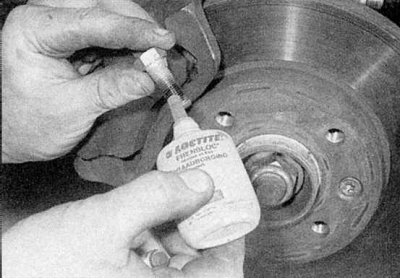
8. Install the brake disc, aligning the marks made before removal, and tighten the mounting screws to the specifications shown Specifications force. Place the brake caliper assembly in its working position on the disc. Apply a few drops of gripping compound to the caliper bolt threads (Renault recommends Lostite Frenbloc), then install the bolts and tighten them to the specified tightening torque (Chapter Brake system, refer to the illustration).
9. Lock the hub using the method used during its removal and tighten the new drive shaft retaining nut to the specifications shown Specifications alternatively, lightly tighten the nut at this stage, leaving the final tightening until the vehicle is lowered to the ground.
10. Make sure the hub rotates freely, then install the wheel and lower the vehicle to the ground. Tighten the wheel bolts to the specified Specifications effort.