



Removal
1. Block the front wheels and select reverse (or "P"). Jack up the rear of the car and place it on axle stands. Remove the rear wheel.
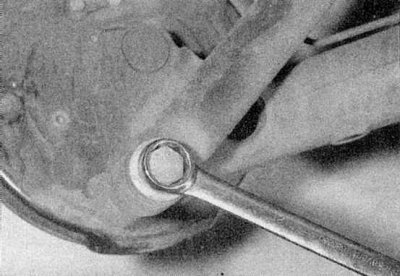
2. Using a jack, lift the trailing arm until the shock absorber is slightly compressed. Remove the lower mounting bolt and washer (refer to the accompanying illustration).
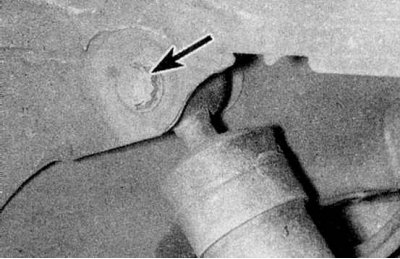
3. Loosen the upper mounting bolt and remove the shock absorber (refer to the accompanying illustration).
Checking the serviceability
1. Inspect the shock absorber for leaks. Check the piston rod for pitting and the shock absorber body for damage. Hold the shock absorber upright and check its operation by moving the piston through its full stroke and then through a shorter stroke several times (50 - 100 mm). In both cases, the resistance should be smooth and equal. If the piston moves jerkily or the elasticity of the shock absorber changes during the test, or if there is any visible sign of wear, replace the shock absorber. Check the condition of the shock absorber mounting bushings. Damage or excessive wear on them also means replacing the shock absorber - the bushings are not sold separately. Inspect the mounting bolts and replace them as necessary.
Installation
1. Before installing the shock absorber, tighten it vertically in a vice and move its piston through its full stroke several times to "pump" the component. Apply a small amount of multi-purpose grease to the shock absorber mounting bolts (Renault recommends Molykote BR2).
2. Place the shock absorber in the working position on the vehicle, then install the upper mounting bolt and tighten it by hand.
Article reprinted from the website www.RENAULTBOOK.ru
3. Install the lower shock absorber mounting bolt and tighten it by hand. Remove the jack from under the trailing arm.
4. Install the wheel, lower the vehicle to the ground and tighten the wheel bolts to the specified Specifications effort.
5. Rock the vehicle to adjust the position of the shock absorber bushings, then tighten both mounting bolts to the specified torque Specifications effort.