


| Engine model | Minimum oil pressure (bar) | Maximum oil pressure (bar) | |
| Idling | 4000 rpm | 4000 rpm | |
| K4M | 0,5 | 3,1 | 4,4 |
| K9K | 0,8 | 3,4 | 5,2 |
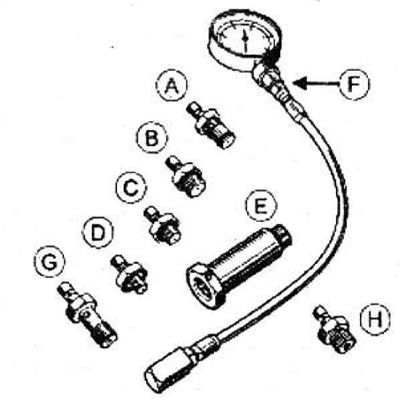
Tips used:
| Engine model | Tips |
| D4D, D4F | C + F |
| K4M, K7J, K7M, K9K | E + C + F |
Attention!
- Be sure to check the oil level using the dipstick.
- Do not allow the oil level to exceed the maximum level on the dipstick (this may lead to engine failure).
- Before handing over the vehicle to the owner, if necessary, bring the engine oil level up to the standard according to the oil dipstick.
Note: After adding oil to the engine, be sure to wait at least 10 minutes before checking the level on the dipstick to allow the oil to completely drain into the crankcase.
Remove the oil pressure sensor.
Install a tool with a suitable tip in place of the oil pressure sensor using the tool (Mot. 1495-01) or a high head of 22 mm.
Start the engine.
Monitor the oil pressure as the engine warms up (to approximately 80°C or until the electric fan of the engine cooling system first turns on), and it should not be lower than at idle.
If the oil pressure is lower than the idle pressure, make sure that:
- the oil filter is not clogged,
- there are no contaminants or metal filings in the oil,
- the oil pump and its drive are operational.
Check the oil pressure against the values given in the table above.
Stop the engine.
Remove the device with the fittings.
Install the oil pressure sensor.
Wipe off any oil stains with a rag.
Wait at least 10 minutes.
Check the engine oil level using the dipstick.
(View the original on the specified resource: renaultbook.ru)
Top up the oil level as needed.
Start the engine and check for oil leaks from the oil pressure sensor.