
English Русский
Български
Беларускі
Український
Српски
Hrvatski
Română
Polski
Slovenský
Magyar
Bookmark Contacts Articles Sitemap
Company vehicles Peugeot Company vehicles Opel Company vehicles Skoda Company vehicles Land Rover Company vehicles Mitsubishi Company vehicles Volkswagen Company vehicles Honda
RenaultBook.ru


Duster   Fluence   Kangoo   Laguna   Logan   Megane   Sandero   Scenic   Symbol   Clio   Other
Megane 1 (1995-2002) Megan 2 (2002-2009, petrol)

Checking the condition and pressure of tires (Renault Megane 1)

  • Main
  • Megane
  • Megane 1 (1995-2002)
  • General information
  • Maintenance
  • Checking the condition and pressure of tires
0
Contents: Tread depth - visual inspection 🠛 Tread depth - manual control 🠛 Tire pressure monitoring 🠛 Tread wear 🠛
It is very important to keep your tires in good condition and at the correct pressure - a tire failure at any speed is very dangerous. The type of driving affects the wear of your tires - hard braking and acceleration, or fast cornering will accelerate the wear of your tires. As a rule, the front tires wear faster than the rear ones. Swapping your tires (front to rear, "rotating" your tires) will result in more even wear. However, if necessary, you can change all four tires at once! Remove nails or stones that have become lodged in the tread. If the tire starts to leak water after removing a nail, insert a nail to mark the puncture. Then immediately replace the wheel and repair the punctured tire.

Check your tires regularly for damage in the form of cuts or bulges, especially in the sidewalls. Remove the wheels periodically and clean the inside and outside surfaces of dirt. Inspect the inside sidewalls of the wheel rim for signs of rust, corrosion, or other damage. Lightweight wheels with alloy wheels are easily damaged when driving over a curb; steel wheels can also become bent. Installing a new wheel is often the only way to repair serious damage.

New tires should be balanced in the installed position, but may need to be rebalanced as they wear. Unbalanced tires will wear faster, as will steering and suspension components. Wheel imbalances usually show up as vibrations, especially at certain speeds (usually about 80 km/h). If this vibration is felt only through the steering, then it is likely that only the front wheels need to be balanced. However, if the vibration is felt throughout the entire vehicle, the rear wheels may also be unbalanced. Wheel balancing should be performed at a service station.


Tread depth - visual inspection
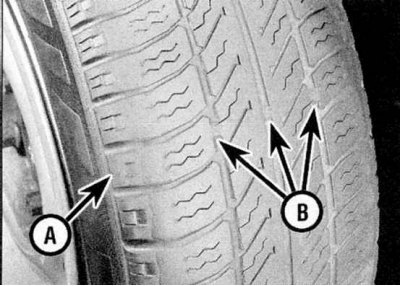


Tread depth - visual inspection


1. New tyres have tread wear markers (B) that will appear when the tread depth reaches approximately 1.6 mm. The marker positions are indicated by a triangular mark on the sidewall of the tyre (A) (refer to the accompanying illustration).

Tread depth - manual control
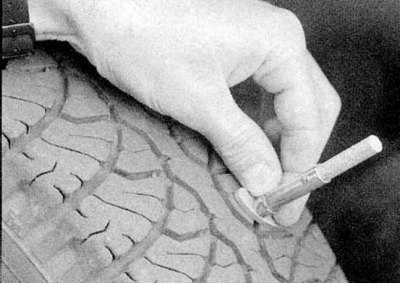


Tread depth - manual control


1. Tread wear can be monitored with a simple, inexpensive device known as a tread depth gauge (refer to the accompanying illustration).

Tire pressure monitoring
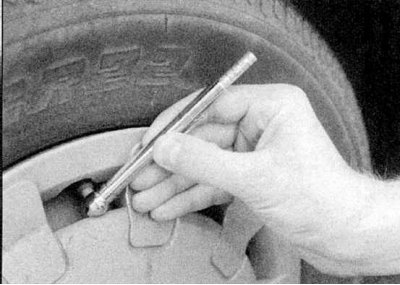


Tire pressure monitoring


1. Check tire pressure regularly when tires are cold. Do not adjust tire pressure. Do not adjust tire pressure immediately after using the vehicle (refer to the accompanying illustration).


Tread wear


Lateral wear
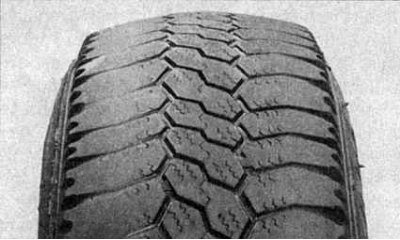


Lateral wear


Insufficient pressure (wears out on both sides)

Underinflation causes the tire to overheat because the cord will bend too much and the tread will not sit properly on the road surface. This will cause loss of traction and excessive wear, not to mention the risk of sudden tire failure due to increased temperature.

Check and adjust pressure.

Incorrect wheel alignment (wears out on one side)

Repair or replace suspension parts.

Difficult movement on the turn

Slow down!

Central wear
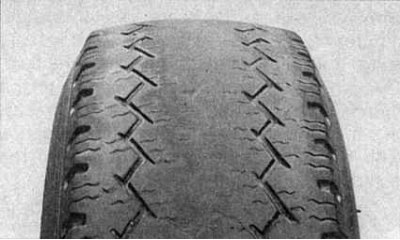


Central wear


Original version on our portal [www.RenaultBook.ru]

Pumping

Overinflation causes rapid wear of the central part of the tyre tread, as well as reduced traction and increased risk of tyre failure.

Check and adjust pressure.


If you occasionally need to inflate your vehicle's tires to a pressure higher than specified for the maximum load rating or high speed to be maintained, be sure to reduce the pressure back to normal afterward.

Uneven wear
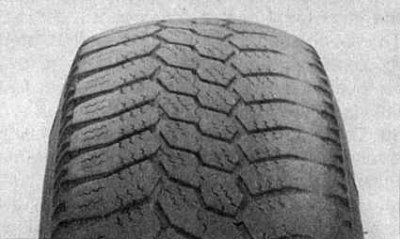


Uneven wear


Front tires may wear unevenly due to wheel misalignment. Most service stations can check and adjust the wheel alignment for moderate loads.

Incorrect camber or caster angle

Repair or replace suspension parts.

Faulty suspension

Repair or replace suspension parts.

Unbalanced wheels

Balance the tires.

Incorrect alignment

Adjust the front wheel alignment.
This article is available on: russian, bulgarian, belarusian, ukrainian, serbian, croatian, romanian, polish, slovak, hungarian
Article has been reviewed by editor: Fedoseev Denis
Share with friends:
Previous
Megane 1: Maintenance
Next

Checking fluid levels
Maintenance schedule
View of the engine compartment and the underside of the car
Maintenance Specifications
General maintenance information and initial checks
Checking the windshield wipers
Checking the battery status and charge level
Checking lamps and fuses
Engine oil and filter change
Removal water from a diesel engine fuel filter
Other articles on other Renault models

➽ Checking the condition of tires and their pressure (400 km) Renault Symbol 1 (1999-2008, petrol)
➽ Checking the condition of the tires Renault 19 (1988-1996)
➽ Checking oil pressure Renault Duster 1 (2009-2017)
➽ Checking oil pressure Renault Fluence 1 (2009-2020, petrol)
➽ Checking the fuel supply pressure (engines F4R, F4P, K4M) Renault Laguna 2 (2001-2007)
Link to this article in different formats
Reviews and comments of visitors
No comments yet


Add two numbers 25 + 22


Megan 2 (2002-2009, petrol) 
  • User manual
  • Introduction to manual
  • Controls and instruments
  • Salon equipment
  • Operation and driving
  • Maintenance and care
  • Power unit
  • Engine repair
  • Fuel system
  • Injection system
  • Intake and exhaust system
  • Starting and charging system
  • Cooling system
  • Decreased toxicity
  • Transmission
  • Clutch
  • Mechanical gearbox
  • Automatic gearbox
  • Wheel drive mechanism
  • Chassis, running gear
  • Suspension and wheels
  • Steering
  • Brake system
  • Body and interior
  • Exterior (external elements)
  • Interior (internal elements)
  • Doors, locks and windows
  • Heating and air conditioning
  • Electrical equipment
  • Equipment and devices
  • Headlights and lighting
  • Electrical circuits
Megane 1 (1995-2002) 
  • General information
  • User manual
  • Maintenance
  • Power unit
  • Petrol engines 1.4/1.6 l
  • Petrol engines 2.0 l
  • Diesel engines 1.9 l
  • Overhaul of engines
  • Cooling system
  • Fuel system (petrol)
  • Fuel system (diesel)
  • Decreased toxicity
  • Charge and launch systems
  • Ignition system (petrol)
  • Preheat system (diesel)
  • Transmission
  • Clutch
  • Mechanical gearbox
  • Automatic gearbox
  • Drive shafts
  • Chassis, running gear
  • Brake system
  • Car suspension
  • Steering
  • Body and interior
  • Exterior (external elements)
  • Interior (internal elements)
  • Doors, locks and windows
  • Electrical equipment
  • Equipment and devices
  • Electrical circuits
RenaultBook.ru © 2018–2026 | Mobile version | News and articles | Sitemap: EN BG BY UA RS HR RO PL SK HU | Administration | Site search | Bookmark
Duster 1 (2009-2017) | Fluence 1 (2009-2020, petrol) | Kangoo 1 (1997-2007) | Laguna 2 (2001-2007) | Logan 1 (2004-2012, petrol) | Logan 2 (2012-2020) | Megane 1 (1995-2002) | Megan 2 (2002-2009, petrol) | Sandero 1 (2007-2012, petrol) | Scenic 1 (1996-2003) | Symbol 1 (1999-2008, petrol) | Symbol 2 (2008-2013, petrol) | Renault 19 (1988-1996) | Espace I and II (1984-1996) | Espace III (1996-2002) | Clio 1 (1990-1998) |
We want your visit to be comfortable 😌 and use cookies 🍪 to do so.