



Cars with a petrol engine with a capacity of 150 hp.
The 16-valve engine is equipped with hydraulic plate tappets, which eliminates the need for valve clearance adjustment as part of vehicle maintenance. This also reduces valve drive noise.
With the engine running, the load from the pushrod is 203 (see illustration 8.0) is removed by turning cam 184 of camshaft 185 upward.
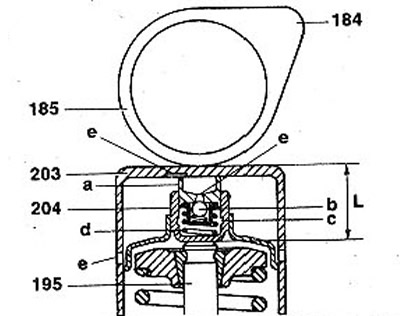
8.0 Operation of the disc tappets
In this case, the spring "d" presses on the compensator 204, the lower part of which is pressed against the valve stem 195, and from above the pressure pin "a" presses the plate tappet 203 toward the camshaft. At this moment, the engine oil flows out or flows into the working chamber "c" through the openings "e". As soon as the cam of the rotating camshaft again begins to press on the plate tappet, the ball valve "b" closes, and the remaining oil creates a dynamic pressure, because it does not have the ability to be compressed like a solid body. The distance "L" thus remains unchanged with each rotation of the camshaft, corresponding to the dimensions of the valve drive parts.
The distinctive external feature of hydraulic plate tappets is the presence of a circular groove and the absence of mounting washers. Repair of hydraulic tappets is not possible.
(Original publication on the website: «Renaultbook.ru»)
Attention! Valve train noises when starting the engine are normal because when the engine is turned off, depending on the position of the cam, a certain amount of oil flows out of the corresponding tappet. As a result, the tappets start to work with a knock when starting due to a lack of oil. These noises disappear as the tappets fill with oil. Sometimes this phenomenon can continue until the engine warms up to operating temperature. To ensure flawless operation of the plate tappets, there is a shut-off valve in the cylinder head that prevents oil from flowing out of the oil channels when the car is parked with the engine turned off.