If the valve clearance is too small, the valve timing changes, compression deteriorates, engine power drops, and engine running becomes uneven. In extreme cases, this can lead to valve deformation or burnout. Valve seating can also burnout.
With increased valve clearance, strong mechanical noises appear in the engine operation, the valve timing changes. Due to incomplete filling of the cylinders, the power and stability of the engine operation decreases.
Adjusting the valve clearance will produce the desired result if the valves themselves are tight, have no play in the guides, and the valve plates are not broken.
Valve clearance should be checked and adjusted, as a rule, after repairs or when noise appears in the valve drive. Checking the valve clearance is not provided for in the framework of maintenance.
Checking and adjusting valve clearance should be performed on a cold engine.
Important! It is necessary to take into account the engine type when checking or adjusting the clearance. In cars with a 150 hp engine, the valve clearance is not adjusted, since they have hydraulic plate tappets that automatically adjust the clearance.
To check or adjust the clearance, the corresponding valve must be unloaded. This is possible by turning the camshaft, which can be turned in several ways.
- method 1. Place the car on a level surface. Engage 5th gear and release the parking brake. Push the car forward or backward. Raise the front of the car from the side with a jack.
- method 2. Engage 5th gear, tighten the parking brake lever. Jack up the car so that one of the front wheels can be rotated. Turn the raised front wheel by hand.
- method 3. Place the car on a level surface. Engage neutral gear and apply the parking brake. Rotate the crankshaft by the central belt pulley mounting bolt using a socket head.
Note: To make it easier to turn the engine, you can unscrew the spark plugs.
Cars with 1.4-/1.6-liter petrol engine (E7J/K7M)
Examination
1. Remove the air filter, see the relevant chapter.
2. Disconnect the accelerator cable from the throttle valve and place it aside from the work area, see the relevant chapter.
3. Disconnect the low pressure hose 2 on the cylinder head cover (see illustration).
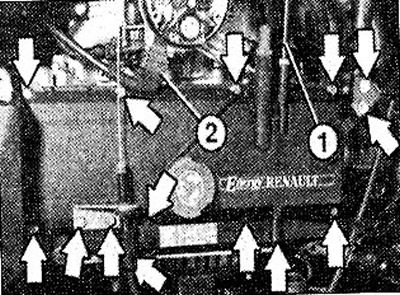
10.3 Disconnect the low pressure hose 2 on the cylinder head cover
4. Disconnect plug 2 by squeezing the wire clamp (see illustration 10.3).
5. Unscrew the bolts (see arrows in illustration 10.3) and remove the cylinder head cover
The sequence of the valves in the cylinder head is as follows: EA-EA-AE-AE. The letter A denotes the exhaust valves, and the letter E denotes the intake valves (see illustration 10.0).
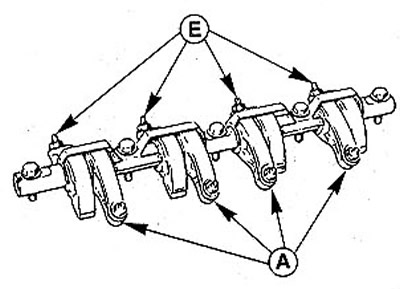
10.0 The sequence of the valves in the cylinder head is EA-EA-AE-AE. The letter A denotes the exhaust valves, and the letter E denotes the intake valves
The valves are fairly easy to identify because the intake valves are located on the intake manifold side and the exhaust valves are located on the exhaust manifold side.
6. Rotate the camshaft so that the exhaust valve of cylinder #1 is fully open. Cylinder #1 is on the left side near the flywheel. The cylinders are arranged in sequence from 1 to 4, counting from the gearbox to the V-belt. The valve is fully open when the rocker arm pushes the valve down (see left part of the illustration). In this position of the camshaft (the exhaust valve of cylinder #1 is fully open), the clearance of the intake valve of cylinder #3 and the exhaust valve of cylinder #4 can be adjusted (see illustration 10.6).
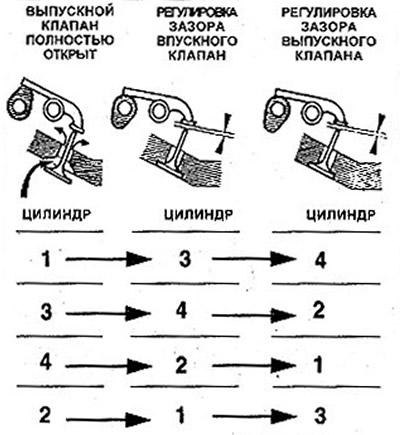
10.6 The valve is fully open when the rocker arm pushes the valve down (see left side)
7. Measure the valve clearance by inserting a feeler gauge between the rocker arm and the end of the valve stem.
Nominal valve clearance values (for cold engine):
- inlet valves - 0.10 mm
- exhaust valves - 0.25 mm
Attention! A cold engine is defined as an engine temperature corresponding to the air temperature, approximately +20°C.
The valve clearance is adjusted correctly if the gauge can be inserted and removed with some force and a sound similar to air suction is heard.
8. Move the car a little again to open the exhaust valve of cylinder #3 and adjust the clearances for the intake valve of cylinder #4 and the exhaust cylinder #2 (see illustration 10.6).
Check and adjust the clearances of all other valves in the same manner.
Adjustment
9. Unscrew the lock nut by about 1/2 turn using a regular or 10 mm socket wrench if it is not possible to set the nominal valve clearance value (see illustration). At the same time, hold the adjusting screw from turning by the flats with a smaller key or pliers. For 1.6-liter engines, in these cases you will need a socket wrench for Torx-head bolts.
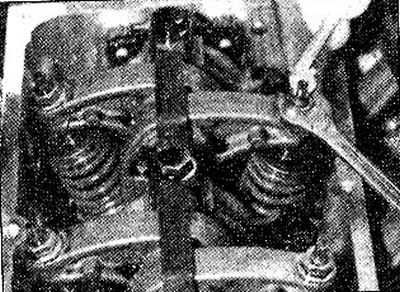
10.9 Unscrew the lock nut by about 1/2 turn using a regular or 10 mm socket wrench if it is not possible to set the nominal valve clearance value
10. Adjust the valve clearance by turning the adjusting screw with a wrench or pliers.
11. Fix the set gap by tightening the lock nut.
12. Check the set clearance again, and then turn the engine to adjust the clearance of the next valve and thus check and adjust the clearances of all valves.
Attention! It is recommended to mark the rocker arms of already adjusted valves with a marker.
13. After completing the valve clearance adjustment, check the position and fit of the clamping brackets on the ends of the rocker arm shaft (see illustration).
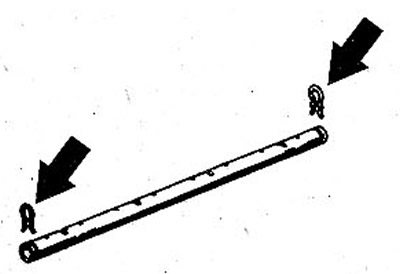
10.13 After completing the valve clearance adjustment, check the position and fit of the clamping brackets on the ends of the rocker arm shaft
14. Replace and bolt the cylinder head cover. Do not tighten the bolts with excessive force, because in this case the cover gasket will be crushed and it will become leaky.
15. Connect the injection system plugs.
16. Connect the low pressure hose to the pipe near the cylinder head cover.
17. Fasten the accelerator cable to the throttle valve and adjust it, see the relevant chapter.
18. Replace the air filter, see the relevant chapter.
Cars with a 113 hp petrol engine and a diesel engine
Examination
19. Remove the cylinder head cover.
20. Install the camshaft so that the valves of cylinder #1 are uniformly facing downwards, see the left side of Illustration 10.20. In this position, the intake and exhaust valves of cylinder #1 are in the overlap phase. Cylinder #1 is near the flywheel. In this case, the cams of the valves of cylinder #4 are turned upwards (see right side of illustration 10.20).
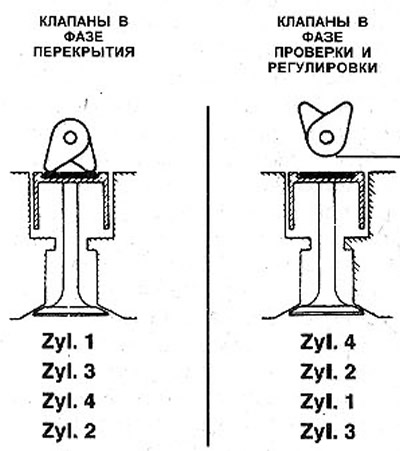
10.20 Install the camshaft so that the valves of cylinder No.1 are uniformly facing downwards, see left side of the illustration
21. Check the valve clearance of cylinder No.4 by inserting a gauge between the adjusting washer of the plate tappet and the rounded part of the camshaft cam (see illustration). The gauge should enter the gap by the principle of a pulling movement. Otherwise, the gap should be adjusted.
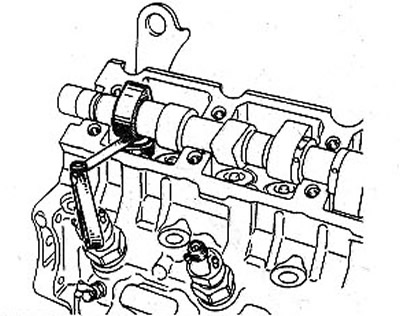
10.21 Check the valve clearance of cylinder No.4 by inserting a gauge between the adjusting washer of the plate tappet and the rounded part of the camshaft cam
To adjust the valve clearance, measure the size of the existing clearance with a gauge. To do this, measure with gauges until the desired one is found. Write down the resulting valve clearance value.
Attention! Consider the sequence of the inlet and outlet valves. E - inlet valves, A - outlet valves (see illustration).
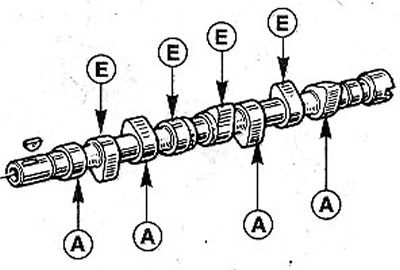
10.21a Consider the sequence of the inlet and outlet valves. E - inlet valves, A - outlet valves
Nominal valve clearance values (for cold engine):
- inlet valves - 0.20 mm;
- exhaust valves - 0.40 mm.
Attention! A cold engine means the engine temperature corresponding to the air temperature.
22. Move the car a little again so that the valves of cylinder #3 are in the overlap phase and adjust the valve clearances of cylinder #2.
23. Check the valve clearances of the remaining cylinders, acting in the sequence shown in Illustration 10.20.
Adjustment
24. Turn the pusher so that the groove on it faces forward (see illustration).
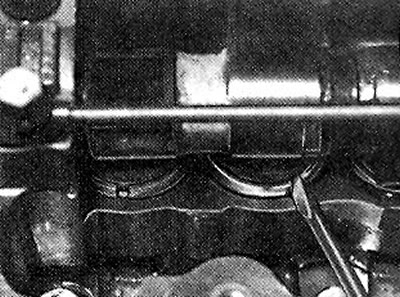
10.24 Turn the pusher so that the groove on it faces forward
25. Adjust the valve clearances by replacing the adjusting washers 1 on the plate tappets 2 (see illustration). To replace the washers, the plate tappets should be pressed using clamping device 3.
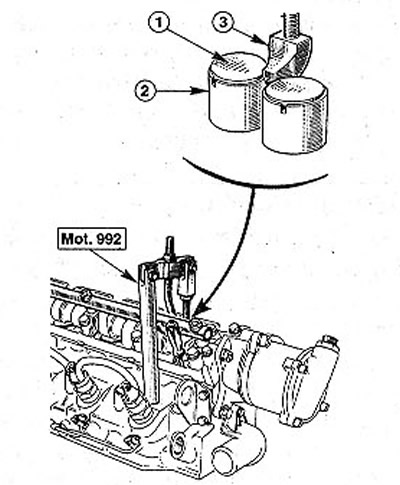
10.25 Adjust the valve clearances by replacing the adjusting washers 1 on the plate tappets 2
Attention! Since the clamping device must precisely match the distance between the plate tappets, the RENAULT Mot. 992 device is required for this purpose.
26. Press the plate plunger and remove the adjusting washer with a screwdriver, scriber or magnet.
27. Measure the thickness of the removed adjusting shim using a micrometer (with a clamp). Record the result. The thickness of the washer is indicated on its bottom side (see illustration).
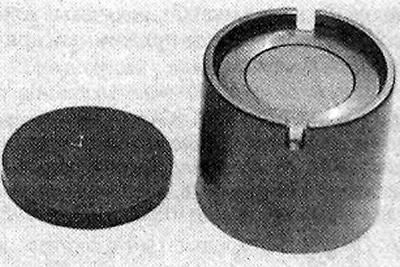
10.27 Measure the thickness of the removed adjusting shim using a micrometer (with a clamp). Record the result. The thickness of the washer is indicated on its bottom side
28. Soak the new adjusting washer in engine oil and install it into the tappet.
Attention! When installing the washer, make sure that its side with the stamped marking is facing downwards. The delivery set includes adjusting washers with a thickness of 3.25 mm to 4.30 mm with a thickness step of 0.05 mm, as well as washers of 4.40 mm and 4.50 mm.
29. Replace the adjusting washers on the remaining tappets in the same way and check the valve clearances.
Please note: The adjusting washers can be used multiple times if they do not show any visible signs of wear, for example, the thickness of the washer stamped on the bottom side is not legible.
30. Install the cylinder head cover and its gasket. Tighten the cover bolts to 10 Nm. If the cover gasket has become porous or flattened, replace the gasket with a new one.
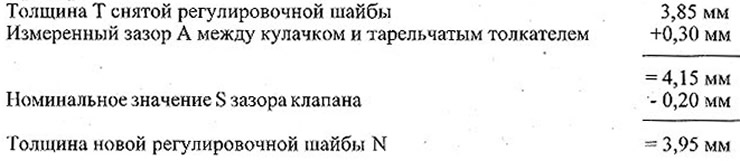
To calculate the thickness of the new adjustment shim, use the following formula:
N = T + (A - S)
N = thickness of new gasket
T = thickness of the removed gasket
A = measured valve clearance value
S = nominal value of valve clearance
Example: