English Русский
Български
Беларускі
Український
Српски
Hrvatski
Română
Polski
Slovenský
Magyar
Bookmark Contacts Articles Sitemap
Company vehicles Peugeot Company vehicles Opel Company vehicles Skoda Company vehicles Land Rover Company vehicles Mitsubishi Company vehicles Volkswagen Company vehicles Honda
RenaultBook.ru


Duster   Fluence   Kangoo   Laguna   Logan   Megane   Sandero   Scenic   Symbol   Clio   Other
Scenic 1 (1996-2003)

Oil pressure sensor — check (Renault Scenic 1)

  • Main
  • Scenic
  • Scenic 1 (1996-2003)
  • Power unit
  • Engine repair
  • Oil pressure sensor — check
0
1. Disconnect the negative (-) battery terminal from the battery.

Warning! This will delete data from storage devices, such as the radio receiver's security code. Read the recommendations in Chapter "Battery - removal and installation".


2. Disconnect the power wire from the sensor and unscrew the oil pressure sensor. The oil pressure sensor is located on the left side of the oil filter or next to the oil filter.

3. Connect the oil pressure sensor and the control lamp to the battery with auxiliary wires. The control lamp should light up when connected to the battery. Instead of the battery and the control lamp, you can connect an ohmmeter, which should show 0 Ohm. If this is not the case, the oil pressure sensor should be replaced (see illustration).
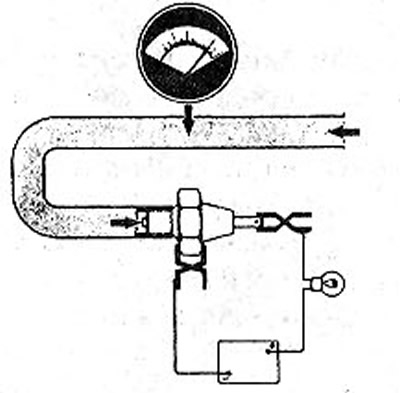
18.3 Connect the oil pressure sensor and indicator light to the battery with auxiliary wires

18.3 Connect the oil pressure sensor and indicator light to the battery with auxiliary wires


4. Place the hose with the pressure gauge and the pressure supply hose on the sensor mounting thread. The hose should fit tightly on the thread.

5. Slowly increase the pressure. At 0.35 bar the control lamp should go out. If an ohmmeter is connected, it should start showing infinite resistance. Otherwise the sensor must be replaced.


6. Install the oil pressure sensor in place, replacing the old sealing ring with a new one, and tighten it to 35 Nm.

7. Connect the negative (-) battery terminal to the negative battery terminal.

8. Set the clock.

Only cars with 150 hp engine.


The oil pressure sensor should be checked if the oil pressure reading on the instrument cluster does not correspond to normal values.

9. Check sensor 1. To do this, disconnect the plug from the sensor (see illustration).
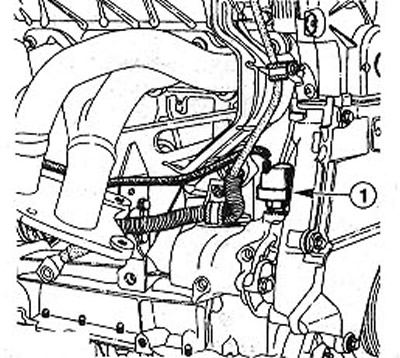
18.9 Check the sensor 1. To do this, disconnect the plug from the sensor

18.9 Check the sensor 1. To do this, disconnect the plug from the sensor


10. Connect an ohmmeter to the sensor.

11. Start the engine and let it idle. The ohmmeter should show a resistance of 155 ohms.

12. Increase engine speed to 3000. The ohmmeter should show a resistance of 45 ohms.

13. Check the oil pressure.

If the oil pressure is normal, but the resistance recorded by the ohmmeter has significant deviations from the nominal values, then the oil pressure sensor must be replaced.
This article is available on: russian, bulgarian, belarusian, ukrainian, serbian, croatian, romanian, polish, slovak, hungarian
Article has been reviewed by editor: Fedoseev Denis
Share with friends:
Previous
Scenic 1: Engine repair
Next

Oil pressure — check
Motor oil — circulation
Engine lubrication system — general information
V-belt — removal, installation, inspection and tensioning
V-belt (petrol engines 1.4/1.6 l, E7J/K7M, without air conditioning)
Oil pan — removal and installation
Other articles on other Renault models

➽ Oil pressure sensor Renault Duster 1 (2009-2017)
➽ Replacing the oil pressure sensor Renault Fluence 1 (2009-2020, petrol)
➽ Removal and installation the fuel pressure sensor Renault Laguna 2 (2001-2007)
➽ Replacing the oil pressure warning light sensor Renault Logan 1 (2004-2012, petrol)
➽ Removal and installation the pressure sensor Renault Megan 2 (2002-2009, petrol)
Link to this article in different formats
Reviews and comments of visitors
No comments yet


Add two numbers 15 + 50


Scenic 1 (1996-2003) 
  • General information
  • User manual
  • Maintenance
  • Troubleshooting
  • Power unit
  • Engine repair
  • Cooling and ventilation
  • Injection system (petrol)
  • Fuel system (diesel)
  • Fuel system
  • Exhaust system
  • Ignition system
  • Transmission
  • Clutch
  • Car gearbox
  • Chassis, running gear
  • Brake system
  • Car suspension
  • Steering
  • Body and interior
  • Exterior (external elements)
  • Interior (internal elements)
  • Doors, locks and windows
  • Electrical equipment
  • Equipment and devices
  • Headlights and lighting
  • Power devices
  • Electrical circuits
RenaultBook.ru © 2018–2026 | Mobile version | News and articles | Sitemap: EN BG BY UA RS HR RO PL SK HU | Administration | Site search | Bookmark
Duster 1 (2009-2017) | Fluence 1 (2009-2020, petrol) | Kangoo 1 (1997-2007) | Laguna 2 (2001-2007) | Logan 1 (2004-2012, petrol) | Logan 2 (2012-2020) | Megane 1 (1995-2002) | Megan 2 (2002-2009, petrol) | Sandero 1 (2007-2012, petrol) | Scenic 1 (1996-2003) | Symbol 1 (1999-2008, petrol) | Symbol 2 (2008-2013, petrol) | Renault 19 (1988-1996) | Espace I and II (1984-1996) | Espace III (1996-2002) | Clio 1 (1990-1998) |
We want your visit to be comfortable 😌 and use cookies 🍪 to do so.