



W in the SAE classification means that the oil is suitable for winter operating conditions.
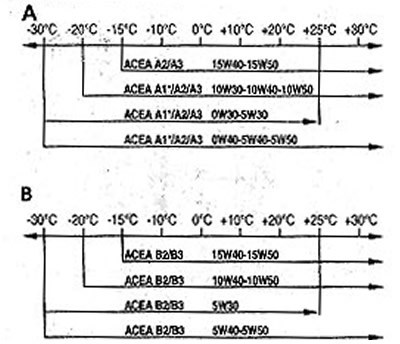
15.0 Application range and viscosity grades:
A = motor oils for gasoline engines
B = motor oils for diesel engines
* = low viscosity oil. Not suitable for 2.0 litre petrol engines (150 hp)
As for low-viscosity oils, we are talking about all-season oils, which include additives that reduce the friction coefficient, as a result of which the friction of internal engine parts is reduced. The basis of low-viscosity oils is synthetic oil. When buying oil, you should pay attention to whether it is approved for use by RENAULT.
Since the application areas of adjacent oils according to SAE classification overlap, short-term temperature fluctuations can be ignored. Mixing oils of different viscosities is allowed if it is necessary to add oil, and the ambient temperatures do not correspond to the viscosity class of the oil poured into the engine.
Caution! Lubricating additives of any kind must not be added to either fuel or lubricating oils.
Motor oil specification
Classification of motor oils of American manufacturers is carried out according to the API system: an abbreviation of the first letters of the American Petroleum Institute (american Petroleum Institute). European oil producers also use this classification.
The designation is made using two letters. The first letter indicates the area of application: S - for internal combustion engines, C - for diesel engines. The second letter shows the quality of the oil in alphabetical order. The highest quality oils are those with the SH specification for internal combustion engines and CF for diesel engines.
European oil manufacturers use the CCMC specification, which takes into account European engine manufacturing technologies. Depending on their quality, oils for gasoline engines are divided into classes CCMC-G1 to G5, and for diesel engines of passenger cars - CCMC-PD1 and the more expensive CCMC-PD2 oil.
The European Commission CCMC has left the Association of Constructeurs Europens d'Automobiles (ACEA), which carries out its own testing and sets its own oil quality criteria. Oils for gasoline engines of passenger cars have ACEA classes from A1-96 to AZ-96; for diesel engines - classes from B1-96 to BZ-96. The highest quality oils are AZ oils for gasoline engines and B3 oils for diesel engines.
The numbers 96 indicate the start of the ACEA classification in 1996. Oils with earlier data are also approved for use.
Attention! Motor oils on which the manufacturer has indicated that they are intended only for diesel engines cannot be used in gasoline engines. However, there are oils that are suitable for both gasoline and diesel engines. In such cases, both specifications are indicated on the packaging of motor oils intended for both gasoline and diesel engines (for example, CCMC-G5/PD2 or AP!SG/CD).
Recommended engine oil for Renault Megane
Cars with gasoline engines: engine oil must meet the minimum requirements of API-SH, CCMC-G4, ACEA-A2-96 for all-season oils and API-SJ, CCMC-G5, ACEA-AZ-96 for low-viscosity oils.
Vehicles with diesel engines: API-CF, CCMC-PD2, ACEA-B2-96 or ACEA-B2-96.
(View the original source on this resource: «Renaultbook.ru»)
Oil consumption
Oil consumption in internal combustion engines refers to the amount of oil produced as a result of the combustion process. Oil consumption should never be equated with oil losses that occur as a result of leaks due to leaks in the oil pan, cylinder head cover, etc.
Normal oil consumption occurs as a result of the combustion of small amounts of oil in the cylinders, the removal of residual combustion products and particles formed as a result of vision. In addition, oil is consumed under the influence of high temperatures and high pressure, to which it is constantly exposed in the engine. In addition, the degree of oil consumption is also affected by external operating conditions, driving mode, and operating tolerances. Oil consumption should be no more than 1 liter per 1000 kilometers.
Be sure to add oil if its level reaches the lower mark.
Caution! Do not fill the oil above the maximum mark on the tank. If too much oil was poured during refueling, remove or drain the excess. Otherwise, unburned oil entering the exhaust system may damage the catalytic converter.