



Contents: Removal 🠛 Installation 🠛
Removal and installation of valves is shown using the example of a 1.4-/1.6-litre petrol engine (E7J/K7M). Differences relating to other engines are indicated separately. Removal and installation of valves on a 1.4-/1.6-litre petrol engine (E7J/K7M) must be performed in a workshop.
Removal
1. Remove the cylinder head.
2. Unscrew the cylinder head cover (see illustration).
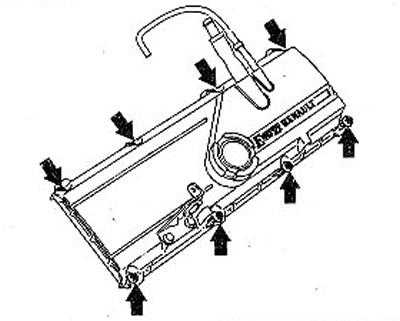
9.2 Unscrew the cylinder head cover
Attention! When installing the valve drive parts later, they should be installed in their original places. To prevent the parts from getting mixed up, they should be placed on a special shelf, which is recommended to be made separately.
3. Remove the rocker arm. Before removing, mark the position of the mounting bolts so that they can be installed in their original places during assembly. Bolts B are solid and painted yellow, and bolts B are black and hollow and are channels for supplying oil (see illustration).
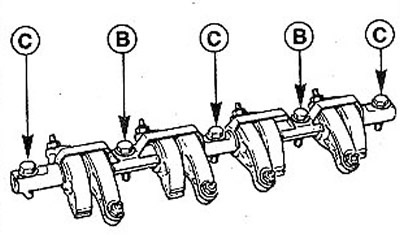
9.3 Bolts B are solid and painted yellow, while bolts B are black and hollow and are channels for oil supply
4. Remove the valve springs. For this purpose, workshops use the FACOM U43L device (see illustration). You can also use regular pliers to remove valve springs. In this case, the crackers are removed, and along with them, the valves with springs.
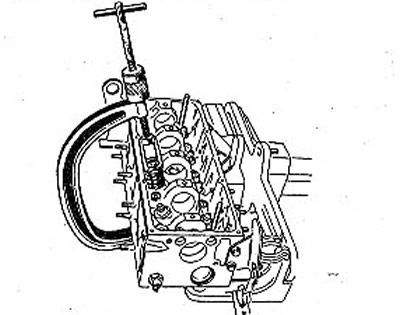
9.4 Remove the valve springs. For this purpose, workshops use the FACOM U43L device
5. Compress the spring and remove the crackers. Then remove the upper valve spring support cup and the spring itself (see illustration).
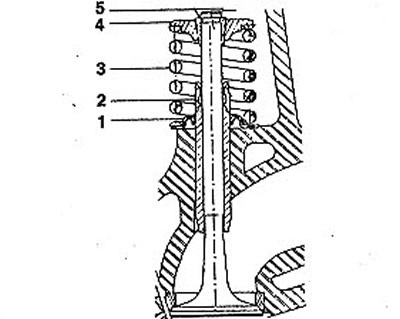
9.5 Compress the spring and remove the crackers: 1 - lower support cup of the valve spring; 2 - oil seal; 3 - valve spring; 4 - upper support cup of the valve spring; 5 - crackers
6. Remove the valve.
7. Remove the oil scraper ring (see illustration).
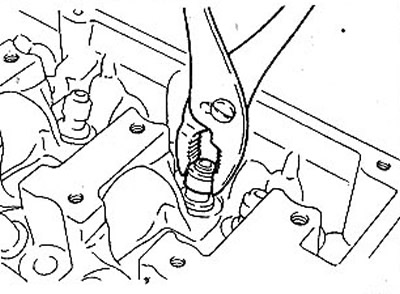
9.7 Remove the oil seal
8. 1.9-/2.0-liter engines: Remove the valve stem seals using special pliers, such as HAZET 791-2 (see illustration).
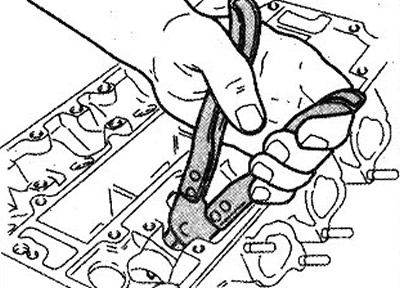
9.8 Remove the valve stem seals using special pliers, e.g. HAZET 791-2. 1.9-/2.0-liter engines
9. Remove the lower valve spring support cup
Installation
10. Lubricate the valve stems with a thin layer of oil and install each valve in its original place. When installing new valves, grind them in their seats with grinding paste.
11. Clean all parts and lubricate their rubbing areas with motor oil.
12. Cover the valve stems 2 in the places where the crackers are installed with smooth tape to avoid damaging them when installing the valve stem seals 1 (see illustration). After installing the caps, remove the tape.
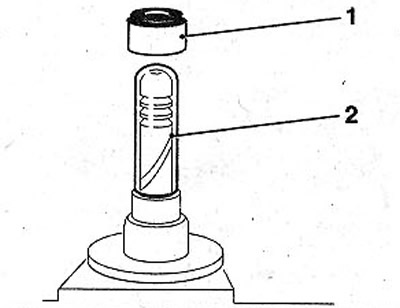
9.12 Cover the valve stems 2 in the places where the crackers are installed with smooth tape to avoid damaging them when installing the valve stem seals 1
13. Be sure to replace the old oil deflector caps with new ones. New oil deflector caps should be installed using an 11 mm tubular wrench (1.4-/1.6-liter petrol engines E7J/K7M)or 12 mm (2.0 liter petrol engines and 1.9 liter diesel engines),ranNervus (see illustration).
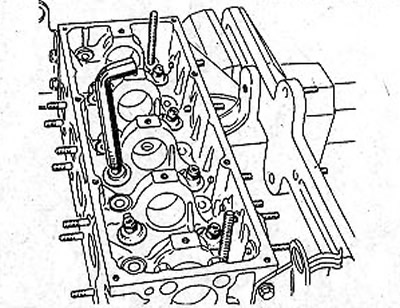
9.13 New valve stem seals should be installed using an 11 mm socket wrench (1.4-/1.6-liter petrol engines E7J/K7M) or 12 mm (2.0 liter petrol engines and 1.9 liter diesel engines), type Nervus
14. Install the valves back into place.
15. Place the lower spring support cup on the valves.
16. Place the springs and upper support cups on the valves.
17. Compress the valve springs with pliers and insert the crackers so that they are fixed in the grooves on the valve stems. The crackers for the intake and exhaust valves are the same.
18. Replace the rocker arm and screw in both yellow bolts B and then the three black bolts C and tighten them to 25 Nm (see illustration).
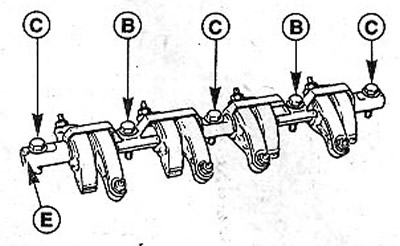
9.18 Replace the rocker arm and screw in both yellow bolts B and then the three black bolts C and tighten them to 25 Nm
19. Make sure the rocker arm adjusting bolts are flush with the valve stems.
Attention! Please note that the rocker arm must be installed in only one position. The end of the rocker arm, marked with the letter E, must face the toothed belt.
20. Replace the cylinder head gasket and install the cylinder head.
(Information is located on the website: www.RENAULTBOOK.ru)
21. Adjust the valve clearance.
Only cars with 113hp petrol engine and diesel engines
22. Remove the camshaft.
23. Mark the plate tappets and remove them (see illustration).
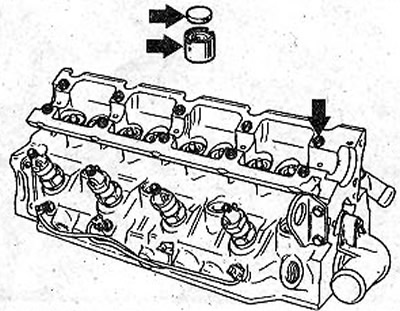
9.23 Mark the plate tappets and remove them
24. After installing the valves, put the plate tappets back in their original places, following the marks applied, and install the corresponding adjusting washers. Before doing this, lubricate the hole for the tappets in the cylinder head, the tappets inside and outside, as well as the adjusting washers on both sides with engine oil.
25. Install the camshaft in place.
Only cars with petrol engine with 150 hp.
26. Remove the hydraulic plate tappets from the holes in the cylinder head using a rubber suction cup.
Caution! Place the removed hydraulic plate tappets upside down to prevent oil from leaking out.
After installing the valves, lubricate the hydraulic lifters with engine oil and insert them into their places in the cylinder head.
Caution! If oil has leaked from the hydraulic tappet, be sure to fill it with engine oil before installing it. To do this, lower the tappet into a container with clean engine oil (see illustration).
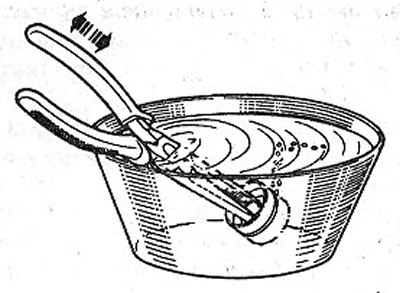
9.26 Place the plunger in a container with clean engine oil
27. Position the plunger with the hole facing up using pliers and move the plunger from side to side in the oil container several times. This will help remove any air trapped in the plunger.