



Cars with a petrol engine with a capacity of 113 hp and with a diesel engine
1. Unscrew the cylinder head cover mounting bolts and remove it together with the gasket (see illustration).
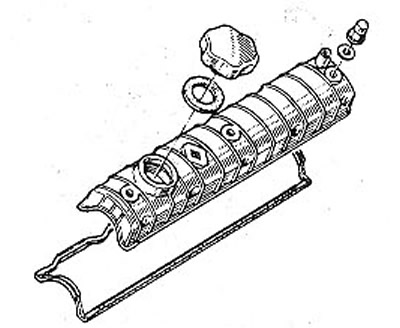
7.1 Unscrew the cylinder head cover mounting bolts and remove it together with the gasket
2. Turn the crankshaft and set the piston of cylinder No.1 to TDC.
Attention! After this, the position of the crankshaft must not be changed.
3. Loosen the timing belt tension and remove it from the camshaft gear only.
4. Lock the camshaft gear with a 10 mm socket head, then unscrew the mounting bolt and remove the gear (see illustration). If necessary, knock the gear off the shaft with light blows from a rubber hammer.
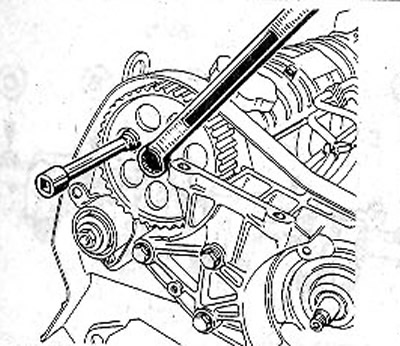
7.4 Lock the camshaft gear with a 10 mm socket head, then unscrew the mounting bolt and remove the gear
5. Remove the key that secures the gear to the camshaft.
6. Vehicles with diesel engine: Remove the vacuum pump.
7. Mark the position and sequence of all camshaft bearing caps (see illustration).
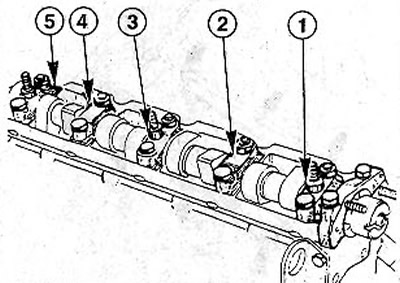
7.7 Mark the position and sequence of all camshaft bearing caps
8. First remove covers 5, 1 and 3, and then, acting in a crosswise order, covers 2 and 4. (see illustration 7.7).
9. Remove the camshaft.
Attention! If it is necessary to remove the plate tappets, they should be marked so that they can be installed in their original places during assembly (see illustration).
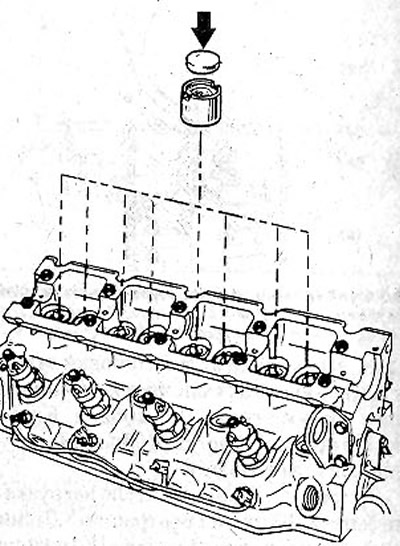
7.9 Mark the tappets before removal
Installation
10. Check the axial runout of the camshaft in a workshop, if necessary.
11. Install the new camshaft oil seal, first lubricating its sealing lip and outer edge with a small amount of oil.
12. Replace the plate tappets if they were removed. Lubricate the tappets with a thin layer of oil and do not allow them to tilt when installing.
Attention! Replacing the plate tappets in places is not permitted.
(Text published on the website RENAULTBOOK.ru)
13. Lubricate the camshaft with engine oil and install it into the cylinder head.
Attention! The cams of cylinder #1 must be facing upwards. Cylinder #1 is located near the flywheel.
14. Make sure that the bearing cap centering pins are in place. Reinstall them if necessary (see bottom arrow in illustration).
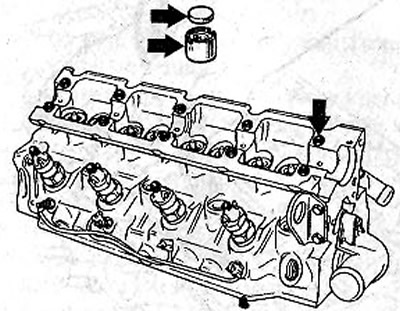
7.14 Check that the bearing cap centering pins are in place. Reinstall them if necessary (see bottom arrow)
15. Place the camshaft bearing caps in their places, following the marks made before removal.
Attention! Apply a little sealant, for example CAF 4/60 THIXO by RENAULT or CURIL, to the shaded areas of bearing caps 1 and 5 in the illustration (see illustration).
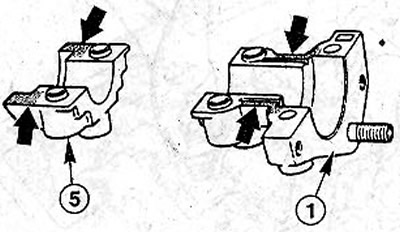
7.15 Apply a small amount of sealant, such as CAF4/60THIXO from RENAULT or CURIL, to the shaded areas of bearing caps 1 and 5 in the illustration
16. Apply a small amount of sealant to the threads of the bearing cap mounting bolts to prevent oil from leaking out through the bolt threads. Loctite Frenetanch can be used for this purpose.
17. Tighten the bearing cap bolts using a torque wrench. The tightening torque depends on the thread diameter. Bolts with a diameter of: mm are tightened with a force of 10 Nm, and bolts with a diameter of 8 mm - 20 Nm.
18. Insert the locking key into the groove on the camshaft, put on the timing belt gear and secure it with a bolt with a tightening torque of 50 Nm, holding the gear from turning with a pin or punch.
19. Place the timing belt on the camshaft gear.
Attention! Before doing this, make sure that the crankshaft is in a constant position. For diesel engines, it is also necessary to look at the position of the fuel injection pump.
20. Tighten the timing belt.
21. Vehicles with diesel engine: Reinstall the vacuum pump, see relevant chapter.
22. Check the valve clearances, if necessary, see the relevant chapter.
23. Install the cylinder head cover together with the sealing gasket and carefully tighten the mounting bolts to 10 Nm. If the cylinder head cover sealing gasket has become porous or flattened, replace it with a new one.
24. Replace the timing belt cover.